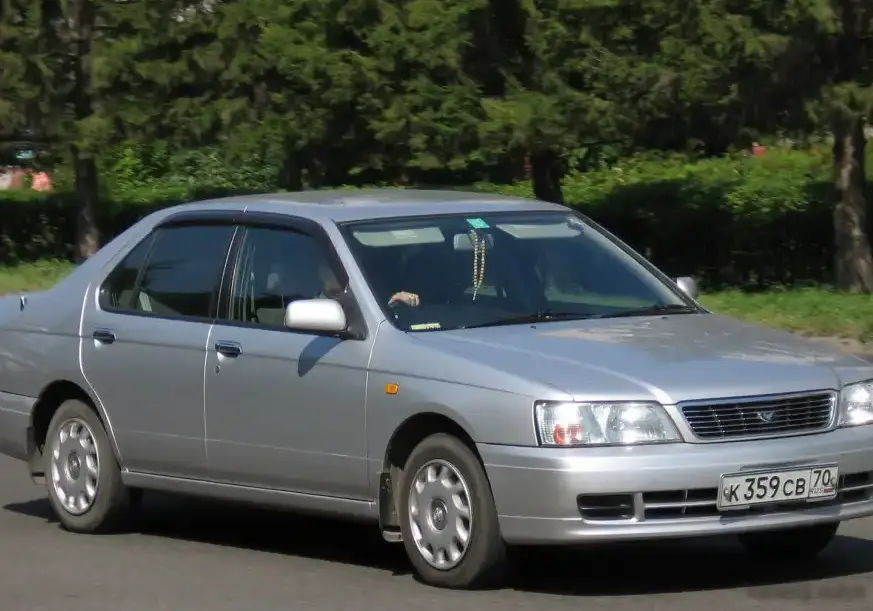
The Nissan Bluebird U14 2.0i Automatic, produced between 1996 and 1998, represented a mid-range offering within the broader U14 Bluebird generation. The U14 series, sold primarily in Japan and select export markets, aimed to provide a comfortable and reliable family sedan. This 2.0-liter variant, paired with a four-speed automatic transmission, was positioned as a step up from the base 1.6-liter models, offering increased performance and a more refined driving experience without the higher price tag of the more luxurious options available in some markets. It was a common sight on Japanese roads during its production run, catering to buyers seeking a practical and dependable vehicle.
Technical Specifications
| Brand | Nissan |
| Model | Bluebird |
| Generation | Bluebird (U14) |
| Type | 2.0i (145 Hp) Automatic |
| Start of production | 1996 |
| End of production | 1998 |
| Powertrain Architecture | Internal Combustion engine |
| Body type | Sedan |
| Seats | 5 |
| Doors | 4 |
| Fuel consumption (urban) | 10.5-13.8 l/100 km (22.4 – 17 US mpg, 26.9 – 20.5 UK mpg, 9.5 – 7.2 km/l) |
| Fuel consumption (extra urban) | 6.7-8.9 l/100 km (35.1 – 26.4 US mpg, 42.2 – 31.7 UK mpg, 14.9 – 11.2 km/l) |
| Fuel consumption (combined) | 9.4 l/100 km (25 US mpg, 30.1 UK mpg, 10.6 km/l) |
| Fuel Type | Petrol (Gasoline) |
| Acceleration 0 – 100 km/h | 10.1 sec |
| Acceleration 0 – 62 mph | 10.1 sec |
| Acceleration 0 – 60 mph | 9.6 sec |
| Maximum speed | 198 km/h (123.03 mph) |
| Weight-to-power ratio | 8.3 kg/Hp, 120.8 Hp/tonne |
| Weight-to-torque ratio | 6.7 kg/Nm, 148.3 Nm/tonne |
| Power | 145 Hp @ 6400 rpm |
| Power per litre | 72.6 Hp/l |
| Torque | 178 Nm @ 4800 rpm (131.29 lb.-ft. @ 4800 rpm) |
| Engine layout | Front, Transverse |
| Engine Model/Code | SR20DE |
| Engine displacement | 1998 cm3 (121.93 cu. in.) |
| Number of cylinders | 4 |
| Engine configuration | Inline |
| Cylinder Bore | 86 mm (3.39 in.) |
| Piston Stroke | 86 mm (3.39 in.) |
| Compression ratio | 10:1 |
| Number of valves per cylinder | 4 |
| Fuel injection system | Multi-port manifold injection |
| Engine aspiration | Naturally aspirated engine |
| Valvetrain | DOHC |
| Kerb Weight | 1200 kg (2645.55 lbs.) |
| Fuel tank capacity | 60 l (15.85 US gal | 13.2 UK gal) |
| Length | 4565 mm (179.72 in.) |
| Width | 1695 mm (66.73 in.) |
| Height | 1395 mm (54.92 in.) |
| Wheelbase | 2600 mm (102.36 in.) |
| Front track | 1465 mm (57.68 in.) |
| Rear track | 1455 mm (57.28 in.) |
| Ride height (ground clearance) | 140 mm (5.51 in.) |
| Drag coefficient (Cd) | 0.32 |
| Minimum turning circle | 10.4 m (34.12 ft.) |
| Drivetrain Architecture | Front wheel drive |
| Number of gears | 4 |
| Gearbox type | Automatic transmission |
| Front brakes | Ventilated discs |
| Rear brakes | Drum |
| Steering type | Steering rack and pinion |
| Tires size | 185/65 R14 |
| Wheel rims size | 14 |
Powertrain & Engine Architecture
The heart of the Bluebird 2.0i Automatic was the SR20DE engine, a 1.998-liter inline four-cylinder powerplant. This engine was a mainstay in Nissan’s lineup during the 1990s, known for its relative reliability and smooth operation. The SR20DE featured multi-port fuel injection and a double overhead camshaft (DOHC) valvetrain, contributing to its respectable power output for its displacement. The 10:1 compression ratio was typical for naturally aspirated engines of the era. The four-speed automatic transmission, while not offering the sportiness of a manual, was geared for comfortable cruising and ease of use, aligning with the Bluebird’s intended role as a family vehicle. The transmission’s shift points were calibrated to prioritize fuel efficiency and smooth transitions, rather than aggressive acceleration.
Driving Characteristics
The 145 horsepower and 178 Nm (131 lb-ft) of torque delivered by the SR20DE, when coupled with the four-speed automatic, resulted in a driving experience that was adequate for everyday commuting and highway travel. Acceleration from 0-60 mph took around 9.6 seconds, which was competitive for its class at the time, but noticeably slower than the manual transmission versions or models equipped with the larger 2.0-liter engine found in some export markets. The automatic transmission’s gear ratios were spaced to provide reasonable acceleration in lower gears, but the limited number of gears meant that the engine could feel strained at higher speeds. The focus was on providing a comfortable and predictable ride, rather than sporty handling.
Equipment & Trim Levels
The 2.0i Automatic trim typically included features such as power windows, power steering, air conditioning, and a basic audio system. Interior upholstery was generally cloth, with options for upgraded materials available depending on the specific market and package. Dashboard configuration was functional and straightforward, prioritizing ease of use over elaborate styling. Optional extras could include alloy wheels, a sunroof, and upgraded audio systems. The level of equipment was generally considered competitive with other mid-range sedans of the time.
Chassis & Braking
The Bluebird U14 utilized a front-wheel-drive layout with independent suspension in the front and a semi-independent torsion beam suspension in the rear. Front brakes were ventilated discs, providing adequate stopping power, while the rear brakes were drums, a cost-saving measure common in this segment. Stabilizer bars were fitted to both the front and rear axles to reduce body roll during cornering. The suspension tuning was geared towards comfort, providing a relatively soft ride quality. The 185/65 R14 tires offered a good balance of grip and ride comfort.
Market Reception & Comparison
The Nissan Bluebird U14 2.0i Automatic was generally well-received in its primary market of Japan as a reliable and practical family sedan. Critics noted its comfortable ride, spacious interior, and fuel efficiency. However, some reviewers found the automatic transmission to be somewhat sluggish compared to the manual versions, and the overall driving experience lacked the excitement of more performance-oriented competitors. Compared to the 1.6-liter models, the 2.0i offered a noticeable improvement in performance, but at a higher price point. It offered a compelling alternative to other Japanese sedans like the Toyota Corolla and Honda Accord.
Legacy
The SR20DE engine, in general, has a reputation for being a durable and relatively easy-to-maintain powerplant. The four-speed automatic transmission, while not as sophisticated as modern transmissions, is also known for its reliability. Today, the Bluebird U14 2.0i Automatic can be found in the used car market, often at affordable prices. While not a particularly sought-after classic, it remains a viable option for those seeking a simple, dependable, and inexpensive mode of transportation. Parts availability can be a concern in some markets, but the SR20DE engine’s widespread use in other Nissan models means that many components are still readily available.