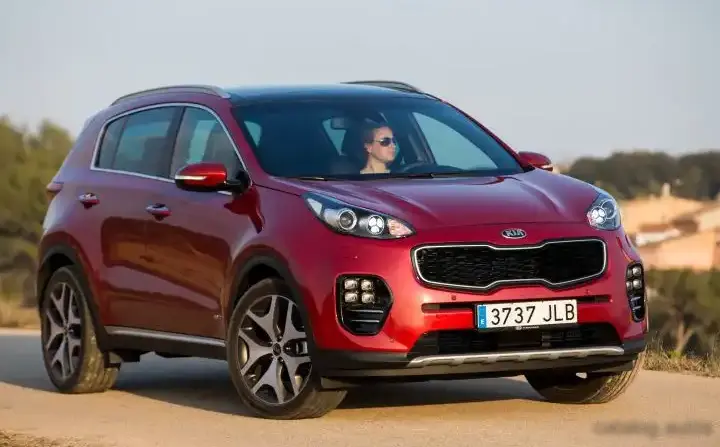
The Kia Sportage IV, produced from 2016 to 2018, represented a significant step forward for the South Korean automaker in the highly competitive compact SUV segment. Among the various engine and drivetrain configurations offered, the 1.6 T-GDI (177 hp) All-Wheel Drive (AWD) variant occupied a middle ground, appealing to buyers seeking a balance between performance, fuel efficiency, and all-weather capability. This model, built on the PQY platform, aimed to broaden the Sportage’s appeal beyond its traditionally value-focused image, offering a more refined driving experience and a wider range of features. It was positioned as a step up from the base 1.6L naturally aspirated engine, while remaining more accessible than the higher-output 2.0L and diesel options.
Technical Specifications
| Brand | Kia |
| Model | Sportage |
| Generation | Sportage IV |
| Type (Engine) | 1.6 T-GDI (177 Hp) AWD |
| Start of production | 2016 |
| End of production | 2018 |
| Powertrain Architecture | Internal Combustion engine |
| Body type | SUV |
| Seats | 5 |
| Doors | 5 |
| Fuel consumption (economy) – urban (NEDC) | 10 l/100 km (23.5 US mpg, 28.2 UK mpg, 10 km/l) |
| Fuel consumption (economy) – extra urban (NEDC) | 6.2 l/100 km (37.9 US mpg, 45.6 UK mpg, 16.1 km/l) |
| Fuel consumption (economy) – combined (NEDC) | 7.6 l/100 km (30.9 US mpg, 37.2 UK mpg, 13.2 km/l) |
| CO2 emissions (NEDC) | 177 g/km |
| Fuel Type | Petrol (Gasoline) |
| Acceleration 0 – 100 km/h | 9.5 sec |
| Acceleration 0 – 62 mph | 9.5 sec |
| Acceleration 0 – 60 mph | 9 sec |
| Maximum speed | 202 km/h (125.52 mph) |
| Emission standard | Euro 6 b |
| Weight-to-power ratio | 8.1 kg/Hp, 123.5 Hp/tonne |
| Weight-to-torque ratio | 5.4 kg/Nm, 184.9 Nm/tonne |
| Power | 177 Hp @ 5500 rpm |
| Power per litre | 111.3 Hp/l |
| Torque | 265 Nm @ 1500-4500 rpm (195.45 lb.-ft. @ 1500-4500 rpm) |
| Engine layout | Front, Transverse |
| Engine Model/Code | Gamma II / G4FJ |
| Engine displacement | 1591 cm3 (97.09 cu. in.) |
| Number of cylinders | 4 |
| Engine configuration | Inline |
| Cylinder Bore | 77 mm (3.03 in.) |
| Piston Stroke | 85.4 mm (3.36 in.) |
| Compression ratio | 10:1 |
| Number of valves per cylinder | 4 |
| Fuel injection system | Direct injection |
| Engine aspiration | Twin-scroll turbo, Intercooler |
| Valvetrain | DOHC |
| Engine oil capacity | 4.5 l (4.76 US qt | 3.96 UK qt) |
| Coolant | 7.3 l (7.71 US qt | 6.42 UK qt) |
| Kerb Weight | 1433-1583 kg (3159.22 – 3489.92 lbs.) |
| Max. weight | 2120 kg (4673.8 lbs.) |
| Max load | 537-687 kg (1183.88 – 1514.58 lbs.) |
| Trunk (boot) space – minimum | 491 l (17.34 cu. ft.) |
| Trunk (boot) space – maximum | 1492 l (52.69 cu. ft.) |
| Fuel tank capacity | 62 l (16.38 US gal | 13.64 UK gal) |
| Max. roof load | 100 kg (220.46 lbs.) |
| Permitted trailer load with brakes (12%) | 1900 kg (4188.78 lbs.) |
| Permitted trailer load without brakes | 750 kg (1653.47 lbs.) |
| Permitted towbar download | 100 kg (220.46 lbs.) |
| Length | 4480 mm (176.38 in.) |
| Width | 1855 mm (73.03 in.) |
| Width including mirrors | 2085 mm (82.09 in.) |
| Height | 1645 mm (64.76 in.) |
| Wheelbase | 2670 mm (105.12 in.) |
| Front track | 1609-1625 mm (63.35 – 63.98 in.) |
| Rear (Back) track | 1620-1636 mm (63.78 – 64.41 in.) |
| Front overhang | 910 mm (35.83 in.) |
| Rear overhang | 900 mm (35.43 in.) |
| Ride height (ground clearance) | 172 mm (6.77 in.) |
| Minimum turning circle (turning diameter) | 10.6 m (34.78 ft.) |
| Approach angle | 16.7° |
| Departure angle | 23.9° |
| Ramp-over (brakeover) angle | 18.6° |
| Drivetrain Architecture | The Internal combustion engine (ICE) drives the front wheels permanently, and the rear wheels are driven through an electrically or mechanically operated clutch if necessary. |
| Drive wheel | All wheel drive (4×4) |
| Number of gears and type of gearbox | 6 gears, manual transmission |
| Front suspension | Independent, type McPherson with coil spring and anti-roll bar |
| Rear suspension | Independent multi-link spring suspension with stabilizer |
| Front brakes | Ventilated discs, 305 mm |
| Rear brakes | Disc, 302 mm |
| Assisting systems | ABS (Anti-lock braking system) |
| Steering type | Steering rack and pinion |
| Power steering | Electric Steering |
| Tires size | 215/70 R16; 225/60 R17; 245/45 R19 |
| Wheel rims size | 6.5J x 16; 7J x 17; 7.5J x 19 |
Powertrain & Engine Architecture
At the heart of this Sportage variant lies the Gamma II 1.6 T-GDI engine, designated G4FJ. This is a four-cylinder, inline engine featuring direct fuel injection and a twin-scroll turbocharger. The twin-scroll design improves turbocharger response by separating exhaust pulses, reducing turbo lag and enhancing low-end torque. The engine utilizes a DOHC (Dual Overhead Camshaft) valvetrain, optimizing airflow for increased power and efficiency. The 1.6L displacement, combined with the turbocharging, allowed Kia to achieve a respectable 177 horsepower and 265 Nm (195 lb-ft) of torque. The engine’s control unit (ECU) manages fuel delivery and ignition timing to optimize performance and emissions. The 6-speed manual transmission was standard, providing drivers with direct control over gear selection.
Driving Characteristics
The 1.6 T-GDI AWD Sportage offered a noticeable improvement in performance compared to the base engine options. While not a sports car, the turbocharger provided ample power for everyday driving and highway overtaking. The all-wheel-drive system enhanced traction, particularly in inclement weather conditions. The 6-speed manual transmission allowed for engaging driving experience, though the gear ratios were tuned more for fuel efficiency than outright acceleration. Compared to the higher-output 2.0L engine, the 1.6 T-GDI felt less powerful, especially at higher speeds, but it offered a more balanced driving experience for many drivers.
Equipment & Trim Levels
The 1.6 T-GDI AWD Sportage typically came equipped with a reasonable level of standard features. These included air conditioning, power windows and locks, a touchscreen infotainment system with Bluetooth connectivity, and a rearview camera. Higher trim levels added features such as leather upholstery, heated front seats, a panoramic sunroof, and advanced driver-assistance systems like lane departure warning and automatic emergency braking. Interior materials were generally of good quality for the price point, and the cabin offered ample space for passengers and cargo.
Chassis & Braking
The Sportage IV utilized an independent suspension setup at all four corners, with McPherson struts at the front and a multi-link system at the rear. This configuration provided a comfortable ride and decent handling characteristics. The front brakes were ventilated discs measuring 305mm, while the rear brakes were solid discs measuring 302mm. Anti-lock braking system (ABS) was standard, enhancing safety during emergency braking situations. Stabilizer bars were fitted to both the front and rear axles to reduce body roll during cornering.
Market Reception & Comparison
The 1.6 T-GDI AWD Sportage was generally well-received by automotive critics. It was praised for its stylish design, comfortable interior, and balanced driving experience. Fuel economy was considered competitive for its class, and the all-wheel-drive system added a layer of practicality. Compared to rivals like the Honda CR-V and Toyota RAV4, the Sportage offered a more affordable price point and a longer warranty. However, some critics noted that the interior materials weren’t quite as premium as those found in some competitors.
Legacy
The Kia Sportage IV 1.6 T-GDI AWD has proven to be a relatively reliable vehicle in the used car market. The Gamma II engine, while not without its occasional issues, is generally considered durable. Regular maintenance, including oil changes and timing belt replacements, is crucial for ensuring long-term reliability. The all-wheel-drive system has also proven to be robust. Today, these Sportages represent a good value proposition for buyers seeking a capable and well-equipped compact SUV at an affordable price.