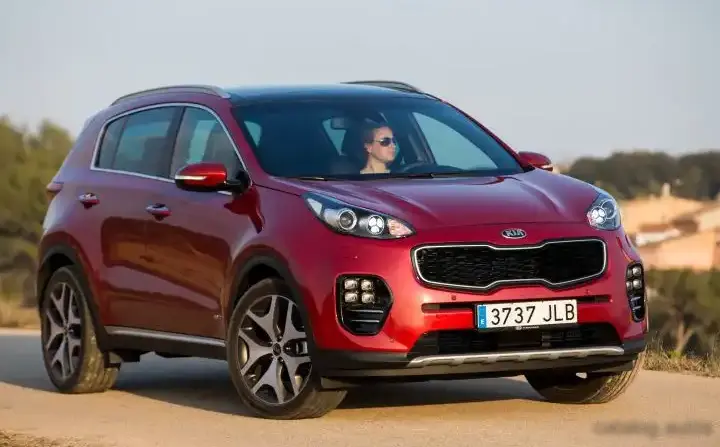
The Kia Sportage IV, produced from 2016 to 2018, represented a significant step forward for the South Korean automaker in the highly competitive compact SUV segment. Among the various engine and drivetrain configurations offered, the 1.6 T-GDI (177 hp) paired with a seven-speed Dual Clutch Transmission (DCT) and All-Wheel Drive (AWD) occupied a middle-ground position in the lineup, balancing performance, fuel efficiency, and available features. This variant aimed to appeal to buyers seeking a more engaging driving experience than the base engine offered, while remaining more accessible than the higher-output options.
Technical Specifications
| Brand | Kia |
| Model | Sportage |
| Generation | Sportage IV |
| Type (Engine) | 1.6 T-GDI (177 Hp) AWD DCT |
| Start of production | 2016 |
| End of production | 2018 |
| Powertrain Architecture | Internal Combustion engine |
| Body type | SUV |
| Seats | 5 |
| Doors | 5 |
| Fuel consumption (economy) – urban (NEDC) | 9.2 l/100 km (25.6 US mpg, 30.7 UK mpg, 10.9 km/l) |
| Fuel consumption (economy) – extra urban (NEDC) | 6.5 l/100 km (36.2 US mpg, 43.5 UK mpg, 15.4 km/l) |
| Fuel consumption (economy) – combined (NEDC) | 7.5 l/100 km (31.4 US mpg, 37.7 UK mpg, 13.3 km/l) |
| CO2 emissions (NEDC) | 175 g/km |
| Fuel Type | Petrol (Gasoline) |
| Acceleration 0 – 100 km/h | 9.1 sec |
| Acceleration 0 – 62 mph | 9.1 sec |
| Acceleration 0 – 60 mph | 8.6 sec |
| Maximum speed | 201 km/h (124.9 mph) |
| Emission standard | Euro 6 b |
| Weight-to-power ratio | 8.2 kg/Hp, 121.3 Hp/tonne |
| Weight-to-torque ratio | 5.5 kg/Nm, 181.6 Nm/tonne |
| Power | 177 Hp @ 5500 rpm |
| Power per litre | 111.3 Hp/l |
| Torque | 265 Nm @ 1500-4500 rpm (195.45 lb.-ft. @ 1500-4500 rpm) |
| Engine layout | Front, Transverse |
| Engine Model/Code | Gamma II / G4FJ |
| Engine displacement | 1591 cm3 (97.09 cu. in.) |
| Number of cylinders | 4 |
| Engine configuration | Inline |
| Cylinder Bore | 77 mm (3.03 in.) |
| Piston Stroke | 85.4 mm (3.36 in.) |
| Compression ratio | 10:1 |
| Number of valves per cylinder | 4 |
| Fuel injection system | Direct injection |
| Engine aspiration | Twin-scroll turbo, Intercooler |
| Valvetrain | DOHC |
| Engine oil capacity | 4.5 l (4.76 US qt | 3.96 UK qt) |
| Coolant | 7.3 l (7.71 US qt | 6.42 UK qt) |
| Kerb Weight | 1459-1629 kg (3216.54 – 3591.33 lbs.) |
| Max. weight | 2170 kg (4784.03 lbs.) |
| Max load | 541-711 kg (1192.7 – 1567.49 lbs.) |
| Trunk (boot) space – minimum | 491 l (17.34 cu. ft.) |
| Trunk (boot) space – maximum | 1492 l (52.69 cu. ft.) |
| Fuel tank capacity | 62 l (16.38 US gal | 13.64 UK gal) |
| Max. roof load | 100 kg (220.46 lbs.) |
| Permitted trailer load with brakes (12%) | 1600 kg (3527.4 lbs.) |
| Permitted trailer load without brakes | 750 kg (1653.47 lbs.) |
| Permitted towbar download | 100 kg (220.46 lbs.) |
| Length | 4480 mm (176.38 in.) |
| Width | 1855 mm (73.03 in.) |
| Width including mirrors | 2085 mm (82.09 in.) |
| Height | 1645 mm (64.76 in.) |
| Wheelbase | 2670 mm (105.12 in.) |
| Front track | 1609-1625 mm (63.35 – 63.98 in.) |
| Rear (Back) track | 1620-1636 mm (63.78 – 64.41 in.) |
| Front overhang | 910 mm (35.83 in.) |
| Rear overhang | 900 mm (35.43 in.) |
| Ride height (ground clearance) | 172 mm (6.77 in.) |
| Minimum turning circle (turning diameter) | 10.6 m (34.78 ft.) |
| Approach angle | 16.7° |
| Departure angle | 23.9° |
| Ramp-over (brakeover) angle | 18.6° |
| Drivetrain Architecture | The Internal combustion engine (ICE) drives the front wheels permanently, and the rear wheels are driven through an electrically or mechanically operated clutch if necessary. |
| Drive wheel | All wheel drive (4×4) |
| Number of gears and type of gearbox | 7 gears, automatic transmission DCT |
| Front suspension | Independent, type McPherson with coil spring and anti-roll bar |
| Rear suspension | Independent multi-link spring suspension with stabilizer |
| Front brakes | Ventilated discs, 305 mm |
| Rear brakes | Disc, 302 mm |
| Assisting systems | ABS (Anti-lock braking system) |
| Steering type | Steering rack and pinion |
| Power steering | Electric Steering |
| Tires size | 215/70 R16; 225/60 R17; 245/45 R19 |
| Wheel rims size | 6.5J x 16; 7J x 17; 7.5J x 19 |
Powertrain & Engine Architecture
At the heart of this Sportage variant lies the Gamma II 1.6-liter turbocharged gasoline direct injection (TGDI) engine, designated G4FJ. This engine is an inline-four cylinder unit featuring a twin-scroll turbocharger and intercooler, designed to minimize turbo lag and maximize power delivery. The direct injection system precisely meters fuel into the combustion chambers, improving efficiency and reducing emissions. The engine produces 177 horsepower at 5500 rpm and 265 Nm (195 lb-ft) of torque between 1500 and 4500 rpm. This broad torque curve contributes to responsive acceleration in everyday driving situations. The engine utilizes a double overhead camshaft (DOHC) valvetrain with four valves per cylinder, optimizing airflow for increased performance. Paired with this engine is a seven-speed Dual Clutch Transmission (DCT). DCTs offer faster and smoother gear changes compared to traditional automatic transmissions, enhancing the driving experience. The AWD system operates by primarily driving the front wheels, engaging the rear wheels as needed via an electronically controlled multi-plate clutch to maintain optimal traction.
Driving Characteristics
The 1.6 T-GDI with the DCT and AWD provides a noticeably more spirited driving experience than the base 1.6-liter naturally aspirated engine. Acceleration to 60 mph takes approximately 8.6 seconds, and 0-100 km/h (0-62 mph) is achieved in 9.1 seconds. While not a performance-oriented SUV, the turbocharger provides ample power for merging onto highways and overtaking maneuvers. The DCT contributes to quick and seamless gear changes, keeping the engine in its optimal power band. The AWD system enhances stability and grip, particularly in inclement weather conditions. Compared to manual transmission versions of the same engine, the DCT offers convenience and ease of use, although some drivers may prefer the greater control of a manual gearbox. The gear ratios are tuned for a balance between acceleration and fuel economy, with taller gears for relaxed cruising on the highway.
Equipment & Trim Levels
The 1.6 T-GDI AWD DCT trim typically included a good level of standard equipment. Features commonly found in this variant include air conditioning, power windows and locks, a touchscreen infotainment system with Bluetooth connectivity, and a rearview camera. Higher trim levels added features such as leather upholstery, heated front seats, a panoramic sunroof, and advanced driver-assistance systems like lane departure warning and automatic emergency braking. Interior upholstery was typically cloth on lower trims, with leather options available on higher-spec models. Dashboard configurations were generally consistent across the range, with a focus on user-friendliness and functionality.
Chassis & Braking
The Sportage IV utilizes a McPherson strut front suspension and a multi-link rear suspension, providing a comfortable ride and responsive handling. Stabilizer bars are fitted to both the front and rear axles to reduce body roll during cornering. Braking duties are handled by ventilated discs at the front and solid discs at the rear. The braking system is equipped with Anti-lock Braking System (ABS) as standard. The suspension tuning is geared towards providing a balance between comfort and handling, making it suitable for both city driving and longer journeys.
Market Reception & Comparison
The 1.6 T-GDI AWD DCT Sportage received generally positive reviews from automotive critics. It was praised for its responsive engine, smooth-shifting DCT, and capable AWD system. Fuel economy was considered respectable for its class, with combined fuel consumption figures around 31.4 US mpg. Compared to the base 1.6-liter engine, the turbo variant offered a significant performance upgrade. Compared to the 2.0-liter diesel models, the 1.6 T-GDI offered a more refined driving experience and lower emissions, but slightly less torque. Reliability reports have been mixed, with some owners reporting issues with the turbocharger and DCT, while others have experienced no major problems.
Legacy
The Kia Sportage IV 1.6 T-GDI AWD DCT remains a popular choice in the used car market. Its combination of performance, fuel efficiency, and features makes it an attractive option for buyers seeking a compact SUV. The long-term reliability of the Gamma II engine and DCT is a consideration for potential buyers, and regular maintenance is crucial to ensure optimal performance and longevity. The Sportage IV helped to establish Kia as a major player in the global automotive market, and this particular variant played a key role in attracting customers who desired a more engaging and refined driving experience.