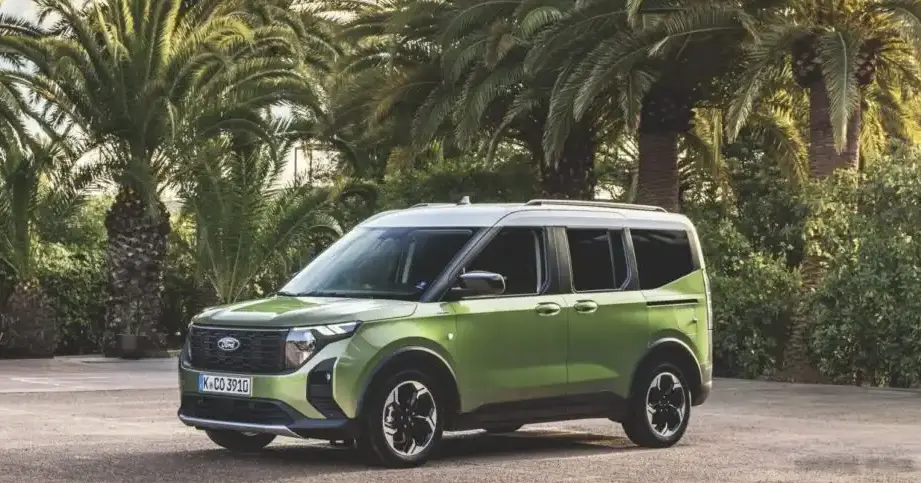
The Ford Tourneo Courier II 54 kWh is an all-electric, compact multi-purpose vehicle (MPV) introduced by Ford in November 2024. Representing the second generation of the Tourneo Courier, this variant is a key component of Ford’s strategy to electrify its commercial and passenger vehicle lineup in Europe and other markets. It’s built on the same platform as the Puma, offering a practical and efficient option for families and small businesses seeking a versatile vehicle with zero tailpipe emissions. This specific 54 kWh configuration positions itself as the entry-level electric offering within the Tourneo Courier II range, prioritizing affordability and everyday usability over outright performance.
Technical Specifications
| Brand | Ford |
| Model | Tourneo Courier |
| Generation | Tourneo Courier II |
| Type (Engine) | 54 kWh (136 Hp) Electric |
| Start of production | November, 2024 |
| Powertrain Architecture | BEV (Electric Vehicle) |
| Body type | MPV |
| Seats | 5 |
| Doors | 5 |
| Fuel Type | Electricity |
| Gross battery capacity | 54 kWh |
| Net (usable) battery capacity | 43.5 kWh |
| Battery technology | Lithium-ion (Li-Ion) |
| Battery location | Below the floor |
| All-electric range (WLTP) | 266-288 km (165.28 – 178.95 mi) |
| Average Energy consumption (WLTP) | 17.3-18.3 kWh/100 km (27.84 – 29.45 kWh/100 mi) |
| Average Energy consumption (MPGe) | 121 – 114 |
| Energy consumption (km/kWh) | 5.8 – 5.5 |
| Energy consumption (mi/kWh) | 3.6 – 3.4 |
| Electric motor power | 136 Hp |
| Electric motor location | Front axle, Transverse |
| Electric motor type | Synchronous |
| System power | 136 Hp |
| Trunk (boot) space – minimum | 570 l (20.13 cu. ft.) |
| Trunk (boot) space – maximum | 2162 l (76.35 cu. ft.) |
| Length | 4337 mm (170.75 in.) |
| Width | 1800-1813 mm (70.87 – 71.38 in.) |
| Width with mirrors folded | 1876 mm (73.86 in.) |
| Width including mirrors | 2076 mm (81.73 in.) |
| Height | 1817-1836 mm (71.54 – 72.28 in.) |
| Wheelbase | 2692 mm (105.98 in.) |
| Front overhang | 832 mm (32.76 in.) |
| Rear overhang | 813 mm (32.01 in.) |
| Minimum turning circle | 10.7 m (35.1 ft.) |
| Drivetrain | Front wheel drive |
| Number of gears | 1 |
| Gearbox type | Automatic transmission |
| Front suspension | Independent, type McPherson with coil spring and anti-roll bar |
| Rear suspension | Elastic beam |
| Front brakes | Ventilated discs |
| Rear brakes | Drum |
| Steering type | Steering rack and pinion |
| Power steering | Electric |
| Tires size | 205/65 R16; 215/55 R17 |
| Wheel rims size | 6.5J x 16; 7J x 17 |
Powertrain & Engine Architecture
The Tourneo Courier II 54 kWh utilizes a fully Battery Electric Vehicle (BEV) powertrain. At its heart is a liquid-cooled, Lithium-ion battery pack with a gross capacity of 54 kWh, providing a usable capacity of 43.5 kWh. This battery is positioned under the vehicle floor, contributing to a lower center of gravity and maximizing interior space. The electric motor, a synchronous type, is mounted transversely on the front axle and delivers 136 horsepower. The vehicle employs a single-speed automatic transmission, typical of most electric vehicles, simplifying the driving experience and focusing on efficient power delivery. The charging system supports both AC and DC fast charging, allowing for convenient replenishment of the battery at home, work, or public charging stations. The onboard charger handles AC charging, while DC fast charging capabilities enable significant range recovery in a relatively short period.
Driving Characteristics
The 136 hp electric motor provides adequate performance for urban and suburban driving. Acceleration is brisk from a standstill due to the instant torque characteristic of electric motors, making it easy to merge into traffic. While not designed for outright speed, the Tourneo Courier II 54 kWh offers a smooth and refined driving experience. The single-speed automatic transmission ensures seamless power delivery, and the regenerative braking system helps to recapture energy during deceleration, extending the vehicle’s range. Compared to potential future, higher-powered electric variants, this version prioritizes efficiency and affordability over sporty handling. The relatively low weight of the vehicle, compared to larger EVs, contributes to its nimble feel.
Equipment & Trim Levels
The Tourneo Courier II 54 kWh, in its base trim, typically includes standard features such as air conditioning, a touchscreen infotainment system with smartphone integration (Apple CarPlay and Android Auto), and a suite of driver-assistance systems including automatic emergency braking and lane-keeping assist. Interior upholstery is generally cloth, with durable and practical materials used throughout the cabin. Higher trim levels offer upgrades such as a larger touchscreen, heated seats, a rearview camera, and parking sensors. Optional extras may include a panoramic sunroof, upgraded audio system, and various styling enhancements.
Chassis & Braking
The Tourneo Courier II utilizes a McPherson strut suspension setup at the front, providing a comfortable ride and responsive handling. The rear suspension employs an elastic beam configuration, a cost-effective solution that balances ride quality and cargo space. The braking system features ventilated discs at the front and drum brakes at the rear. Electric power steering provides light and precise steering feel. Tire sizes vary depending on the trim level, with 205/65 R16 and 215/55 R17 being common options. ABS (Anti-lock Braking System) is standard, enhancing safety and stability during emergency braking situations.
Market Reception & Comparison
The Ford Tourneo Courier II 54 kWh has been generally well-received by automotive critics as a practical and affordable entry point into the electric MPV segment. Its compact size and versatile interior make it well-suited for urban environments and families. Compared to other electric vehicles in its class, the Tourneo Courier II offers a competitive range and a reasonable price point. Fuel economy, expressed as kWh per 100 km, is competitive with other EVs, and the regenerative braking system helps to maximize efficiency. Reliability is still being established, as the vehicle is relatively new to the market, but Ford has a generally good reputation for build quality and durability.
Legacy
The long-term reliability of the Tourneo Courier II’s electric powertrain remains to be seen, but the components used – particularly the battery technology – are becoming increasingly mature and proven. The vehicle’s relatively simple design and robust construction suggest that it should be a reliable and durable option for years to come. On the used car market, the Tourneo Courier II 54 kWh is expected to hold its value reasonably well, particularly as demand for electric vehicles continues to grow. Its practicality, affordability, and zero-emission operation will likely make it a popular choice for environmentally conscious buyers.