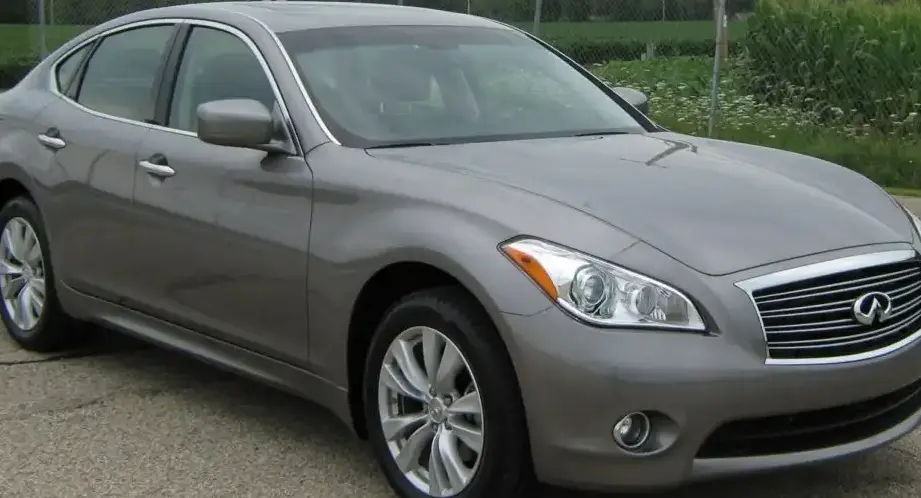
The Infiniti M37, produced from 2010 to 2019 as part of the fourth generation (Y51) of the Infiniti M line, represented a significant step forward in the brand’s luxury performance sedan offerings. This variant, specifically the 3.7-liter V6 engine paired with a seven-speed automatic transmission and all-wheel drive (AWD), was positioned as a mid-to-high range trim, offering a compelling blend of power, comfort, and all-weather capability. It served as a direct competitor to established European and domestic luxury sedans like the BMW 5 Series, Audi A6, and Cadillac CTS.
Technical Specifications
| Brand | Infiniti |
| Model | M |
| Generation | M IV (Y51) |
| Type (Engine) | M37 V6 (330 Hp) AWD Automatic |
| Start of production | 2010 |
| End of production | 2019 |
| Powertrain Architecture | Internal Combustion engine |
| Body type | Sedan |
| Seats | 5 |
| Doors | 4 |
| Fuel consumption (urban) | 13.8 l/100 km (17 US mpg, 20.5 UK mpg, 7.2 km/l) |
| Fuel consumption (extra urban) | 9.8 l/100 km (24 US mpg, 28.8 UK mpg, 10.2 km/l) |
| Fuel Type | Petrol (Gasoline) |
| Weight-to-power ratio | 5.6 kg/Hp, 179.1 Hp/tonne |
| Weight-to-torque ratio | 5 kg/Nm, 198.6 Nm/tonne |
| Power | 330 Hp @ 7000 rpm |
| Power per litre | 89.3 Hp/l |
| Torque | 366 Nm @ 5200 rpm (269.95 lb.-ft. @ 5200 rpm) |
| Maximum engine speed | 7500 rpm |
| Engine layout | Front, Longitudinal |
| Engine Model/Code | VQ37VHR |
| Engine displacement | 3696 cm3 (225.54 cu. in.) |
| Number of cylinders | 6 |
| Engine configuration | V-engine |
| Cylinder Bore | 95.5 mm (3.76 in.) |
| Piston Stroke | 86 mm (3.39 in.) |
| Compression ratio | 11:1 |
| Number of valves per cylinder | 4 |
| Fuel injection system | Multi-port manifold injection |
| Valvetrain | DOHC |
| Engine oil capacity | 4.9 l (5.18 US qt | 4.31 UK qt) |
| Coolant capacity | 8.4 l (8.88 US qt | 7.39 UK qt) |
| Kerb Weight | 1843 kg (4063.12 lbs.) |
| Max. weight | 2330 kg (5136.77 lbs.) |
| Max load | 487 kg (1073.65 lbs.) |
| Trunk (boot) space – minimum | 422 l (14.9 cu. ft.) |
| Fuel tank capacity | 76 l (20.08 US gal | 16.72 UK gal) |
| Length | 4945 mm (194.69 in.) |
| Width | 1844 mm (72.6 in.) |
| Height | 1514 mm (59.61 in.) |
| Wheelbase | 2901 mm (114.21 in.) |
| Front track | 1575 mm (62.01 in.) |
| Rear (Back) track | 1565 mm (61.61 in.) |
| Ride height (ground clearance) | 147 mm (5.79 in.) |
| Drag coefficient (Cd) | 0.27 |
| Minimum turning circle (turning diameter) | 11.4 m (37.4 ft.) |
| Drivetrain Architecture | All wheel drive (4×4). ICE drives rear wheels, front wheels engaged via clutch. |
| Number of gears and type of gearbox | 7 gears, automatic transmission |
| Front suspension | Double wishbone |
| Rear suspension | Independent multi-link with stabilizer |
| Front brakes | Ventilated discs, 320.04×27.94 mm |
| Rear brakes | Ventilated discs, 307.34×15.24 mm |
| Assisting systems | ABS (Anti-lock braking system) |
| Steering type | Steering rack and pinion |
| Power steering | Electric |
| Tires size | 245/50 R18 V |
| Wheel rims size | 8.0J x 18 |
Powertrain & Engine Architecture
The heart of the M37 is the VQ37VHR 3.7-liter V6 engine. This engine is a member of Nissan’s highly regarded VQ engine family, known for its smooth operation, reliability, and strong performance. The “VHR” designation stands for “Variable Valve Timing and lift with high response.” This system utilizes continuously variable valve timing and lift on both the intake and exhaust valves, optimizing engine performance across the rev range. The engine employs multi-port fuel injection and a dual overhead camshaft (DOHC) design with four valves per cylinder. The 3696cc displacement is achieved with a 95.5mm bore and 86mm stroke.
The seven-speed automatic transmission, sourced from Aisin, was a key component of the M37’s appeal. It offered smooth and responsive shifts, contributing to a refined driving experience. The AWD system is primarily rear-wheel drive biased, sending power to the rear wheels under normal conditions. When slippage is detected, an electronically controlled clutch engages the front wheels, providing additional traction.
Driving Characteristics
The M37 AWD Automatic delivers a balanced driving experience. With 330 horsepower and 366 lb-ft of torque, acceleration is brisk, with 0-60 mph times typically around 5.2-5.5 seconds. The seven-speed automatic transmission is well-tuned, providing quick and seamless gear changes. While not as overtly sporty as some of its European rivals, the M37 offers a comfortable and confident ride. The AWD system provides enhanced stability and grip, particularly in inclement weather. Compared to the base M37 models with rear-wheel drive, the AWD version offers increased traction but also a slight weight penalty, potentially impacting fuel economy and agility.
Equipment & Trim Levels
The M37 typically came well-equipped, even in its base form. Standard features included leather upholstery, power-adjustable front seats, a premium audio system, a navigation system, and a rearview camera. Higher trim levels, such as the “Journey” and “Sport” packages, added features like upgraded leather, wood trim, a panoramic sunroof, adaptive cruise control, and a more advanced safety suite. Optional extras included a Bose premium sound system, and various driver-assistance technologies.
Chassis & Braking
The M37 utilizes a double wishbone front suspension and an independent multi-link rear suspension, providing a comfortable and controlled ride. Stabilizer bars are fitted to both axles to reduce body roll during cornering. The braking system consists of ventilated discs on all four wheels, providing ample stopping power. The front brakes measure 320.04×27.94 mm, while the rear brakes are 307.34×15.24 mm. An Anti-lock Braking System (ABS) is standard.
Market Reception & Comparison
The Infiniti M37 was generally well-received by automotive critics. It was praised for its powerful engine, comfortable ride, and luxurious interior. However, some reviewers noted that its styling was somewhat conservative compared to its European competitors. Fuel economy was considered average for its class. Compared to other M37 trims, the AWD Automatic version offered a trade-off between performance and all-weather capability. The rear-wheel drive version was slightly more engaging to drive, while the AWD version provided greater confidence in slippery conditions.
Legacy
The VQ37VHR engine has proven to be remarkably durable and reliable, with many examples exceeding 200,000 miles with proper maintenance. The seven-speed automatic transmission is also generally considered reliable. On the used car market, the M37 represents a good value proposition, offering a lot of luxury and performance for the price. Common maintenance items include regular oil changes, coolant flushes, and brake service. While not without its quirks, the M37 remains a compelling choice for buyers seeking a comfortable, capable, and reliable luxury sedan.