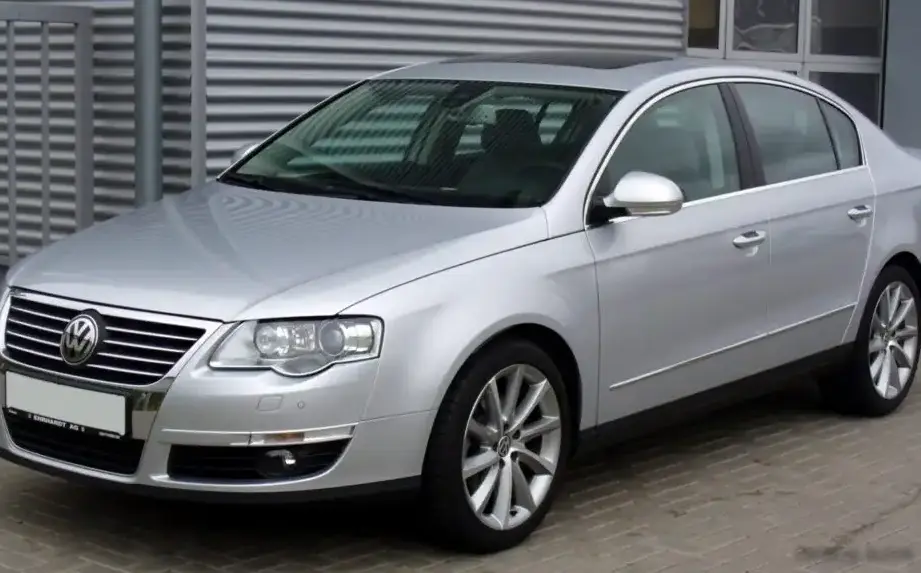
The Volkswagen Passat B6 2.0 FSI Tiptronic, produced from February 2005 to October 2007, represented a significant evolution in Volkswagen’s mid-size sedan offering. Positioned as a mid-range trim within the B6 generation (2005-2010), this variant aimed to balance performance and fuel efficiency with the convenience of an automatic transmission. It was a key model in the European market, where sedans and wagons were highly popular, and also saw moderate sales in North America. The B6 Passat was built on the Volkswagen Group’s B6 platform, shared with models like the Audi A4 and Škoda Superb, offering a more refined and spacious interior compared to its predecessor.
Technical Specifications
| Brand | Volkswagen |
| Model | Passat |
| Generation | Passat (B6) |
| Type (Engine) | 2.0 FSI (150 Hp) Tiptronic |
| Start of production | February, 2005 |
| End of production | October, 2007 |
| Powertrain Architecture | Internal Combustion engine |
| Body type | Sedan |
| Seats | 5 |
| Doors | 4 |
| Fuel consumption (urban) | 11.9 l/100 km (19.8 US mpg, 23.7 UK mpg, 8.4 km/l) |
| Fuel consumption (extra urban) | 6.5 l/100 km (36.2 US mpg, 43.5 UK mpg, 15.4 km/l) |
| Fuel consumption (combined) | 8.5 l/100 km (27.7 US mpg, 33.2 UK mpg, 11.8 km/l) |
| Fuel Type | Petrol (Gasoline) |
| Acceleration 0 – 100 km/h | 10.2 sec |
| Acceleration 0 – 62 mph | 10.2 sec |
| Acceleration 0 – 60 mph | 9.7 sec |
| Maximum speed | 208 km/h (129.25 mph) |
| Emission standard | Euro 4 |
| Weight-to-power ratio | 9 kg/Hp, 111.7 Hp/tonne |
| Weight-to-torque ratio | 6.7 kg/Nm, 148.9 Nm/tonne |
| Power | 150 Hp @ 6000 rpm |
| Power per litre | 75.6 Hp/l |
| Torque | 200 Nm @ 3500 rpm (147.51 lb.-ft. @ 3500 rpm) |
| Engine layout | Front, Transverse |
| Engine Model/Code | BLR |
| Engine displacement | 1984 cm3 (121.07 cu. in.) |
| Number of cylinders | 4 |
| Engine configuration | Inline |
| Cylinder Bore | 82.5 mm (3.25 in.) |
| Piston Stroke | 92.8 mm (3.65 in.) |
| Compression ratio | 11.5:1 |
| Number of valves per cylinder | 4 |
| Fuel injection system | Direct injection |
| Engine aspiration | Naturally aspirated engine |
| Valvetrain | DOHC |
| Engine oil capacity | 4.6 l (4.86 US qt | 4.05 UK qt) |
| Coolant | 8 l (8.45 US qt | 7.04 UK qt) |
| Kerb Weight | 1343 kg (2960.81 lbs.) |
| Max. weight | 2030 kg (4475.38 lbs.) |
| Max load | 687 kg (1514.58 lbs.) |
| Trunk (boot) space – minimum | 565 l (19.95 cu. ft.) |
| Trunk (boot) space – maximum | 1091 l (38.53 cu. ft.) |
| Fuel tank capacity | 70 l (18.49 US gal | 15.4 UK gal) |
| Max. roof load | 100 kg (220.46 lbs.) |
| Permitted trailer load with brakes (12%) | 1500 kg (3306.93 lbs.) |
| Permitted trailer load without brakes | 730 kg (1609.37 lbs.) |
| Permitted towbar download | 85 kg (187.39 lbs.) |
| Length | 4765 mm (187.6 in.) |
| Width | 1820 mm (71.65 in.) |
| Width including mirrors | 1991 mm (78.39 in.) |
| Height | 1472 mm (57.95 in.) |
| Wheelbase | 2709 mm (106.65 in.) |
| Front track | 1552 mm (61.1 in.) |
| Rear (Back) track | 1551 mm (61.06 in.) |
| Front overhang | 965 mm (37.99 in.) |
| Rear overhang | 1091 mm (42.95 in.) |
| Ride height (ground clearance) | 114 mm (4.49 in.) |
| Drag coefficient (Cd) | 0.281 |
| Minimum turning circle (turning diameter) | 11.4 m (37.4 ft.) |
| Approach angle | 14.4° |
| Departure angle | 12.6° |
| Ramp-over (brakeover) angle | 10.8° |
| Drivetrain Architecture | The Internal combustion engine (ICE) drives the front wheels of the vehicle. |
| Drive wheel | Front wheel drive |
| Number of gears and type of gearbox | 6 gears, automatic transmission |
| Front suspension | Spring Strut |
| Rear suspension | Coil spring |
| Front brakes | Ventilated discs |
| Rear brakes | Disc |
| Assisting systems | ABS (Anti-lock braking system) |
| Steering type | Steering rack and pinion |
| Tires size | 215/55 R16 |
| Wheel rims size | 6.5J x 16 |
Powertrain & Engine Architecture
The heart of the Passat 2.0 FSI Tiptronic is the BLR engine code, a 1.984-liter (121.07 cubic inches) inline-four cylinder gasoline engine. This engine utilizes direct fuel injection (FSI – Fuel Stratified Injection), a technology that allows for precise fuel delivery directly into the combustion chamber, improving efficiency and power output. The engine features a double overhead camshaft (DOHC) valvetrain with four valves per cylinder, contributing to its responsive nature. The 150 horsepower peak is achieved at 6000 rpm, while the 200 Nm (147.51 lb-ft) of torque is available at 3500 rpm. Paired with this engine is a six-speed Tiptronic automatic transmission, offering both fully automatic operation and the ability for the driver to manually select gears for more control. The Tiptronic transmission uses a torque converter and electronic controls to provide smooth and efficient shifting.
Driving Characteristics
The 2.0 FSI Tiptronic offered a comfortable and refined driving experience. While not as sporty as the higher-output variants like the 2.0T or the VR6, it provided adequate power for everyday driving and highway cruising. The automatic transmission, while convenient, did result in a slight performance deficit compared to the six-speed manual version. Acceleration from 0 to 60 mph took approximately 9.7 seconds, and the top speed was around 129.25 mph. The Tiptronic transmission’s gear ratios were tuned for fuel efficiency and smooth transitions, rather than outright acceleration. The engine felt responsive in the mid-range, making overtaking maneuvers relatively easy, but lacked the punch of more powerful engines at higher RPMs.
Equipment & Trim Levels
The 2.0 FSI Tiptronic trim typically included standard features such as air conditioning, power windows and locks, a CD stereo system, and alloy wheels. Higher trim levels offered options like leather upholstery, a sunroof, heated front seats, and a more advanced audio system. Safety features included ABS brakes, front and side airbags, and electronic stability control. The interior generally featured a dark color scheme with cloth upholstery as standard, with the option to upgrade to leather. The dashboard layout was functional and well-designed, with easy-to-read gauges and intuitive controls.
Chassis & Braking
The Passat B6 featured a MacPherson strut front suspension and a multi-link rear suspension, providing a comfortable ride and good handling characteristics. The front brakes were ventilated discs, while the rear brakes were solid discs. ABS (Anti-lock Braking System) was standard, enhancing braking performance and stability. The suspension was tuned to prioritize comfort over sporty handling, resulting in a smooth ride quality, even on uneven road surfaces. Stabilizer bars were fitted to both the front and rear axles to reduce body roll during cornering.
Market Reception & Comparison
The Passat 2.0 FSI Tiptronic was generally well-received by automotive critics as a practical and comfortable family sedan. However, some reviewers noted that the automatic transmission dulled the engine’s performance compared to the manual version. Fuel economy was considered reasonable for its class, averaging around 27.7 US mpg in combined driving. Compared to the more powerful 2.0T and VR6 models, the 2.0 FSI Tiptronic offered a more affordable entry point into the Passat range, appealing to buyers who prioritized fuel efficiency and comfort over outright performance. The 1.9 TDI diesel variant was also a popular alternative, offering even better fuel economy but with a different driving experience.
Legacy
The BLR engine, while generally reliable, is known to be susceptible to carbon buildup on the intake valves, particularly if not regularly driven on longer journeys. This can lead to reduced performance and rough idling. The Tiptronic transmission, if properly maintained with regular fluid changes, is also considered relatively durable. Today, the Passat B6 2.0 FSI Tiptronic can be found on the used car market at relatively affordable prices. It remains a viable option for buyers seeking a comfortable and practical mid-size sedan, but potential buyers should be aware of the potential for carbon buildup and ensure the transmission has been well-maintained.