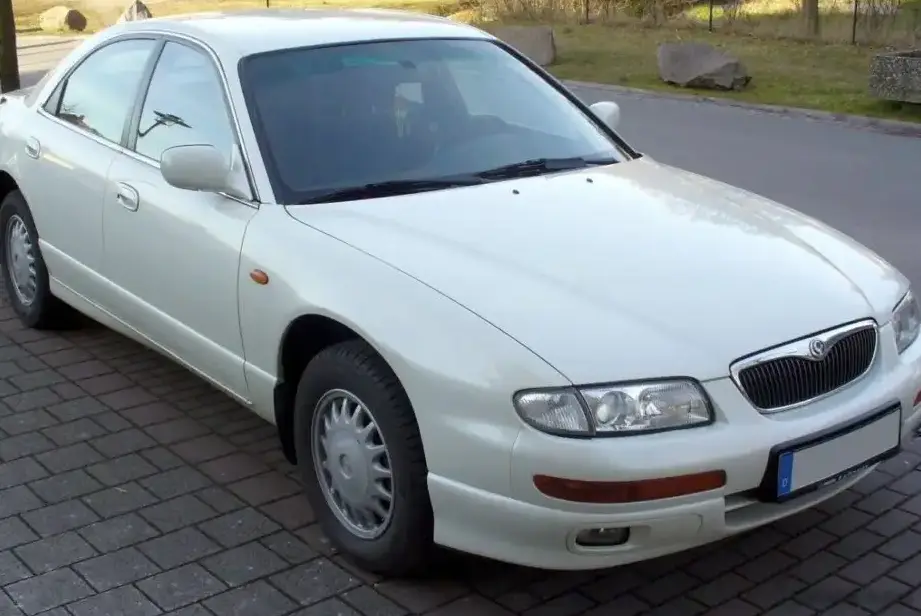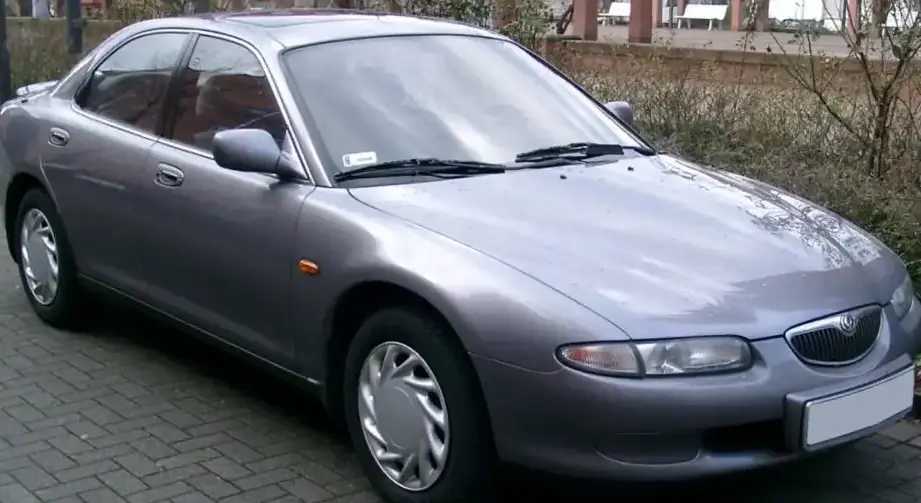
The Mazda Xedos 6, produced between 1994 and 2000, represented Mazda’s foray into the burgeoning entry-level luxury sedan market, primarily aimed at European consumers. The “CA” chassis designation refers to the first generation of the Xedos 6. Within the Xedos 6 lineup, the 1.6 16V variant, producing 107 horsepower, served as the entry point, offering a balance of affordability and Mazda’s commitment to driving dynamics. It was positioned below the more powerful 2.0L models, targeting buyers who prioritized fuel efficiency and a comfortable ride over outright performance. This model competed with vehicles like the Honda Accord, Toyota Camry, and Ford Mondeo in the European market.
Technical Specifications
| Brand | Mazda |
| Model | Xedos 6 |
| Generation | Xedos 6 (CA) |
| Type (Engine) | 1.6 16V (107 Hp) |
| Start of production | 1994 |
| End of production | 2000 |
| Powertrain Architecture | Internal Combustion engine |
| Body type | Sedan |
| Seats | 5 |
| Doors | 4 |
| Fuel consumption (urban) | 9.5 l/100 km (24.8 US mpg) |
| Fuel consumption (extra urban) | 5.4 l/100 km (43.6 US mpg) |
| Fuel Type | Petrol (Gasoline) |
| Acceleration 0 – 100 km/h | 10.3 sec |
| Acceleration 0 – 62 mph | 10.3 sec |
| Acceleration 0 – 60 mph | 9.8 sec |
| Maximum speed | 184 km/h (114.33 mph) |
| Weight-to-power ratio | 10.7 kg/Hp |
| Weight-to-torque ratio | 8.3 kg/Nm |
| Power | 107 Hp @ 6200 rpm |
| Power per litre | 67 Hp/l |
| Torque | 138 Nm @ 3600 rpm (101.78 lb.-ft. @ 3600 rpm) |
| Engine layout | Front, Transverse |
| Engine displacement | 1598 cm3 (97.52 cu. in.) |
| Number of cylinders | 4 |
| Engine configuration | Inline |
| Cylinder Bore | 78 mm (3.07 in.) |
| Piston Stroke | 83.6 mm (3.29 in.) |
| Compression ratio | 9:1 |
| Number of valves per cylinder | 4 |
| Fuel injection system | Multi-port manifold injection |
| Engine aspiration | Naturally aspirated engine |
| Valvetrain | OHC |
| Kerb Weight | 1140 kg (2513.27 lbs.) |
| Max. weight | 1645 kg (3626.6 lbs.) |
| Max load | 505 kg (1113.33 lbs.) |
| Trunk (boot) space – minimum | 390 l (13.77 cu. ft.) |
| Fuel tank capacity | 55 l (14.53 US gal | 12.1 UK gal) |
| Length | 4560 mm (179.53 in.) |
| Width | 1700 mm (66.93 in.) |
| Height | 1355 mm (53.35 in.) |
| Wheelbase | 2610 mm (102.76 in.) |
| Front track | 1480 mm (58.27 in.) |
| Rear (Back) track | 1490 mm (58.66 in.) |
| Drivetrain Architecture | The Internal combustion engine (ICE) drives the front wheels of the vehicle. |
| Drive wheel | Front wheel drive |
| Number of gears and type of gearbox | 5 gears, manual transmission |
| Front suspension | Wishbone |
| Rear suspension | Trailing arm |
| Front brakes | Ventilated discs |
| Rear brakes | Disc |
| Assisting systems | ABS (Anti-lock braking system) |
| Steering type | Steering rack and pinion |
| Power steering | Hydraulic Steering |
| Tires size | 185/65 R14 |
Powertrain & Engine Architecture
The heart of the Xedos 6 1.6 16V is the Mazda B6 engine, specifically the B6-ZE variant. This 1.6-liter inline-four cylinder engine utilizes a single overhead camshaft (SOHC) valvetrain operating 16 valves (four per cylinder). The engine employs multi-port fuel injection, delivering fuel directly into the intake ports for improved combustion efficiency. The 9:1 compression ratio was a typical figure for naturally aspirated engines of the era. The engine’s 107 horsepower output at 6200 rpm and 138 Nm (101.78 lb-ft) of torque at 3600 rpm were respectable for its displacement, but not particularly groundbreaking. The engine was paired with a five-speed manual transmission as standard, providing a relatively direct connection between the engine and the front wheels. An optional four-speed automatic transmission was also available, though it impacted acceleration and fuel economy.
Driving Characteristics
The Xedos 6 1.6 16V offered a comfortable and refined driving experience, prioritizing ease of use over sporty performance. Acceleration from 0-60 mph took approximately 9.8 seconds, which was adequate for everyday driving but noticeably slower than the 2.0L models. The five-speed manual transmission allowed drivers to extract the most from the engine, while the optional automatic, while convenient, resulted in a more sluggish response. Gear ratios were tuned for fuel efficiency and smooth cruising, rather than aggressive acceleration. The engine felt relatively responsive at lower RPMs, making it well-suited for urban driving, but lacked the top-end punch of larger displacement engines. Compared to the more powerful Xedos 6 variants, the 1.6L model offered a more economical and accessible entry point into the Xedos 6 range.
Equipment & Trim Levels
The Xedos 6 1.6 16V typically came equipped with a reasonable level of standard features, reflecting its positioning as an entry-level luxury car. Standard equipment included power steering, central locking, electric front windows, and an AM/FM radio. Interior upholstery was typically cloth, with a focus on comfort and durability. Higher trim levels offered upgrades such as alloy wheels, air conditioning, a sunroof, and upgraded audio systems. Optional extras included leather upholstery, a CD player, and anti-lock brakes (ABS), which became increasingly common as standard equipment towards the end of production. The dashboard layout was clean and functional, with a focus on ergonomics.
Chassis & Braking
The Xedos 6 utilized a front-wheel-drive layout with independent wishbone suspension at the front and a trailing arm suspension at the rear. This suspension setup provided a comfortable ride quality, absorbing bumps and imperfections in the road effectively. The 1.6L models typically featured ventilated disc brakes at the front and solid disc brakes at the rear, providing adequate stopping power for its weight class. ABS was available as an option, enhancing braking performance and stability, particularly in adverse conditions. Stabilizer bars were fitted to both the front and rear axles to reduce body roll during cornering. The chassis was designed to prioritize comfort and refinement over outright handling prowess.
Market Reception & Comparison
The Mazda Xedos 6 1.6 16V was generally well-received by automotive critics as a comfortable and well-equipped entry-level sedan. However, its performance was often criticized as being somewhat underwhelming compared to its rivals. Fuel economy was a strong point, with the 1.6L engine offering competitive figures. Reliability was generally good, although some owners reported minor issues with the fuel injection system and electrical components. Compared to the 2.0L Xedos 6 models, the 1.6L variant offered a more affordable price point but sacrificed performance. Against competitors like the Honda Accord and Toyota Camry, the Xedos 6 offered a more distinctive styling and a slightly more engaging driving experience, but lacked the established reputation for reliability of its Japanese rivals.
Legacy
The Mazda Xedos 6, while not a massive sales success, played an important role in establishing Mazda as a manufacturer of stylish and well-engineered vehicles. The 1.6L engine, while not particularly powerful, proved to be relatively durable and reliable. Today, the Xedos 6 1.6 16V can be found in the used car market at affordable prices. Parts availability is generally good, although some specific components may be difficult to source. The Xedos 6 remains a popular choice for enthusiasts seeking a comfortable and distinctive classic sedan. Its relatively simple mechanical design makes it a relatively easy car to maintain and repair, appealing to those who enjoy hands-on automotive work.