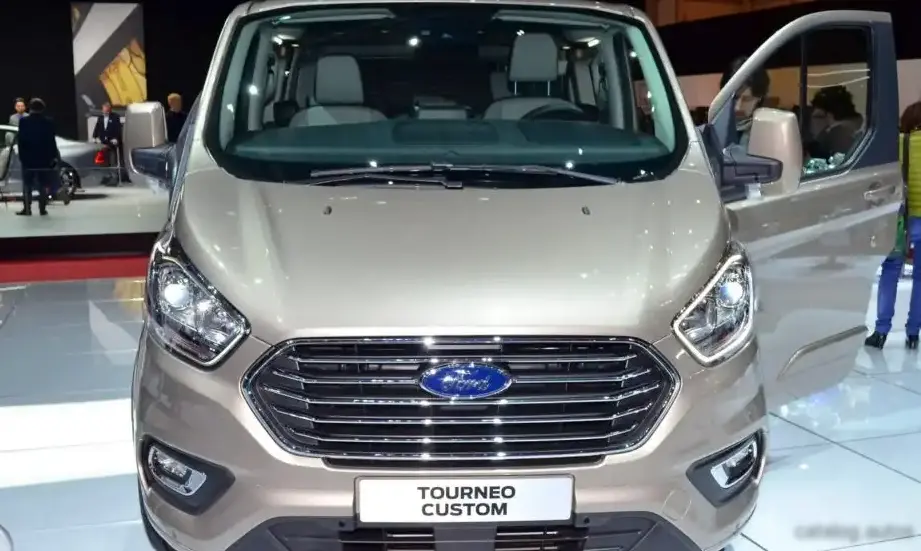
Technical Specifications
| Brand | Ford |
| Model | Tourneo Custom |
| Generation | Tourneo Custom I (facelift 2018) L1 |
| Type (Engine) | 2.0 TDCi (105 Hp) |
| Start of production | 2018 |
| End of production | 2023 |
| Powertrain Architecture | Internal Combustion engine |
| Body type | Van |
| Seats | 8-9 |
| Doors | 5 |
| Fuel consumption (urban) | 7.2 l/100 km (32.7 US mpg) |
| Fuel consumption (extra urban) | 5.8 l/100 km (40.6 US mpg) |
| Fuel consumption (combined) | 6.3 l/100 km (37.3 US mpg) |
| CO2 emissions | 164 g/km |
| Fuel Type | Diesel |
| Maximum speed | 150 km/h (93.21 mph) |
| Emission standard | Euro 6b |
| Weight-to-power ratio | 22.1 kg/Hp |
| Weight-to-torque ratio | 6.4 kg/Nm |
| Power | 105 Hp @ 3500 rpm |
| Torque | 360 Nm @ 1375-2000 rpm (265.52 lb.-ft.) |
| Engine layout | Front, Transverse |
| Engine Model/Code | YLFS, YLF6 |
| Engine displacement | 1995 cm3 (121.74 cu. in.) |
| Number of cylinders | 4 |
| Engine configuration | Inline |
| Number of valves per cylinder | 4 |
| Fuel injection system | Diesel Commonrail |
| Engine aspiration | Turbocharger, Intercooler |
| Engine oil capacity | 9.8 l (10.36 US qt | 8.62 UK qt) |
| Coolant capacity | 11.2 l (11.83 US qt | 9.85 UK qt) |
| Kerb Weight | 2318 kg (5110.32 lbs.) |
| Max. weight | 3190 kg (7032.75 lbs.) |
| Max load | 872 kg (1922.43 lbs.) |
| Trunk (boot) space – minimum | 1150 l (40.61 cu. ft.) |
| Fuel tank capacity | 70 l (18.49 US gal | 15.4 UK gal) |
| AdBlue tank | 21 l (5.55 US gal | 4.62 UK gal) |
| Permitted trailer load with brakes (12%) | 2000 kg (4409.25 lbs.) |
| Permitted trailer load without brakes | 750 kg (1653.47 lbs.) |
| Length | 4973 mm (195.79 in.) |
| Width | 2032 mm (80 in.) |
| Height | 1979 mm (77.91 in.) |
| Wheelbase | 2933 mm (115.47 in.) |
| Minimum turning circle | 11.6 m (38.06 ft.) |
| Drivetrain | Front wheel drive |
| Number of gears | 6 |
| Gearbox type | Manual transmission |
| Front brakes | Ventilated discs |
| Rear brakes | Ventilated discs |
| Tire size | 215/65 R16 |
| Wheel rims size | 16 |
The Ford Tourneo Custom, specifically the first generation (facelifted in 2018) L1 variant powered by the 2.0 TDCi 105 horsepower engine, represents a key offering in Ford’s European commercial vehicle lineup. Introduced in 2018 and continuing through 2023, this configuration was designed to balance affordability, practicality, and fuel efficiency for businesses and larger families needing a versatile passenger van. The Tourneo Custom, built on the 1HX0 platform, aimed to provide a more comfortable and refined experience than traditional cargo vans, while still maintaining the durability expected of a Ford workhorse. This particular engine and trim level served as an entry point into the Tourneo Custom range, appealing to buyers prioritizing cost-effectiveness over outright performance.
Powertrain & Engine Architecture
The heart of this Tourneo Custom variant is the 2.0-liter TDCi diesel engine, specifically utilizing the YLFS or YLF6 engine code depending on the exact production year and market. This engine is a four-cylinder, inline configuration featuring a turbocharger and intercooler to enhance power and efficiency. The engine employs a common-rail direct fuel injection system, delivering fuel directly into the combustion chamber at extremely high pressure for optimized combustion. The 105 horsepower output is achieved at 3500 rpm, while the more substantial 360 Nm (265.52 lb.-ft.) of torque is available from a low 1375 rpm, providing good pulling power for a vehicle of this size. The engine features four valves per cylinder, contributing to improved breathing and overall performance. Paired with this engine is a six-speed manual transmission, chosen for its efficiency and lower cost compared to an automatic option.
Driving Characteristics
The 105 hp 2.0 TDCi with a manual transmission in the Tourneo Custom L1 delivers a practical, if not exhilarating, driving experience. Acceleration is adequate for everyday driving, but it won’t be winning any races. The focus is on usability and fuel economy. The readily available torque at low engine speeds makes it well-suited for carrying passengers or light cargo. The six-speed gearbox is well-matched to the engine’s characteristics, allowing drivers to keep the engine in its optimal power band. Compared to higher-output versions of the 2.0 TDCi or the larger 2.2-liter engine options, this variant feels noticeably less powerful, especially when fully loaded. However, the manual transmission provides more driver control and engagement than an automatic would. The gear ratios are tuned for efficiency, prioritizing fuel savings over rapid acceleration.
Equipment & Trim Levels
The 105 hp Tourneo Custom L1 typically served as the base trim level, offering a functional but not overly luxurious interior. Standard features generally included air conditioning, power steering, electric front windows, a basic audio system with USB connectivity, and a driver’s airbag. The interior upholstery was typically durable cloth. Optional extras included features like rear parking sensors, upgraded audio systems, navigation, cruise control, and additional airbags. The L1 designation refers to the short wheelbase version, offering seating for up to nine passengers depending on the configuration. The dashboard layout is functional and straightforward, prioritizing ease of use over aesthetic flair.
Chassis & Braking
The Tourneo Custom utilizes a front-wheel-drive layout with independent suspension at the front and a semi-independent twist beam suspension at the rear. The braking system consists of ventilated discs on all four wheels, providing adequate stopping power for the vehicle’s weight. Anti-lock Braking System (ABS) is standard. The suspension is tuned for a balance between comfort and handling, prioritizing ride quality over sporty dynamics. Stabilizer bars are fitted to both the front and rear axles to reduce body roll during cornering. The relatively modest power output of the 105 hp engine meant that the standard braking and suspension components were generally sufficient for the vehicle’s intended use.
Market Reception & Comparison
The 105 hp Tourneo Custom L1 was generally well-received as a practical and affordable option for businesses and families. Critics praised its fuel efficiency and spacious interior, but noted its lack of outright performance. Compared to the higher-powered versions of the 2.0 TDCi, this variant offered a lower purchase price and better fuel economy, but at the expense of acceleration and towing capacity. The 1.9 TDI versions of the previous generation Tourneo Custom were often compared, with the Ford offering a more modern interior and improved ride quality, but potentially slightly higher running costs. The manual transmission was favored by many drivers for its improved fuel economy and driver engagement.
Legacy
The 2.0 TDCi engine, in its various iterations, has proven to be a relatively reliable powertrain. While not immune to issues like turbocharger failures or common-rail injector problems, these engines are generally durable when properly maintained. In the used car market, the 105 hp Tourneo Custom L1 represents a good value proposition for buyers seeking a practical and affordable passenger van. Its simplicity and relatively low power output contribute to its longevity and lower maintenance costs. However, potential buyers should be aware of the importance of regular servicing and maintenance to ensure continued reliability. The Tourneo Custom, in general, established Ford as a strong contender in the European passenger van segment, and this 105 hp variant played a significant role in its success.