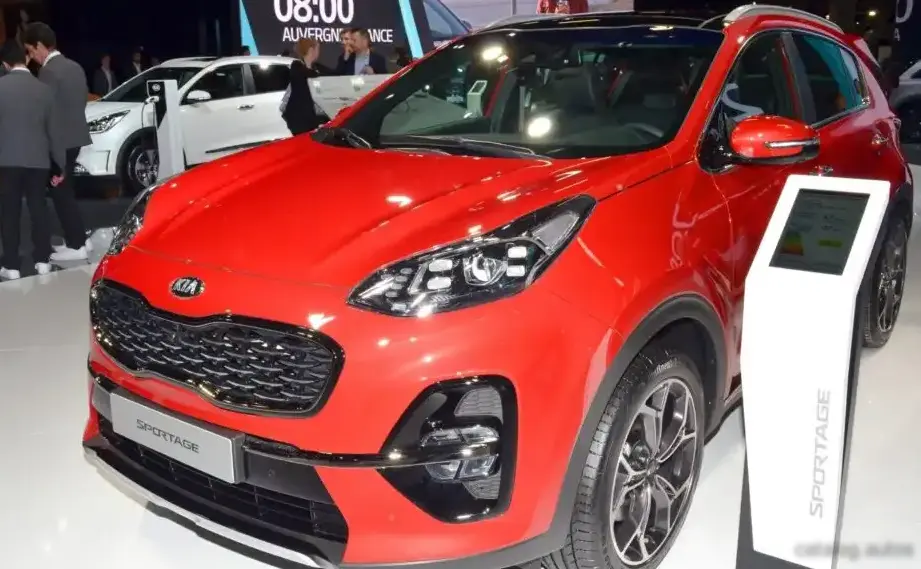
The Kia Sportage IV, specifically the 1.6 CRDi variant producing 136 horsepower, was a key offering in the compact SUV segment during its production run from July 2018 to July 2021. This facelifted version of the fourth-generation Sportage (QL) aimed to refine the model’s appeal with updated styling, improved technology, and a focus on fuel efficiency. Positioned as a mid-range option within the Sportage lineup, the 1.6 CRDi offered a balance between affordability, practicality, and reasonable performance, targeting buyers seeking a versatile family vehicle. It was primarily sold in the European market, where diesel engines remained popular due to favorable taxation and fuel economy.
Technical Specifications
| Brand | Kia |
| Model | Sportage |
| Generation | Sportage IV (facelift 2018) |
| Type (Engine) | 1.6 CRDi (136 Hp) |
| Start of production | July, 2018 |
| End of production | July, 2021 |
| Powertrain Architecture | Internal Combustion engine |
| Body type | SUV |
| Seats | 5 |
| Doors | 5 |
| Fuel consumption (urban) | 5.1-5.3 l/100 km (46.1 – 44.4 US mpg) |
| Fuel consumption (extra urban) | 4.6-4.8 l/100 km (51.1 – 49 US mpg) |
| Fuel consumption (combined) | 4.8-5.0 l/100 km (49 – 47 US mpg) |
| CO2 emissions | 126-132 g/km |
| Fuel Type | Diesel |
| Acceleration 0 – 100 km/h | 11.2 sec |
| Acceleration 0 – 62 mph | 11.2 sec |
| Acceleration 0 – 60 mph | 10.6 sec |
| Maximum speed | 180 km/h (111.85 mph) |
| Emission standard | Euro 6d – TEMP |
| Weight-to-power ratio | 11 kg/Hp, 90.6 Hp/tonne |
| Weight-to-torque ratio | 4.7 kg/Nm, 213.2 Nm/tonne |
| Power | 136 Hp @ 4000 rpm |
| Torque | 320 Nm @ 2000-2250 rpm (236.02 lb.-ft. @ 2000-2250 rpm) |
| Engine layout | Front, Transverse |
| Engine Model/Code | D4FE |
| Engine displacement | 1598 cm3 (97.52 cu. in.) |
| Number of cylinders | 4 |
| Engine configuration | Inline |
| Cylinder Bore | 77 mm (3.03 in.) |
| Piston Stroke | 85.8 mm (3.38 in.) |
| Compression ratio | 16:1 |
| Number of valves per cylinder | 4 |
| Fuel injection system | Diesel Commonrail |
| Engine aspiration | Turbocharger, Intercooler |
| Engine oil capacity | 4.4 l (4.65 US qt | 3.87 UK qt) |
| Coolant | 6.8 l (7.19 US qt | 5.98 UK qt) |
| Kerb Weight | 1501-1658 kg (3309.14 – 3655.26 lbs.) |
| Max. weight | 2120 kg (4673.8 lbs.) |
| Max load | 462-619 kg (1018.54 – 1364.66 lbs.) |
| Trunk (boot) space – minimum | 480 l (16.95 cu. ft.) |
| Trunk (boot) space – maximum | 1469 l (51.88 cu. ft.) |
| Fuel tank capacity | 62 l (16.38 US gal | 13.64 UK gal) |
| Max. roof load | 100 kg (220.46 lbs.) |
| Permitted trailer load with brakes (12%) | 1400 kg (3086.47 lbs.) |
| Permitted trailer load without brakes | 750 kg (1653.47 lbs.) |
| Permitted towbar download | 100 kg (220.46 lbs.) |
| Length | 4485 mm (176.57 in.) |
| Width | 1855 mm (73.03 in.) |
| Height | 1635-1645 mm (64.37 – 64.76 in.) |
| Wheelbase | 2670 mm (105.12 in.) |
| Front track | 1613-1625 mm (63.5 – 63.98 in.) |
| Rear (Back) track | 1625-1636 mm (63.98 – 64.41 in.) |
| Front overhang | 905 mm (35.63 in.) |
| Rear overhang | 910 mm (35.83 in.) |
| Ride height (ground clearance) | 172 mm (6.77 in.) |
| Minimum turning circle (turning diameter) | 11.0 m (36.09 ft.) |
| Approach angle | 16.8° |
| Departure angle | 26.1° |
| Ramp-over (brakeover) angle | 17.3° |
| Drivetrain Architecture | The Internal combustion engine (ICE) drives the front wheels of the vehicle. |
| Drive wheel | Front wheel drive |
| Number of gears and type of gearbox | 6 gears, manual transmission |
| Front suspension | Independent, type McPherson with coil spring and anti-roll bar |
| Rear suspension | Independent multi-link suspension |
| Front brakes | Ventilated discs |
| Rear brakes | Disc |
| Assisting systems | ABS (Anti-lock braking system) |
| Steering type | Steering rack and pinion |
| Power steering | Electric Steering |
| Tires size | 215/70 R16; 225/60 R17 |
| Wheel rims size | 6.5J x 16; 7.0J x 17 |
Powertrain & Engine Architecture
The heart of this Sportage variant is the D4FE 1.6-liter four-cylinder diesel engine. This engine utilizes a common-rail direct injection system, delivering fuel at extremely high pressure for optimized combustion. A turbocharger with an intercooler is employed to boost power output and improve torque across a wider rev range. The engine produces 136 horsepower at 4,000 rpm and a respectable 320 Nm (236 lb-ft) of torque between 2,000 and 2,250 rpm. The engine features a cast iron block and aluminum cylinder head, contributing to its durability. The 6-speed manual transmission was standard, offering a relatively conventional gear ratio spread designed for fuel efficiency rather than outright performance.
Driving Characteristics
The 1.6 CRDi with the manual transmission provided adequate, though not exhilarating, performance. Acceleration from 0 to 60 mph took around 10.6 seconds, making it suitable for everyday driving and highway cruising. The engine’s torque delivery was its strong suit, providing sufficient pulling power for overtaking maneuvers and navigating hilly terrain. Compared to the more powerful 1.6 T-GDi gasoline engine or the 2.0 CRDi diesel, the 1.6 CRDi felt less responsive, particularly at higher engine speeds. The manual gearbox was generally smooth, but the shift linkage wasn’t particularly sporty. The focus was clearly on providing a comfortable and economical driving experience.
Equipment & Trim Levels
The 1.6 CRDi typically came equipped with a reasonable level of standard features. These included air conditioning, a touchscreen infotainment system with Bluetooth connectivity, alloy wheels, and basic safety equipment like ABS, ESC (Electronic Stability Control), and multiple airbags. Higher trim levels added features such as a reversing camera, parking sensors, heated seats, and a panoramic sunroof. Interior upholstery was typically cloth, with options for leather upgrades. The dashboard layout was functional and user-friendly, though not particularly luxurious.
Chassis & Braking
The Sportage IV utilized a McPherson strut front suspension and a multi-link rear suspension, providing a comfortable ride quality. The suspension was tuned for compliance rather than sporty handling. Front brakes were ventilated discs, while rear brakes were solid discs. The steering was electrically assisted, offering light and precise control. The 1.6 CRDi models generally featured smaller wheels and tires (typically 215/70 R16 or 225/60 R17) compared to higher-spec variants, contributing to a slightly softer ride.
Market Reception & Comparison
The 1.6 CRDi Sportage was generally well-received by critics as a practical and fuel-efficient SUV. It offered a good balance of features and affordability, making it a popular choice for families. However, some reviewers noted that the engine lacked the refinement and performance of its competitors. Compared to the 1.6 T-GDi gasoline version, the diesel offered superior fuel economy but less overall power. The 2.0 CRDi diesel provided significantly more performance but came at a higher price point. Fuel economy figures were competitive, with combined cycle consumption ranging from 4.8 to 5.0 l/100 km (49-47 US mpg).
Legacy
The D4FE 1.6 CRDi engine has proven to be relatively reliable, although, like all diesel engines, it requires regular maintenance, including oil changes and diesel particulate filter (DPF) regeneration. Used examples of the 1.6 CRDi Sportage are readily available on the market and generally represent good value for money. The engine’s fuel efficiency and practicality continue to appeal to buyers seeking a cost-effective and versatile SUV. While not the most exciting option in the Sportage lineup, the 1.6 CRDi remains a solid and dependable choice for everyday transportation.