
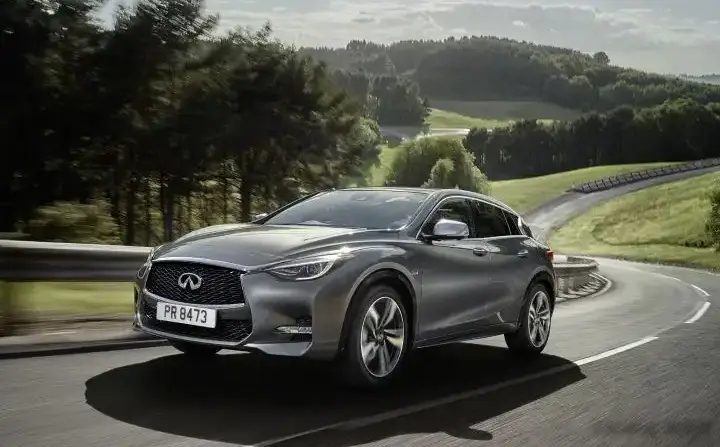
The Infiniti Q30 1.5 CDI, produced from December 2015 to February 2018, represents an entry-level offering within the Q30 range. Positioned as a compact crossover/hatchback, the Q30 was Infiniti’s attempt to capture a segment of the premium market dominated by European brands. Built upon the Mercedes-Benz MFA platform (shared with the A-Class and GLA), the Q30 aimed to blend practicality with a distinctive Infiniti design language. The 1.5 CDI variant, powered by a Renault-sourced diesel engine, was primarily targeted at European markets where diesel fuel was prevalent and fuel economy was a key purchasing factor. This model served as the most affordable gateway into the Q30 lineup.
Technical Specifications
| Brand | Infiniti |
| Model | Q30 |
| Generation | Q30 |
| Type (Engine) | 1.5 CDI (109 Hp) |
| Start of production | December, 2015 |
| End of production | February, 2018 |
| Powertrain Architecture | Internal Combustion engine |
| Body type | Hatchback, Crossover |
| Seats | 5 |
| Doors | 5 |
| Fuel consumption (urban) | 4.5-4.8 l/100 km (52.3 – 49 US mpg) |
| Fuel consumption (extra urban) | 3.6-3.8 l/100 km (65.3 – 61.9 US mpg) |
| Fuel consumption (combined) | 3.9-4.2 l/100 km (60.3 – 56 US mpg) |
| CO2 emissions | 103-109 g/km |
| Fuel Type | Diesel |
| Acceleration 0 – 100 km/h | 12 sec |
| Acceleration 0 – 62 mph | 12 sec |
| Acceleration 0 – 60 mph | 11.4 sec |
| Maximum speed | 190 km/h (118.06 mph) |
| Emission standard | Euro 6 |
| Weight-to-power ratio | 12.5 kg/Hp |
| Weight-to-torque ratio | 5.2 kg/Nm |
| Power | 109 Hp @ 4000 rpm |
| Torque | 260 Nm @ 1750-2500 rpm (191.77 lb.-ft.) |
| Engine layout | Front, Transverse |
| Engine Model/Code | K9K 480 |
| Engine displacement | 1461 cm3 (89.16 cu. in.) |
| Number of cylinders | 4 |
| Engine configuration | Inline |
| Fuel injection system | Diesel Commonrail |
| Engine aspiration | Turbocharger, Intercooler |
| Valvetrain | OHC |
| Engine oil capacity | 4.5 l (4.76 US qt | 3.96 UK qt) |
| Coolant capacity | 6.3 l (6.66 US qt | 5.54 UK qt) |
| Kerb Weight | 1359-1397 kg (2996.08 – 3079.86 lbs.) |
| Max. weight | 1960 kg (4321.06 lbs.) |
| Max load | 563-601 kg (1241.2 – 1324.98 lbs.) |
| Trunk (boot) space – minimum | 430 l (15.19 cu. ft.) |
| Fuel tank capacity | 50 l (13.21 US gal | 11 UK gal) |
| Permitted trailer load with brakes (12%) | 1200 kg (2645.55 lbs.) |
| Permitted trailer load without brakes | 720 kg (1587.33 lbs.) |
| Length | 4425 mm (174.21 in.) |
| Width | 1805 mm (71.06 in.) |
| Height | 1495 mm (58.86 in.) |
| Wheelbase | 2700 mm (106.3 in.) |
| Front track | 1572 mm (61.89 in.) |
| Rear track | 1573 mm (61.93 in.) |
| Drag coefficient (Cd) | 0.30-0.32 |
| Minimum turning circle | 11.4 m (37.4 ft.) |
| Drivetrain Architecture | Front wheel drive |
| Number of gears | 6 gears, manual transmission |
| Front suspension | Independent type McPherson |
| Rear suspension | Independent multi-link suspension |
| Front brakes | Ventilated discs |
| Rear brakes | Disc |
| Assisting systems | ABS (Anti-lock braking system) |
| Steering type | Steering rack and pinion |
| Power steering | Electric Steering |
| Tires size | 215/60 R17; 235/50 R18; 235/45 R19 |
| Wheel rims size | 17; 18; 19 |
INTRODUCTION
The Infiniti Q30 1.5 CDI, launched in late 2015, was a key component of Infiniti’s expansion into the compact premium segment. Sharing its underpinnings with the Mercedes-Benz A-Class and GLA, the Q30 aimed to offer a more expressive and individualistic alternative. The 1.5 CDI variant, utilizing a Renault-sourced diesel engine, was specifically tailored for European markets, capitalizing on the demand for fuel-efficient vehicles. It represented the entry point to the Q30 range, offering a balance of affordability and premium features. Production continued until February 2018, after which the model was discontinued.
Powertrain & Engine Architecture
At the heart of the Q30 1.5 CDI lies the K9K 480 engine, a 1.5-liter inline-four cylinder diesel engine developed by Renault. This engine is a common rail direct injection (CRDI) unit, utilizing piezo injectors for precise fuel delivery. The engine features a single turbocharger with an intercooler to enhance performance and efficiency. The overhead camshaft (OHC) valvetrain operates four valves per cylinder. The engine produces 109 horsepower at 4000 rpm and 260 Nm (191.77 lb-ft) of torque between 1750 and 2500 rpm. The Q30 1.5 CDI was exclusively offered with a six-speed manual transmission, directing power to the front wheels. This transmission was chosen to maximize fuel economy and provide a more engaging driving experience compared to an automatic option.
Driving Characteristics
The Q30 1.5 CDI, with its 109 hp and manual transmission, offered a practical and economical driving experience. Acceleration from 0-60 mph took approximately 11.4 seconds, and top speed was limited to 190 km/h (118 mph). While not particularly sporty, the engine provided adequate power for everyday driving situations. The turbocharger helped to deliver a usable amount of torque at low engine speeds, making it easy to navigate city traffic. Compared to the more powerful 2.0t gasoline variants, the 1.5 CDI prioritized fuel efficiency over outright performance. The six-speed manual transmission offered precise shifts, but the gear ratios were tuned for economy rather than spirited driving. The relatively low power output meant that the engine needed to be revved to maintain speed on inclines or during overtaking maneuvers.
Equipment & Trim Levels
The Q30 1.5 CDI typically came equipped with a reasonable level of standard features. These included automatic climate control, a 7-inch touchscreen infotainment system, Bluetooth connectivity, and alloy wheels. Safety features such as ABS, electronic stability control, and multiple airbags were also standard. Higher trim levels, such as the ‘Luxury’ or ‘Sport’ variants, added features like leather upholstery, heated front seats, a panoramic sunroof, and parking sensors. Optional extras included a navigation system, premium audio system, and various styling enhancements. The interior design was generally well-appointed, reflecting Infiniti’s focus on creating a premium cabin environment.
Chassis & Braking
The Q30 1.5 CDI utilized a McPherson strut front suspension and a multi-link rear suspension, providing a comfortable and controlled ride. The suspension was tuned to prioritize comfort over sporty handling. The front brakes were ventilated discs, while the rear brakes were solid discs. ABS (Anti-lock Braking System) was standard, enhancing braking performance and stability. The Q30’s chassis was designed to provide a balance between ride comfort and handling precision. The steering was electrically assisted, offering a light and responsive feel. The weight distribution was relatively balanced, contributing to predictable handling characteristics.
Market Reception & Comparison
The Infiniti Q30 1.5 CDI was generally well-received by automotive critics, particularly for its stylish design and comfortable interior. However, some reviewers noted that the 1.5 diesel engine lacked the refinement and performance of its competitors. Fuel economy was a strong point, with the Q30 1.5 CDI achieving combined fuel consumption figures of 3.9-4.2 l/100 km. Compared to the more powerful Q30 2.0t models, the 1.5 CDI offered significantly better fuel economy but at the expense of performance. Against rivals like the Audi A3, BMW 1 Series, and Mercedes-Benz A-Class, the Q30 1.5 CDI offered a distinctive alternative, but its relatively limited engine range and brand recognition hindered its sales success.
Legacy
The Infiniti Q30, including the 1.5 CDI variant, ultimately failed to achieve significant sales volume. While the K9K diesel engine is known for its durability and reliability, the Q30 itself suffered from a lack of brand awareness and a relatively limited dealer network. On the used car market, the Q30 1.5 CDI represents an affordable entry point into the premium compact segment. Potential buyers should be aware of the potential for diesel particulate filter (DPF) issues, particularly if the vehicle has been primarily used for short journeys. Overall, the Q30 1.5 CDI remains a reasonably reliable and economical vehicle, offering a unique blend of style and practicality.
