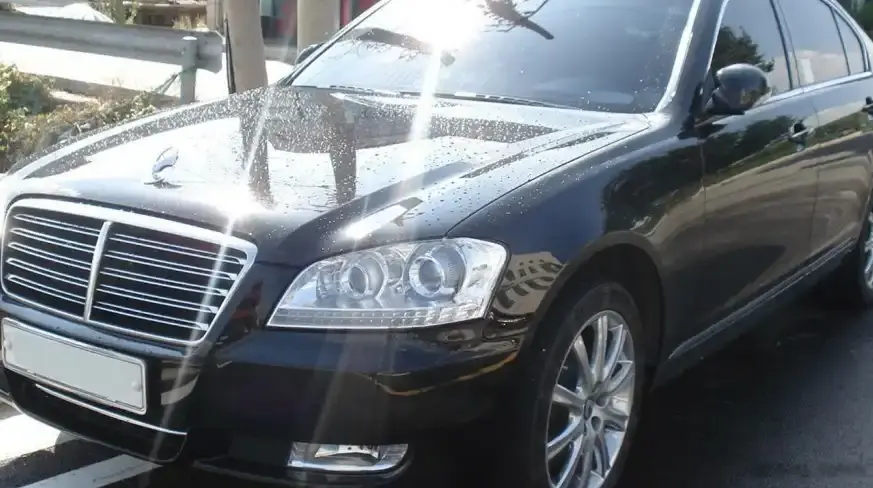
The SsangYong Chairman W (facelift 2011) 3.2, a full-size luxury sedan, represents a significant evolution of SsangYong’s flagship model. Produced from 2011 to 2017, this iteration of the Chairman, known internally as the W variant, aimed to elevate the brand’s image with enhanced styling, improved technology, and a more refined driving experience. Positioned as the top-tier engine option within the Chairman W lineup, the 3.2-liter model with the T-tronic automatic transmission and four-wheel drive offered a blend of performance and luxury intended to compete with established European and Japanese rivals, primarily within the South Korean domestic market. While never achieving significant sales volume in North America, the Chairman W represents SsangYong’s ambition to create a world-class luxury vehicle.
Technical Specifications
| Brand | SsangYong |
| Model | Chairman |
| Generation | Chairman W (facelift 2011) |
| Type | 3.2 (224 Hp) 4WD T-tronic |
| Start of production | 2011 |
| End of production | 2017 |
| Powertrain Architecture | Internal Combustion engine |
| Body type | Sedan |
| Seats | 5 |
| Doors | 4 |
| Fuel consumption (urban) | 14.3 l/100 km (16.4 US mpg, 19.8 UK mpg, 7 km/l) |
| Fuel consumption (extra urban) | 10.1 l/100 km (23.3 US mpg, 28 UK mpg, 9.9 km/l) |
| Fuel consumption (combined) | 12.3 l/100 km (19.1 US mpg, 23 UK mpg, 8.1 km/l) |
| Fuel Type | Petrol (Gasoline) |
| Maximum speed | 205 km/h (127.38 mph) |
| Weight-to-power ratio | 8.7 kg/Hp, 115 Hp/tonne |
| Weight-to-torque ratio | 6.6 kg/Nm, 152 Nm/tonne |
| Power | 224 Hp @ 6600 rpm |
| Power per litre | 70 Hp/l |
| Torque | 296 Nm @ 4600 rpm (218.32 lb.-ft. @ 4600 rpm) |
| Engine layout | Front, Longitudinal |
| Engine Model/Code | G32D |
| Engine displacement | 3199 cm3 (195.21 cu. in.) |
| Number of cylinders | 6 |
| Engine configuration | Inline |
| Cylinder Bore | 89.9 mm (3.54 in.) |
| Piston Stroke | 84 mm (3.31 in.) |
| Compression ratio | 10:1 |
| Number of valves per cylinder | 4 |
| Fuel injection system | Multi-port manifold injection |
| Engine aspiration | Naturally aspirated engine |
| Engine oil capacity | 7 l (7.4 US qt | 6.16 UK qt) |
| Coolant capacity | 11.5 l (12.15 US qt | 10.12 UK qt) |
| Kerb Weight | 1948 kg (4294.6 lbs.) |
| Max. weight | 2490 kg (5489.51 lbs.) |
| Max load | 542 kg (1194.91 lbs.) |
| Fuel tank capacity | 83 l (21.93 US gal | 18.26 UK gal) |
| Length | 5135 mm (202.17 in.) |
| Width | 1895 mm (74.61 in.) |
| Height | 1495 mm (58.86 in.) |
| Wheelbase | 2970 mm (116.93 in.) |
| Front track | 1600 mm (62.99 in.) |
| Rear track | 1590 mm (62.6 in.) |
| Front overhang | 945 mm (37.2 in.) |
| Rear overhang | 1220 mm (48.03 in.) |
| Ride height (ground clearance) | 175 mm (6.89 in.) |
| Minimum turning circle | 11.2 m (36.75 ft.) |
| Drive wheel | All wheel drive (4×4) |
| Number of gears | 7 |
| Gearbox type | Automatic transmission T-tronic |
| Front suspension | Independent multi-link suspension |
| Rear suspension | Independent multi-link suspension |
| Front brakes | Ventilated discs |
| Rear brakes | Ventilated discs |
| Assisting systems | ABS (Anti-lock braking system) |
| Steering type | Steering rack and pinion |
| Power steering | Electric Steering |
| Tires size | 245/45 R19 |
| Wheel rims size | 19 |
INTRODUCTION
The SsangYong Chairman W (facelift 2011) 3.2 4WD T-tronic represents the pinnacle of SsangYong’s sedan offerings during its production run. Built on the platform initially developed with Mercedes-Benz influence (the 1HX0/A3 platform), the Chairman W aimed to provide a luxurious and technologically advanced alternative to more established brands. The 2011 facelift brought revised styling, including a new front grille, headlights, and interior refinements. The 3.2-liter engine, paired with the T-tronic seven-speed automatic transmission and a full-time four-wheel-drive system, was the range-topping configuration, offering the highest level of performance and all-weather capability. This variant was primarily targeted at discerning Korean buyers seeking a spacious, well-equipped, and domestically produced luxury vehicle.
Powertrain & Engine Architecture
The heart of the Chairman W 3.2 is the G32D engine, a 3.2-liter inline-six cylinder gasoline engine. This engine utilizes a naturally aspirated configuration and multi-port fuel injection, delivering a balance of power and refinement. The engine’s architecture is relatively conventional, featuring a single overhead camshaft (SOHC) design with four valves per cylinder. The T-tronic seven-speed automatic transmission, sourced from a collaboration with a European supplier, provides smooth and responsive gear changes. The four-wheel-drive system is a full-time setup, employing a viscous coupling to distribute torque between the front and rear axles, enhancing traction in various driving conditions. The engine produces 224 horsepower at 6600 rpm and 296 Nm (218.32 lb-ft) of torque at 4600 rpm. While not a cutting-edge design by modern standards, the G32D engine proved to be reasonably durable and reliable.
Driving Characteristics
The Chairman W 3.2 Automatic delivers a comfortable and composed driving experience. The T-tronic transmission is well-tuned for smooth shifts, although it isn’t particularly sporty or quick to respond to aggressive throttle inputs. The 3.2-liter engine provides adequate power for effortless cruising and overtaking, but it doesn’t offer the exhilarating acceleration of some competitors. The four-wheel-drive system provides enhanced stability and traction, particularly on slippery surfaces. Compared to the lower-displacement engines offered in the Chairman W lineup (such as the 2.0-liter), the 3.2-liter variant offers significantly more power and torque, resulting in a more relaxed and confident driving experience. However, it lacks the fuel efficiency of the smaller engines and doesn’t provide the engaging driving dynamics of a rear-wheel-drive luxury sedan.
Equipment & Trim Levels
The Chairman W 3.2 4WD T-tronic came generously equipped, reflecting its position as the flagship model. Standard features typically included leather upholstery, power-adjustable front seats with heating and ventilation, a premium audio system, automatic climate control, and a sunroof. Higher trim levels offered additional features such as a navigation system, rear-seat entertainment, and advanced safety systems like lane departure warning and adaptive cruise control. Interior materials were generally of good quality, although they didn’t quite match the standards of some European luxury brands. The spacious cabin provided ample legroom and headroom for both front and rear passengers.
Chassis & Braking
The Chairman W utilizes an independent multi-link suspension system at both the front and rear, providing a comfortable ride quality. The suspension is tuned for smoothness rather than outright handling prowess. The braking system consists of ventilated discs on all four wheels, providing adequate stopping power. Anti-lock braking system (ABS) is standard. The steering is electrically assisted, offering light and precise control. The chassis is robust and well-built, providing a solid and stable platform for the vehicle. Stabilizer bars are fitted to both the front and rear axles to reduce body roll during cornering.
Market Reception & Comparison
The SsangYong Chairman W 3.2 received mixed reviews from automotive critics. While praised for its spacious interior, comfortable ride, and generous equipment levels, it was often criticized for its somewhat dated design, lack of brand recognition, and relatively uninspiring driving dynamics. Compared to its rivals, such as the Hyundai Equus and Kia K9, the Chairman W offered a competitive value proposition but lacked the prestige and refinement of established luxury brands. Fuel economy was also a concern, with the 3.2-liter engine consuming a significant amount of fuel, especially in urban driving conditions. Reliability was generally considered to be average, with some reports of minor electrical issues.
Legacy
The SsangYong Chairman W 3.2, while not a commercial success on a global scale, remains a significant vehicle in SsangYong’s history. It represents the company’s ambition to compete in the luxury car segment and showcases its engineering capabilities. On the used car market, the Chairman W 3.2 is relatively affordable, making it an attractive option for buyers seeking a spacious and well-equipped luxury sedan at a reasonable price. The G32D engine, while not particularly fuel-efficient, has proven to be reasonably durable, and parts availability is generally good. However, potential buyers should be aware of the potential for minor electrical issues and the relatively high maintenance costs associated with a luxury vehicle.