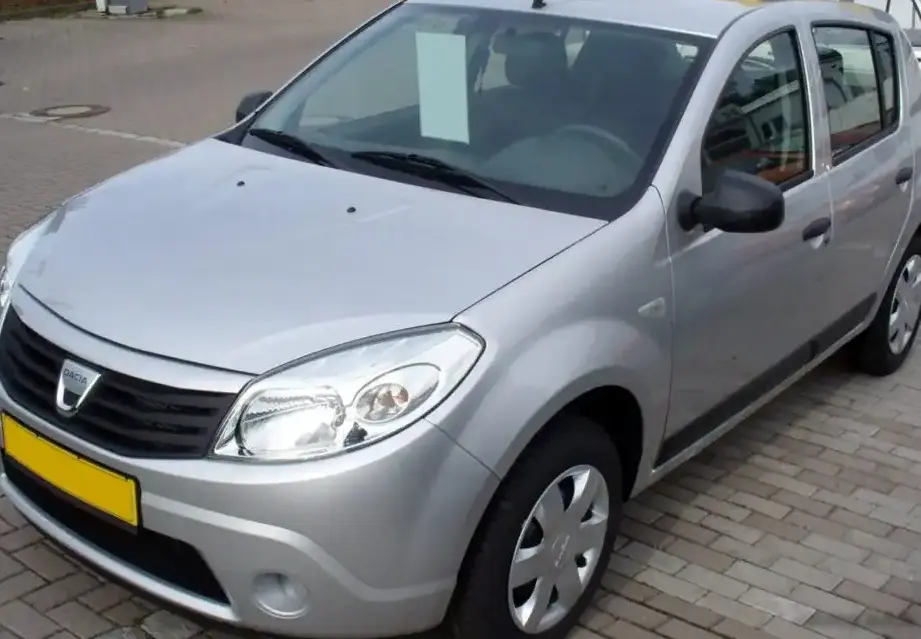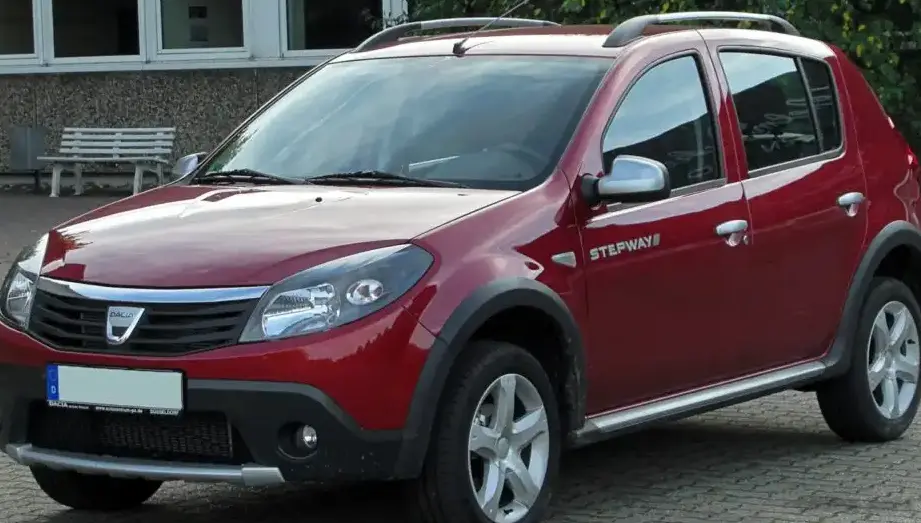
The Dacia Sandero I Stepway 1.6 8V (84 hp) was a crossover variant of the first-generation Dacia Sandero, produced between 2010 and 2012. Positioned as a more rugged and visually distinct version of the standard Sandero, the Stepway aimed to appeal to buyers seeking a vehicle with increased ground clearance and a more adventurous aesthetic. It represented an early foray by Dacia into the burgeoning small crossover segment, offering an affordable and practical option in European markets. This particular 1.6 8V engine and five-speed manual transmission combination served as a core offering within the Stepway lineup, providing a balance between fuel economy and usability.
Technical Specifications
| Brand | Dacia |
| Model | Sandero |
| Generation | Sandero I Stepway |
| Type (Engine) | 1.6 8V (84 Hp) |
| Start of production | 2010 |
| End of production | 2012 |
| Powertrain Architecture | Internal Combustion engine |
| Body type | Crossover |
| Seats | 5 |
| Doors | 5 |
| Fuel consumption (urban) | 9.2 l/100 km (25.6 US mpg, 30.7 UK mpg, 10.9 km/l) |
| Fuel consumption (extra urban) | 5.6 l/100 km (42 US mpg, 50.4 UK mpg, 17.9 km/l) |
| Fuel consumption (combined) | 6.9 l/100 km (34.1 US mpg, 40.9 UK mpg, 14.5 km/l) |
| CO2 emissions | 160 g/km |
| Fuel Type | Petrol (Gasoline) |
| Acceleration 0 – 100 km/h | 13.5 sec |
| Acceleration 0 – 62 mph | 13.5 sec |
| Acceleration 0 – 60 mph | 12.8 sec |
| Maximum speed | 160 km/h (99.42 mph) |
| Emission standard | Euro 5 |
| Weight-to-power ratio | 12.6 kg/Hp, 79.1 Hp/tonne |
| Weight-to-torque ratio | 7.9 kg/Nm, 127.1 Nm/tonne |
| Power | 84 Hp @ 5250 rpm |
| Power per litre | 52.6 Hp/l |
| Torque | 135 Nm @ 3000 rpm (99.57 lb.-ft. @ 3000 rpm) |
| Engine layout | Front, Transverse |
| Engine Model/Code | K7M 800 |
| Engine displacement | 1598 cm3 (97.52 cu. in.) |
| Number of cylinders | 4 |
| Engine configuration | Inline |
| Cylinder Bore | 79.5 mm (3.13 in.) |
| Piston Stroke | 80.5 mm (3.17 in.) |
| Compression ratio | 9.5:1 |
| Number of valves per cylinder | 2 |
| Fuel injection system | Multi-port manifold injection |
| Engine aspiration | Naturally aspirated engine |
| Valvetrain | SOHC |
| Engine oil capacity | 3.3 l (3.49 US qt | 2.9 UK qt) |
| Coolant capacity | 4.5 l (4.76 US qt | 3.96 UK qt) |
| Kerb Weight | 1062 kg (2341.31 lbs.) |
| Max. weight | 1561 kg (3441.42 lbs.) |
| Max load | 499 kg (1100.11 lbs.) |
| Trunk (boot) space – minimum | 320 l (11.3 cu. ft.) |
| Trunk (boot) space – maximum | 1200 l (42.38 cu. ft.) |
| Fuel tank capacity | 50 l (13.21 US gal | 11 UK gal) |
| Max. roof load | 80 kg (176.37 lbs.) |
| Permitted trailer load with brakes (12%) | 1100 kg (2425.08 lbs.) |
| Permitted trailer load without brakes | 565 kg (1245.61 lbs.) |
| Permitted towbar download | 60 kg (132.28 lbs.) |
| Length | 4024 mm (158.43 in.) |
| Width | 1753 mm (69.02 in.) |
| Width including mirrors | 1997 mm (78.62 in.) |
| Height | 1584 mm (62.36 in.) |
| Wheelbase | 2588 mm (101.89 in.) |
| Front track | 1494 mm (58.82 in.) |
| Rear track | 1483 mm (58.39 in.) |
| Front overhang | 785 mm (30.91 in.) |
| Rear overhang | 651 mm (25.63 in.) |
| Ride height (ground clearance) | 175 mm (6.89 in.) |
| Drag coefficient (Cd) | 0.36 |
| Minimum turning circle | 10.5 m (34.45 ft.) |
| Drivetrain Architecture | The Internal combustion engine (ICE) drives the front wheels of the vehicle. |
| Drive wheel | Front wheel drive |
| Number of gears and type of gearbox | 5 gears, manual transmission |
| Front suspension | Independent type McPherson, Transverse stabilizer |
| Rear suspension | Coil spring, Torsion |
| Front brakes | Ventilated discs, 259×20.6 mm |
| Rear brakes | Drum, 203 mm |
| Assisting systems | ABS (Anti-lock braking system) |
| Steering type | Steering rack and pinion |
| Power steering | Hydraulic Steering |
| Tires size | 195/55 R16 |
| Wheel rims size | 6.5J x 16 |
Powertrain & Engine Architecture
The Dacia Sandero I Stepway 1.6 8V utilized the K7M 800 engine, a 1.6-liter inline-four cylinder petrol engine. This engine was a mainstay in Renault and Dacia vehicles for many years, known for its simplicity and robustness. The ‘8V’ designation indicates an eight-valve cylinder head (two valves per cylinder), employing a single overhead camshaft (SOHC) valvetrain. Fuel delivery was managed by a multi-point fuel injection system. The engine produced 84 horsepower at 5250 rpm and 135 Nm (99.57 lb-ft) of torque at 3000 rpm. The engine’s design prioritized reliability and low-end torque over outright performance. The Stepway was equipped with a five-speed manual transmission, delivering power to the front wheels.
Driving Characteristics
The 1.6 8V engine in the Stepway provided adequate, but not exhilarating, performance. Acceleration from 0-60 mph took approximately 12.8 seconds, and the top speed was around 99.42 mph. The engine felt most comfortable in the mid-range, offering sufficient power for everyday driving and occasional highway use. The five-speed manual transmission was well-matched to the engine’s characteristics, allowing drivers to keep the engine in its optimal power band. Compared to potential higher-output versions (which weren’t offered on the Stepway), this configuration prioritized fuel efficiency and ease of driving over sporty performance. The Stepway’s increased ride height, compared to the standard Sandero, did introduce a slightly higher center of gravity, impacting cornering dynamics, but also provided better visibility and the ability to navigate rougher terrain.
Equipment & Trim Levels
The Stepway trim level added several features over the base Sandero. Standard equipment typically included body-colored bumpers, side moldings, and door handles, along with roof rails and increased ground clearance. Inside, the Stepway featured upgraded upholstery, often with a unique pattern, and sometimes included air conditioning, power steering, and an upgraded audio system. Optional extras could include alloy wheels, electric windows, and a trip computer. The Stepway was positioned as a mid-range offering within the Sandero lineup, bridging the gap between the basic entry-level models and any potential higher-specification variants.
Chassis & Braking
The Sandero I Stepway utilized a McPherson strut front suspension and a torsion beam rear suspension. The front suspension incorporated a transverse stabilizer bar to reduce body roll. Braking duties were handled by ventilated discs at the front and drum brakes at the rear. The Stepway’s suspension was tuned to provide a comfortable ride, absorbing bumps and imperfections in the road surface. The braking system, while adequate for the vehicle’s weight and performance, wasn’t particularly powerful. ABS (Anti-lock Braking System) was standard, enhancing safety during emergency braking situations.
Market Reception & Comparison
The Dacia Sandero I Stepway 1.6 8V was generally well-received by critics and consumers alike. It was praised for its affordability, practicality, and rugged styling. Fuel economy was a strong point, with combined fuel consumption figures around 34.1 US mpg. Compared to other small crossovers available at the time, the Stepway offered a compelling value proposition. While its performance wasn’t class-leading, it was sufficient for most drivers. Reliability was also a key strength, thanks to the proven K7M engine and relatively simple mechanical design. Some reviewers noted the interior materials were basic, but acceptable given the vehicle’s price point.
Legacy
The Dacia Sandero I Stepway 1.6 8V has proven to be a reliable and durable vehicle. The K7M engine is known for its longevity, and with proper maintenance, can withstand high mileage. In the used car market, these Stepways remain relatively affordable and are often sought after by buyers looking for a practical and economical crossover. While not a performance icon, the Stepway played a significant role in establishing Dacia as a major player in the European automotive market, demonstrating that a budget-friendly vehicle could still offer style, practicality, and reliability.