
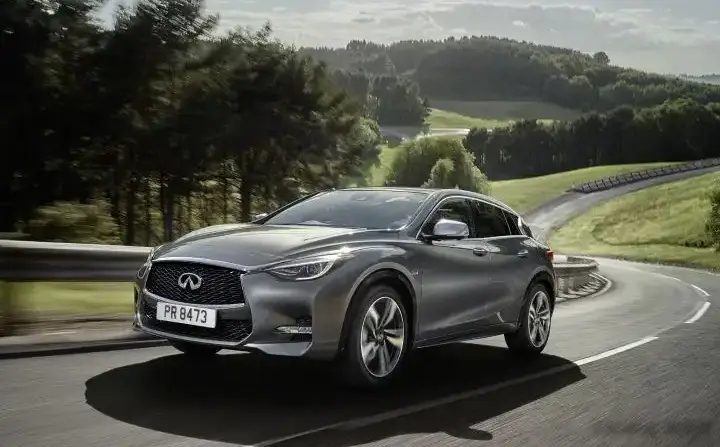
The Infiniti Q30 1.6, producing 156 horsepower with a dual-clutch transmission (DCT), was a key variant in Infiniti’s entry into the premium compact segment. Introduced in December 2015 and produced through 2018, the Q30 aimed to blend the practicality of a hatchback with the elevated styling and features expected of a luxury crossover. Positioned as a more accessible option within the Q30 lineup, the 1.6 DCT model served as the gateway to the brand, offering a balance of efficiency and performance. It was built upon the Mercedes-Benz MFA platform (shared with the A-Class and GLA), reflecting Infiniti’s then-technical partnership with Daimler AG.
Technical Specifications
| Brand | Infiniti |
| Model | Q30 |
| Generation | Q30 |
| Type (Engine) | 1.6 (156 Hp) DCT |
| Start of production | December, 2015 |
| End of production | 2018 |
| Powertrain Architecture | Internal Combustion engine |
| Body type | Hatchback, Crossover |
| Seats | 5 |
| Doors | 5 |
| Fuel consumption (urban) | 7.5 l/100 km (31.4 US mpg) |
| Fuel consumption (extra urban) | 4.9-5.1 l/100 km (48 – 46.1 US mpg) |
| Fuel consumption (combined) | 5.8-5.9 l/100 km (40.6 – 39.9 US mpg) |
| CO2 emissions | 134-136 g/km |
| Fuel Type | Petrol (Gasoline) |
| Acceleration 0 – 100 km/h | 8.9 sec |
| Acceleration 0 – 62 mph | 8.9 sec |
| Acceleration 0 – 60 mph | 8.5 sec |
| Maximum speed | 215 km/h (133.59 mph) |
| Emission standard | Euro 6 |
| Weight-to-power ratio | 8.9 kg/Hp |
| Weight-to-torque ratio | 5.6 kg/Nm |
| Power | 156 Hp @ 5300 rpm |
| Torque | 250 Nm @ 1250-4000 rpm (184.39 lb.-ft. @ 1250-4000 rpm) |
| Engine layout | Front, Transverse |
| Engine Model/Code | M 270.910 |
| Engine displacement | 1595 cm3 (97.33 cu. in.) |
| Number of cylinders | 4 |
| Engine configuration | Inline |
| Fuel injection system | Direct injection |
| Engine aspiration | Turbocharger, Intercooler |
| Valvetrain | DOHC |
| Engine oil capacity | 5.8 l (6.13 US qt | 5.1 UK qt) |
| Coolant | 7.6 l (8.03 US qt | 6.69 UK qt) |
| Kerb Weight | 1395-1402 kg (3075.45 – 3090.88 lbs.) |
| Max. weight | 1920 kg (4232.88 lbs.) |
| Max load | 518-525 kg (1141.99 – 1157.43 lbs.) |
| Trunk (boot) space – minimum | 430 l (15.19 cu. ft.) |
| Fuel tank capacity | 50 l (13.21 US gal | 11 UK gal) |
| Permitted trailer load with brakes (12%) | 1400 kg (3086.47 lbs.) |
| Permitted trailer load without brakes | 700 kg (1543.24 lbs.) |
| Length | 4425 mm (174.21 in.) |
| Width | 1805 mm (71.06 in.) |
| Height | 1495 mm (58.86 in.) |
| Wheelbase | 2700 mm (106.3 in.) |
| Front track | 1572 mm (61.89 in.) |
| Rear (Back) track | 1573 mm (61.93 in.) |
| Drag coefficient (Cd) | 0.31-0.32 |
| Minimum turning circle (turning diameter) | 11.4 m (37.4 ft.) |
| Drivetrain Architecture | Front wheel drive |
| Number of gears and type of gearbox | 7 gears, automatic transmission DCT |
| Front suspension | Independent type McPherson |
| Rear suspension | Independent multi-link suspension |
| Front brakes | Ventilated discs |
| Rear brakes | Disc |
| Assisting systems | ABS (Anti-lock braking system) |
| Steering type | Steering rack and pinion |
| Power steering | Electric Steering |
| Tires size | 235/50 R18; 235/45 R19 |
| Wheel rims size | 18; 19 |
Powertrain & Engine Architecture
The heart of the Q30 1.6 DCT is the Mercedes-Benz M 270.910 engine, a 1.6-liter turbocharged inline-four cylinder. This engine utilizes direct fuel injection and a twin-scroll turbocharger to deliver a responsive driving experience. The engine’s code signifies its origin within the Mercedes-Benz engine family. The M270 engine is known for its relatively compact size and efficient design. The dual-clutch transmission (DCT), a 7-speed unit, was sourced from Getrag. This DCT provides quick and smooth gear changes, contributing to both performance and fuel economy. The DCT operates with two separate clutches, one for odd-numbered gears and one for even-numbered gears, allowing for pre-selection of the next gear and minimizing interruption in power delivery. The valvetrain is a Double Overhead Camshaft (DOHC) configuration, optimizing valve control for improved engine breathing and efficiency.
Driving Characteristics
The Q30 1.6 DCT offered a comfortable and refined driving experience, prioritizing ease of use over outright performance. With 156 horsepower and 184 lb-ft of torque, acceleration from 0-60 mph took approximately 8.5 seconds. While not particularly quick, the turbocharger provided a noticeable boost in power at lower RPMs, making it suitable for everyday driving. The DCT transmission contributed to a smooth and responsive feel, although some drivers noted occasional hesitation at low speeds. Compared to the more powerful Q30 2.0t models, the 1.6 offered a more fuel-efficient and less aggressive driving experience. The gear ratios were tuned for fuel economy and comfortable cruising, rather than maximizing acceleration. The front-wheel-drive configuration provided predictable handling, but lacked the all-weather capability of the optional all-wheel-drive system available on other Q30 trims.
Equipment & Trim Levels
The Q30 1.6 DCT typically came standard with features such as automatic climate control, a 7-inch touchscreen infotainment system, Bluetooth connectivity, and a rearview camera. Interior upholstery was generally cloth, with leather options available as upgrades. Trim levels varied depending on the market, but generally included options for upgraded wheels, panoramic sunroofs, and premium audio systems. Safety features included multiple airbags, ABS, and electronic stability control. Optional packages often bundled together convenience and technology features, such as navigation, parking sensors, and adaptive cruise control.
Chassis & Braking
The Q30 1.6 DCT utilized an independent McPherson strut suspension in the front and an independent multi-link suspension in the rear, providing a comfortable ride quality. The suspension was tuned to prioritize comfort over sporty handling. Braking duties were handled by ventilated discs in the front and solid discs in the rear. ABS (Anti-lock Braking System) was standard, enhancing braking performance and stability. The electric power steering provided light and precise steering feel. Stabilizer bars were fitted to both the front and rear axles to reduce body roll during cornering.
Market Reception & Comparison
The Infiniti Q30 1.6 DCT was generally well-received by critics as a stylish and comfortable entry-level luxury crossover. However, some reviewers noted that the 1.6-liter engine felt underpowered compared to competitors. Fuel economy was a strong point, with combined figures ranging from 39.9 to 40.6 US mpg. Compared to the Q30 2.0t, the 1.6 offered a more affordable price point but sacrificed performance. The Q30 competed with vehicles such as the Audi A3, BMW 2 Series Active Tourer, and Mercedes-Benz GLA, offering a unique blend of style and practicality. Reliability reports were generally positive, with few major issues reported for the powertrain.
Legacy
The Infiniti Q30, including the 1.6 DCT variant, represented Infiniti’s attempt to gain a foothold in the competitive premium compact segment. While production was relatively short-lived, the Q30 offered a distinctive design and a comfortable driving experience. The M 270 engine, while not without its quirks, proved to be a relatively reliable unit when properly maintained. On the used car market, the Q30 1.6 DCT remains an affordable option for buyers seeking a stylish and well-equipped crossover. Its relatively simple powertrain and readily available parts contribute to its ongoing appeal as a practical and economical choice.
