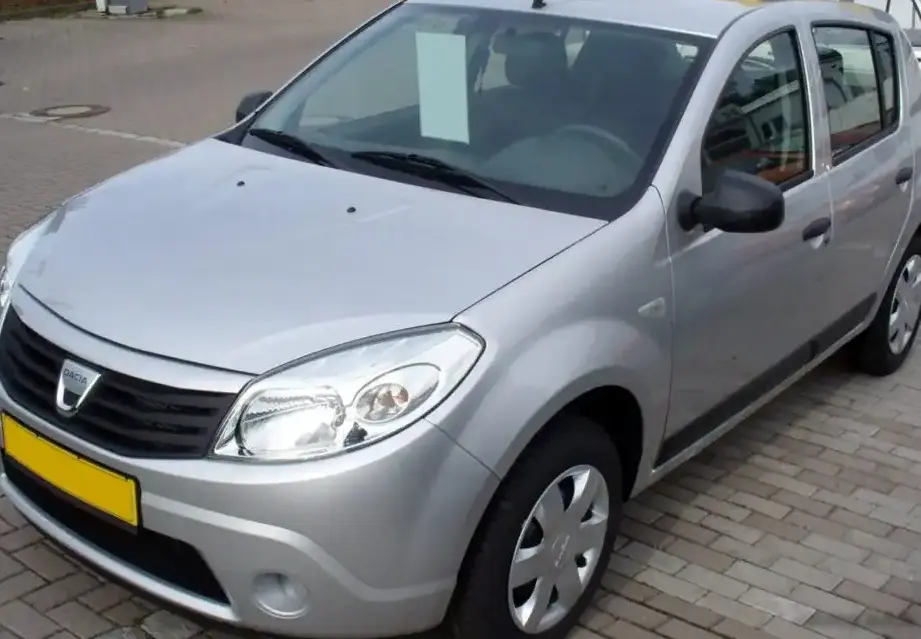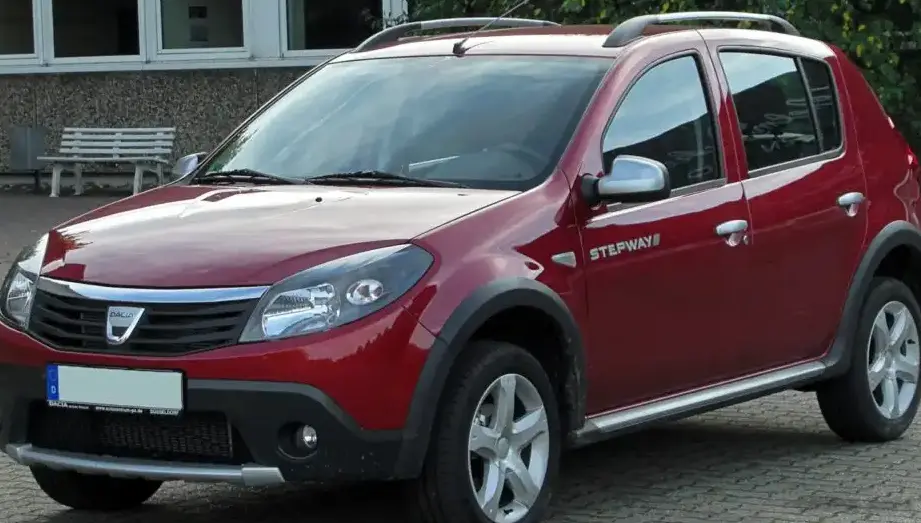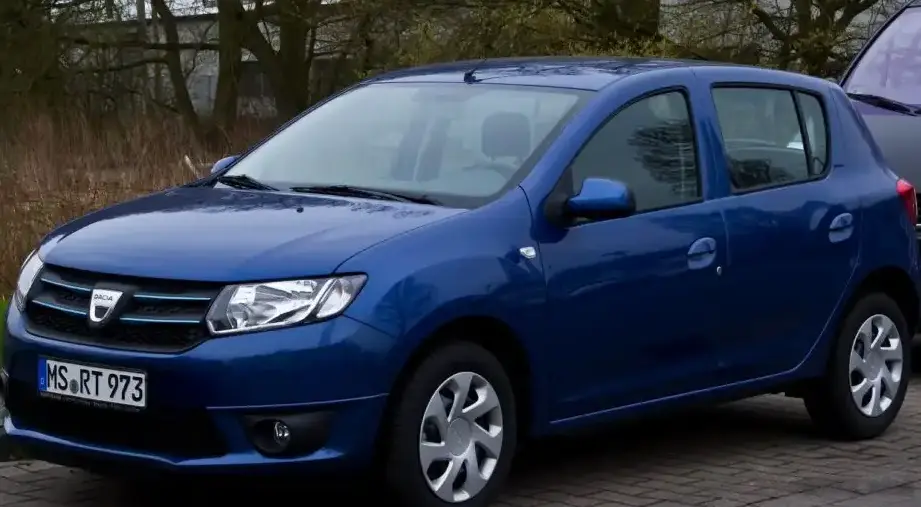
The Dacia Sandero II 0.9 TCe (90 hp) was a key variant within the second generation of Dacia’s popular Sandero hatchback, produced from 2012 to 2015. Positioned as an entry-level offering with a focus on fuel efficiency, it represented a significant step forward for the Sandero line, bringing turbocharged engine technology to a traditionally budget-focused vehicle. This model played a crucial role in Dacia’s expansion across Europe, offering a compelling value proposition in the supermini segment. It was built on the Dacia/Renault B0 platform, also known as the 1HX0/A3 platform.
Technical Specifications
| Brand | Dacia |
| Model | Sandero |
| Generation | Sandero II |
| Type (Engine) | 0.9 TCe (90 Hp) |
| Start of production | 2012 |
| End of production | 2015 |
| Powertrain Architecture | Internal Combustion engine |
| Body type | Hatchback |
| Seats | 5 |
| Doors | 5 |
| Fuel consumption (urban) | 6.4 l/100 km (36.8 US mpg, 44.1 UK mpg, 15.6 km/l) |
| Fuel consumption (extra urban) | 4.3 l/100 km (54.7 US mpg, 65.7 UK mpg, 23.3 km/l) |
| Fuel consumption (combined) | 5 l/100 km (47 US mpg, 56.5 UK mpg, 20 km/l) |
| CO2 emissions | 116 g/km |
| Fuel Type | Petrol (Gasoline) |
| Acceleration 0 – 100 km/h | 11.1 sec |
| Acceleration 0 – 62 mph | 11.1 sec |
| Acceleration 0 – 60 mph | 10.5 sec |
| Maximum speed | 175 km/h (108.74 mph) |
| Emission standard | Euro 5 |
| Weight-to-power ratio | 10.7 kg/Hp |
| Weight-to-torque ratio | 7.1 kg/Nm |
| Power | 90 Hp @ 5250 rpm |
| Torque | 135 Nm @ 2500 rpm (99.57 lb.-ft. @ 2500 rpm) |
| Engine layout | Front, Transverse |
| Engine Model/Code | H4Bt 400 |
| Engine displacement | 898 cm3 (54.8 cu. in.) |
| Number of cylinders | 3 |
| Engine configuration | Inline |
| Cylinder Bore | 72.2 mm (2.84 in.) |
| Piston Stroke | 73.1 mm (2.88 in.) |
| Compression ratio | 9.5:1 |
| Number of valves per cylinder | 4 |
| Fuel injection system | Multi-port manifold injection |
| Engine aspiration | Turbocharger, Intercooler |
| Valvetrain | DOHC |
| Engine oil capacity | 4.1 l (4.33 US qt | 3.61 UK qt) |
| Coolant capacity | 4.5 l (4.76 US qt | 3.96 UK qt) |
| Kerb Weight | 962 kg (2120.85 lbs.) |
| Max. weight | 1520 kg (3351.03 lbs.) |
| Max load | 558 kg (1230.18 lbs.) |
| Trunk (boot) space – minimum | 320 l (11.3 cu. ft.) |
| Trunk (boot) space – maximum | 1200 l (42.38 cu. ft.) |
| Fuel tank capacity | 50 l (13.21 US gal | 11 UK gal) |
| Max. roof load | 80 kg (176.37 lbs.) |
| Permitted trailer load (braked) | 1100 kg (2425.08 lbs.) |
| Permitted trailer load (unbraked) | 515 kg (1135.38 lbs.) |
| Permitted towbar download | 75 kg (165.35 lbs.) |
| Length | 4057 mm (159.72 in.) |
| Width | 1733 mm (68.23 in.) |
| Width including mirrors | 1984 mm (78.11 in.) |
| Height | 1523 mm (59.96 in.) |
| Wheelbase | 2589 mm (101.93 in.) |
| Front track | 1497 mm (58.94 in.) |
| Rear track | 1486 mm (58.5 in.) |
| Front overhang | 818 mm (32.2 in.) |
| Rear overhang | 650 mm (25.59 in.) |
| Ride height (ground clearance) | 163 mm (6.42 in.) |
| Minimum turning circle | 10.68 m (35.04 ft.) |
| Drivetrain Architecture | Front wheel drive |
| Number of gears | 5 |
| Gearbox type | Manual transmission |
| Front suspension | Independent, McPherson with coil spring and anti-roll bar |
| Rear suspension | Coil spring, Torsion |
| Front brakes | Ventilated discs, 258×22 mm |
| Rear brakes | Drum, 203 mm |
| Assisting systems | ABS (Anti-lock braking system) |
| Steering type | Steering rack and pinion |
| Power steering | Electric |
| Tires size | 185/65 R15 |
| Wheel rims size | 6J x 15 |
INTRODUCTION
The Dacia Sandero II 0.9 TCe (90 hp) represented a significant upgrade in powertrain options for the Sandero range. Introduced in 2012 as part of the second-generation Sandero (LS), it aimed to broaden the car’s appeal by offering a more modern and efficient engine. This variant was particularly important in markets where smaller displacement, turbocharged engines were gaining popularity due to tax incentives and fuel economy concerns. The 0.9 TCe engine, a three-cylinder unit, was a key component of Renault-Nissan’s modular engine family and brought a level of refinement previously unseen in the budget-focused Sandero.
Powertrain & Engine Architecture
The heart of this Sandero variant is the H4Bt 400 engine, a 898cc three-cylinder turbocharged petrol engine. This engine is part of Renault’s ‘Energy’ family, designed for efficiency and reduced emissions. It features multi-point fuel injection and a single scroll turbocharger with an intercooler. The engine utilizes a double overhead camshaft (DOHC) valvetrain with four valves per cylinder. The turbocharger provides a noticeable boost in power compared to the naturally aspirated engines previously offered in the Sandero. The engine’s compact size and lightweight construction contribute to the car’s overall efficiency. The 0.9 TCe was paired with a five-speed manual transmission, optimized for fuel economy and drivability. While an automatic transmission was offered on other Sandero II variants, it wasn’t available with the 90hp 0.9 TCe engine.
Driving Characteristics
The 90 hp 0.9 TCe engine delivers a surprisingly lively driving experience for a car in this segment. While not exceptionally quick, with a 0-60 mph time of around 10.5 seconds, the turbocharger provides a useful surge of torque at lower engine speeds. This makes it well-suited for everyday driving and overtaking maneuvers. The five-speed manual transmission is well-matched to the engine’s characteristics, offering smooth gear changes and a reasonable spread of ratios. Compared to the 1.6-liter petrol engine available in other Sandero II models, the 0.9 TCe offers better fuel economy but slightly less outright performance. It also feels more responsive than the older 1.2-liter engine. The relatively light weight of the Sandero helps to mitigate the engine’s modest power output.
Equipment & Trim Levels
The 0.9 TCe (90 hp) variant was typically offered in mid-range trim levels, such as the ‘Ambiance’ or ‘Lauréate’ depending on the market. Standard equipment generally included power steering, central locking, electric front windows, and an audio system with USB connectivity. Higher trim levels added features like air conditioning, alloy wheels, and a trip computer. Interior upholstery was typically cloth, with a functional and durable design. Optional extras included metallic paint, parking sensors, and a navigation system. The interior design was simple and practical, reflecting the Sandero’s value-oriented positioning.
Chassis & Braking
The Sandero II 0.9 TCe utilizes a McPherson strut front suspension and a torsion beam rear suspension. This setup provides a comfortable ride quality, although it’s not particularly sporty. The front brakes are ventilated discs, while the rear brakes are drums. ABS (Anti-lock Braking System) is standard. The steering is electrically assisted, providing light and easy steering feel. The suspension is tuned for comfort and practicality, prioritizing ride quality over handling precision. The relatively lightweight nature of the car helps to compensate for the modest braking performance.
Market Reception & Comparison
The Dacia Sandero II 0.9 TCe (90 hp) was generally well-received by critics for its fuel efficiency and affordability. It offered a compelling alternative to more expensive superminis from established brands. However, some reviewers noted that the three-cylinder engine could be a little rough and noisy, particularly at higher revs. Compared to the 1.6-liter Sandero, the 0.9 TCe offered significantly better fuel economy (around 50 mpg combined) but slightly less performance. It also proved to be more reliable than some of the earlier Sandero models, thanks to the improved engine technology. The 0.9 TCe was a popular choice for urban drivers and those seeking a cost-effective and economical car.
Legacy
The 0.9 TCe engine proved to be a reliable and durable unit, and many Sandero II models equipped with this engine are still on the road today. While not known for exceptional longevity, the engine is generally considered to be relatively trouble-free, provided it is properly maintained. The Sandero II 0.9 TCe remains a popular choice in the used car market, particularly for buyers seeking an affordable and fuel-efficient vehicle. Its simple construction and readily available parts contribute to its low running costs. The success of this variant helped to establish Dacia as a major player in the European supermini segment.