
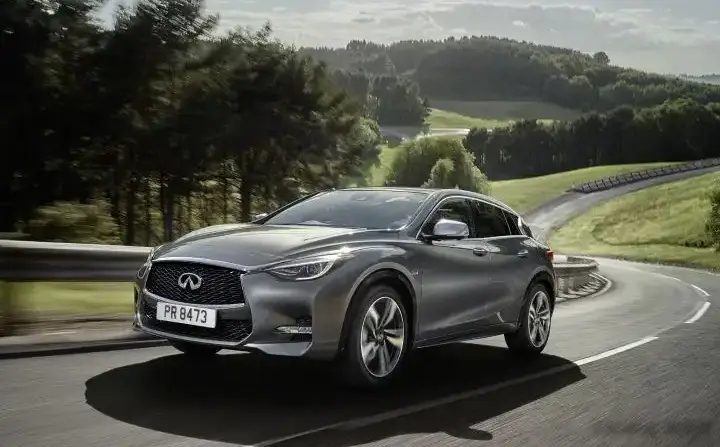
The Infiniti Q30 2.0 AWD DCT, produced from December 2015 to February 2018, represents Infiniti’s entry into the premium compact segment, specifically targeting buyers seeking a more stylish and dynamic alternative to traditional hatchbacks and crossovers. Built upon the Mercedes-Benz MFA platform (shared with the A-Class and GLA), the Q30 aimed to blend Japanese design sensibilities with German engineering. This particular variant, equipped with the 2.0-liter turbocharged engine and a seven-speed dual-clutch transmission (DCT) paired with all-wheel drive, occupied a mid-range position within the Q30 lineup, offering a balance of performance, efficiency, and features. It was primarily marketed towards North America and Europe, offering a unique proposition in a crowded market.
Technical Specifications
| Brand | Infiniti |
| Model | Q30 |
| Generation | Q30 |
| Type (Engine) | 2.0 (211 Hp) AWD DCT |
| Start of production | December, 2015 |
| End of production | February, 2018 |
| Powertrain Architecture | Internal Combustion engine |
| Body type | Hatchback, Crossover |
| Seats | 5 |
| Doors | 5 |
| Fuel consumption (urban) | 8.7 l/100 km (27 US mpg, 32.5 UK mpg, 11.5 km/l) |
| Fuel consumption (extra urban) | 5.5 l/100 km (42.8 US mpg, 51.4 UK mpg, 18.2 km/l) |
| Fuel consumption (combined) | 6.7 l/100 km (35.1 US mpg, 42.2 UK mpg, 14.9 km/l) |
| CO2 emissions | 156 g/km |
| Fuel Type | Petrol (Gasoline) |
| Acceleration 0 – 100 km/h | 7.3 sec |
| Acceleration 0 – 62 mph | 7.3 sec |
| Acceleration 0 – 60 mph | 6.9 sec |
| Maximum speed | 230 km/h (142.92 mph) |
| Emission standard | Euro 6 |
| Weight-to-power ratio | 7 kg/Hp, 143.5 Hp/tonne |
| Weight-to-torque ratio | 4.2 kg/Nm, 238.1 Nm/tonne |
| Power | 211 Hp @ 5500 rpm |
| Power per litre | 106 Hp/l |
| Torque | 350 Nm @ 1200-4000 rpm (258.15 lb.-ft. @ 1200-4000 rpm) |
| Engine layout | Front, Transverse |
| Engine Model/Code | M 270.920 |
| Engine displacement | 1991 cm3 (121.5 cu. in.) |
| Number of cylinders | 4 |
| Engine configuration | Inline |
| Fuel injection system | Direct injection |
| Engine aspiration | Turbocharger, Intercooler |
| Valvetrain | DOHC |
| Engine oil capacity | 5.6 l (5.92 US qt | 4.93 UK qt) |
| Coolant | 7.6 l (8.03 US qt | 6.69 UK qt) |
| Kerb Weight | 1470 kg (3240.8 lbs.) |
| Max. weight | 1990 kg (4387.2 lbs.) |
| Max load | 520 kg (1146.4 lbs.) |
| Trunk (boot) space – minimum | 430 l (15.19 cu. ft.) |
| Fuel tank capacity | 56 l (14.79 US gal | 12.32 UK gal) |
| Permitted trailer load with brakes (12%) | 1800 kg (3968.32 lbs.) |
| Permitted trailer load without brakes | 750 kg (1653.47 lbs.) |
| Length | 4425 mm (174.21 in.) |
| Width | 1805 mm (71.06 in.) |
| Height | 1495 mm (58.86 in.) |
| Wheelbase | 2700 mm (106.3 in.) |
| Front track | 1572 mm (61.89 in.) |
| Rear (Back) track | 1573 mm (61.93 in.) |
| Drag coefficient (Cd) | 0.32 |
| Minimum turning circle (turning diameter) | 11.4 m (37.4 ft.) |
| Drive wheel | All wheel drive (4×4) |
| Number of gears and type of gearbox | 7 gears, automatic transmission DCT |
| Front suspension | Independent type McPherson |
| Rear suspension | Independent multi-link suspension |
| Front brakes | Ventilated discs |
| Rear brakes | Ventilated discs |
| Assisting systems | ABS (Anti-lock braking system) |
| Steering type | Steering rack and pinion |
| Power steering | Electric Steering |
| Tires size | 235/45 R19 |
| Wheel rims size | 19 |
Powertrain & Engine Architecture
The heart of the Q30 2.0 AWD DCT is the Mercedes-Benz M270.920 2.0-liter inline-four cylinder engine. This engine, part of the modular M270 family, features direct fuel injection, a single turbocharger with an intercooler, and a dual overhead camshaft (DOHC) valvetrain. The direct injection system optimizes combustion efficiency and contributes to the engine’s responsive power delivery. The turbocharger provides a significant boost in power and torque, allowing the engine to produce 211 horsepower at 5500 rpm and 350 Nm (258 lb-ft) of torque between 1200 and 4000 rpm. This broad torque curve is a key characteristic of the engine, providing ample pulling power across a wide range of engine speeds.
The engine is mated to a seven-speed dual-clutch transmission (DCT), which offers quick and precise gear changes. The DCT provides both fully automatic operation and the ability for the driver to manually select gears via steering wheel-mounted paddle shifters. The all-wheel-drive system utilizes a multi-plate clutch to distribute torque between the front and rear axles, enhancing traction and stability, particularly in adverse weather conditions.
Driving Characteristics
The Q30 2.0 AWD DCT delivers a comfortable and refined driving experience. The 211 horsepower and 350 Nm of torque provide adequate acceleration, with a 0-60 mph time of around 6.9 seconds. While not a sports car, the Q30 offers a noticeable step up in performance compared to lower-powered variants. The DCT transmission contributes to a responsive feel, with quick shifts and minimal torque interruption. The all-wheel-drive system provides confident handling and stability, especially on slippery surfaces. Compared to the base 1.6-liter engine, the 2.0-liter offers significantly more power and torque, resulting in a more effortless driving experience. However, it doesn’t quite match the performance of the more expensive and sporty Mercedes-Benz A35 AMG, which shares the same platform.
Equipment & Trim Levels
The Q30 2.0 AWD DCT typically came equipped with a generous array of standard features, including leatherette upholstery, automatic climate control, a 7-inch touchscreen infotainment system, and a rearview camera. Optional extras included a panoramic sunroof, heated front seats, a premium audio system, and advanced driver-assistance features such as blind-spot monitoring and lane departure warning. Trim levels varied slightly by market, but generally offered increasing levels of luxury and technology. The Q30 aimed to provide a premium feel with attention to detail in the cabin design and materials.
Chassis & Braking
The Q30 utilizes a McPherson strut front suspension and a multi-link rear suspension, providing a comfortable ride and responsive handling. The suspension is tuned to prioritize comfort over outright sportiness, but still offers decent body control. All four wheels are equipped with ventilated disc brakes, providing ample stopping power. The electronic stability control (ESC) system and anti-lock braking system (ABS) further enhance safety and control. The Q30’s chassis is designed to provide a balance between ride comfort and handling precision.
Market Reception & Comparison
The Infiniti Q30 received mixed reviews from automotive critics. While praised for its stylish design and comfortable interior, some reviewers criticized its relatively high price compared to competitors and its somewhat bland driving dynamics. Fuel economy was generally considered to be average for the segment. Compared to other premium compact hatchbacks and crossovers, such as the Audi A3 and BMW 2 Series, the Q30 offered a unique design and a more comfortable ride, but lacked the same level of performance and brand prestige.
Legacy
The Infiniti Q30, despite its relatively short production run, has established a niche following among buyers seeking a stylish and comfortable premium compact vehicle. The M270 engine, while generally reliable, can be susceptible to issues with the timing chain and carbon buildup, requiring regular maintenance. The DCT transmission is generally robust, but requires periodic fluid changes. On the used car market, the Q30 2.0 AWD DCT represents a relatively affordable entry point into the premium compact segment, offering a good balance of features, performance, and style. Its unique design and comfortable ride continue to appeal to buyers looking for an alternative to more mainstream options.
