Technical Specifications
| Brand | Dacia |
| Model | Sandero |
| Generation | Sandero II |
| Type (Engine) | 1.2 (75 Hp) LPG |
| Start of production | 2012 |
| End of production | 2015 |
| Powertrain Architecture | Internal Combustion engine |
| Body type | Hatchback |
| Seats | 5 |
| Doors | 5 |
| Fuel consumption (economy) – urban (NEDC) | 7.7 l/100 km (30.5 US mpg, 36.7 UK mpg, 13 km/l) |
| Fuel consumption (economy) – urban (LPG) (NEDC) | 9.8 l/100 km |
| Fuel consumption (economy) – extra urban (NEDC) | 4.9 l/100 km (48 US mpg, 57.6 UK mpg, 20.4 km/l) |
| Fuel consumption (economy) – extra urban (LPG) (NEDC) | 6.2 l/100 km |
| Fuel consumption (economy) – combined (NEDC) | 5.9 l/100 km (39.9 US mpg, 47.9 UK mpg, 16.9 km/l) |
| Fuel consumption (economy) – combined (LPG) (NEDC) | 7.5 l/100 km |
| CO2 emissions (NEDC) | 136 g/km |
| CO2 emissions (LPG) (NEDC) | 120 g/km |
| Fuel Type | Petrol / LPG |
| Acceleration 0 – 100 km/h | 14.5 sec |
| Acceleration 0 – 62 mph | 14.5 sec |
| Acceleration 0 – 100 km/h (LPG) | 15.1 sec |
| Acceleration 0 – 60 mph (Calculated) | 13.8 sec |
| Maximum speed | 162 km/h (100.66 mph) |
| Emission standard | Euro 5 |
| Weight-to-power ratio | 13.1 kg/Hp, 76.5 Hp/tonne |
| Weight-to-torque ratio | 9.2 kg/Nm, 109.2 Nm/tonne |
| Power | 75 Hp @ 5500 rpm |
| Power per litre | 65.3 Hp/l |
| Power (LPG) | 72 Hp @ 5500 rpm |
| Power per litre (LPG) | 62.7 Hp/l |
| Torque | 107 Nm @ 4250 rpm (78.92 lb.-ft. @ 4250 rpm) |
| Torque (LPG) | 103 Nm @ 4250 rpm |
| Engine layout | Front, Transverse |
| Engine Model/Code | D4F 734 |
| Engine displacement | 1149 cm3 (70.12 cu. in.) |
| Number of cylinders | 4 |
| Engine configuration | Inline |
| Cylinder Bore | 69 mm (2.72 in.) |
| Piston Stroke | 76.8 mm (3.02 in.) |
| Compression ratio | 9.8:1 |
| Number of valves per cylinder | 4 |
| Fuel injection system | Multi-port manifold injection |
| Engine aspiration | Naturally aspirated |
| Valvetrain | SOHC |
| Engine oil capacity | 4 l (4.23 US qt, 3.52 UK qt) |
| Coolant capacity | 4.5 l (4.76 US qt, 3.96 UK qt) |
| Kerb Weight | 980 kg (2160.53 lbs.) |
| Max. weight | 1540 kg (3395.12 lbs.) |
| Max load | 560 kg (1234.59 lbs.) |
| Trunk (boot) space – minimum | 320 l (11.3 cu. ft.) |
| Trunk (boot) space – maximum | 1200 l (42.38 cu. ft.) |
| Fuel tank capacity | 50 l (13.21 US gal, 11 UK gal) |
| Fuel tank capacity (LPG) | 32 l |
| Max. roof load | 80 kg (176.37 lbs.) |
| Permitted trailer load with brakes (12%) | 1100 kg (2425.08 lbs.) |
| Permitted trailer load without brakes | 525 kg (1157.43 lbs.) |
| Permitted towbar download | 58 kg (127.87 lbs.) |
| Length | 4057 mm (159.72 in.) |
| Width | 1733 mm (68.23 in.) |
| Width including mirrors | 1984 mm (78.11 in.) |
| Height | 1523 mm (59.96 in.) |
| Wheelbase | 2589 mm (101.93 in.) |
| Front track | 1497 mm (58.94 in.) |
| Rear track | 1486 mm (58.5 in.) |
| Front overhang | 818 mm (32.2 in.) |
| Rear overhang | 650 mm (25.59 in.) |
| Ride height (ground clearance) | 163 mm (6.42 in.) |
| Minimum turning circle | 10.68 m (35.04 ft.) |
| Drivetrain Architecture | ICE to Front Wheels |
| Drive wheel | Front wheel drive |
| Number of gears | 5 |
| Gearbox type | Manual transmission |
| Front suspension | Independent type McPherson, Transverse stabilizer |
| Rear suspension | Coil spring, Torsion |
| Front brakes | Ventilated discs, 258×22 mm |
| Rear brakes | Drum, 203 mm |
| Assisting systems | ABS (Anti-lock braking system) |
| Steering type | Steering rack and pinion |
| Power steering | Electric |
| Tires size | 185/65 R15 |
| Wheel rims size | 6J x 15 |
Introduction
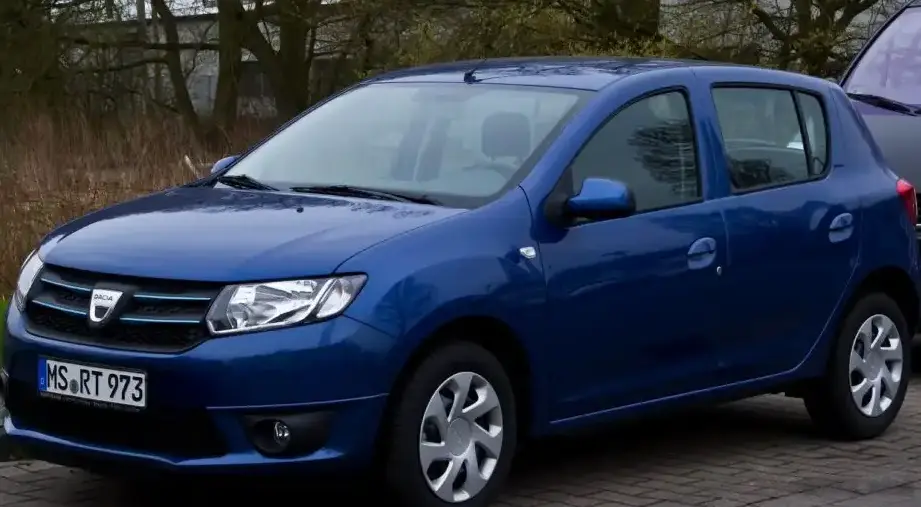
The Dacia Sandero II 1.2 (75 hp) LPG, produced between 2012 and 2015, was an entry-level variant within the second-generation Sandero range (2012-2020). The Sandero II itself was built upon the Renault Clio Mk4 platform, benefiting from shared engineering and components. Positioned as a particularly budget-friendly hatchback, this model aimed to deliver affordable transportation with the added versatility of dual-fuel capability – running on either gasoline or liquefied petroleum gas (LPG). It was primarily marketed in Europe, where Dacia, under Renault ownership, had established a reputation for value. The Sandero II, in general, was designed to appeal to buyers prioritizing practicality and low running costs, and the 1.2 LPG specifically targeted those looking to minimize fuel expenses. This variant occupied the lowest rung of the Sandero II lineup, offering a basic but functional package.
Powertrain & Engine Architecture
The Sandero II 1.2 LPG is powered by the D4F 734 engine, a 1.2-liter inline-four cylinder petrol engine. This engine is part of the Dacia/Renault D4F family, known for its simplicity and cost-effectiveness. It employs a multi-point fuel injection system, delivering fuel to the intake ports. The engine features a single overhead camshaft (SOHC) valvetrain, operating four valves per cylinder. The LPG conversion is typically a factory-installed system, integrating with the engine management system to seamlessly switch between petrol and gas operation. When operating on LPG, a slight reduction in power to 72 hp is observed, due to the lower energy density of LPG compared to gasoline. The engine is transversely mounted, driving the front wheels through a five-speed manual transmission. The transmission’s gear ratios are optimized for fuel efficiency rather than spirited acceleration. The engine’s design prioritizes reliability and ease of maintenance over outright performance.
Driving Characteristics
With only 75 horsepower and 107 Nm (78.92 lb.-ft.) of torque, the Sandero II 1.2 LPG doesn’t offer particularly brisk performance. Acceleration from 0-60 mph takes approximately 13.8 seconds, and its top speed is around 100.66 mph. The five-speed manual transmission is geared for economy. In everyday driving, the engine feels adequate for urban and suburban commutes, but struggles when fully loaded or when attempting to overtake at higher speeds. The LPG system provides a noticeable cost saving at the pump, but also results in a slight performance decrease. Compared to the 0.9 TCe turbocharged engine available in other Sandero II models, this 1.2 LPG feels significantly less responsive and requires more driver input to achieve similar speeds. The engine is relatively smooth at cruising speeds, but can become noisy under heavy acceleration.
Equipment & Trim Levels
The 1.2 LPG variant generally represented the base trim level within the Sandero II range. Standard equipment typically included power steering, central locking, electric front windows, and an ABS anti-lock braking system. Interior upholstery was typically a basic cloth material. Air conditioning and a radio/CD player were often offered as optional extras, and were frequently omitted from the base model to keep the price down. Higher trim levels, such as the Laureate, added features like air conditioning, alloy wheels, and more refined interior trim. The overall interior design was functional but lacked the aesthetic sophistication of some competitors.
Chassis & Braking
The Sandero II utilizes a McPherson strut front suspension and a torsion beam rear suspension. This setup prioritizes cost-effectiveness and simplicity over advanced handling characteristics. The front brakes are ventilated discs, providing adequate stopping power, while the rear brakes are drums – a common configuration for this class of vehicle and weight category. The steering is electrically assisted, offering light and easy steering feel, particularly useful for maneuvering in tight spaces. The relatively lightweight construction of the vehicle (980 kg / 2160.53 lbs) helps to mitigate the effects of the modest engine output. The suspension is tuned for comfort rather than sporty handling, providing a reasonably compliant ride on most road surfaces.
Market Reception & Comparison
The Sandero II 1.2 LPG was well-received in European markets where LPG infrastructure was well-established. Critics consistently praised its affordability and low running costs, particularly the fuel savings offered by the LPG system. However, the engine’s limited power and the somewhat basic interior were frequently cited as drawbacks. Compared to the petrol-only 1.2 version, the LPG model offered a similar driving experience with the added benefit of lower fuel bills. Against competitors like the Skoda Fabia or Volkswagen Polo, the Sandero II 1.2 LPG offered a more attractive price point, but lacked the refinement, build quality, and driving dynamics of those rivals. It appealed to buyers who prioritized value and practicality above all else.
Legacy
The Dacia Sandero II 1.2 LPG remains a popular choice in the used car market, particularly for budget-conscious buyers. The D4F engine is generally considered reliable, although regular maintenance, including oil changes and timing belt replacements, is essential. The LPG system requires periodic inspection and servicing to ensure safe and efficient operation. The Sandero II, as a whole, played a significant role in establishing Dacia as a major player in the European automotive market, demonstrating that a new car could be both affordable and practical. The 1.2 LPG variant specifically appealed to those seeking to minimize their fuel expenses without sacrificing the convenience of a modern hatchback, and continues to offer a compelling value proposition in the used car market today.