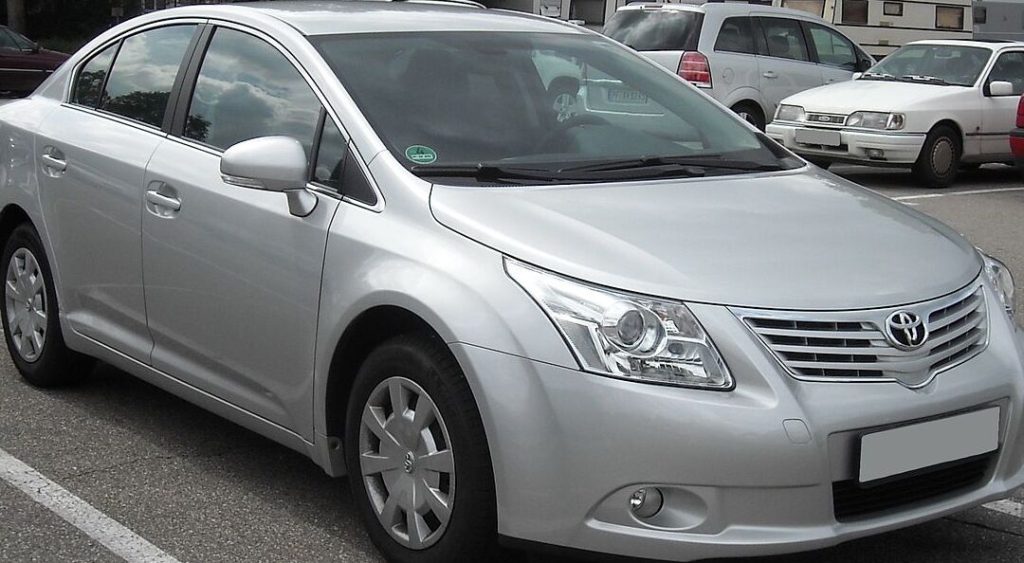
Technical Specifications
| Brand | Toyota |
| Model | Avensis |
| Generation | Avensis III Wagon (facelift 2012) |
| Type (Engine) | 1.8 Valvematic (147 Hp) |
| Start of production | 2012 |
| End of production | 2015 |
| Powertrain Architecture | Internal Combustion engine |
| Body type | Station wagon (estate) |
| Seats | 5 |
| Doors | 5 |
| Fuel consumption (urban) | 8.6 l/100 km (27.4 US mpg) |
| Fuel consumption (extra urban) | 5.4 l/100 km (43.6 US mpg) |
| Fuel consumption (combined) | 6.5 l/100 km (36.2 US mpg) |
| Fuel Type | Petrol (Gasoline) |
| Acceleration 0 – 100 km/h | 9.7 sec |
| Acceleration 0 – 62 mph | 9.7 sec |
| Acceleration 0 – 60 mph | 9.2 sec |
| Maximum speed | 200 km/h (124.27 mph) |
| Emission standard | Euro 5 B |
| Weight-to-power ratio | 9.7 kg/Hp |
| Weight-to-torque ratio | 7.9 kg/Nm |
| Power | 147 Hp @ 6400 rpm |
| Torque | 180 Nm @ 4000 rpm (132.76 lb.-ft. @ 4000 rpm) |
| Engine layout | Front, Transverse |
| Engine Model/Code | 2ZR-FAE |
| Engine displacement | 1798 cm3 (109.72 cu. in.) |
| Number of cylinders | 4 |
| Engine configuration | Inline |
| Cylinder Bore | 80.5 mm (3.17 in.) |
| Piston Stroke | 88.3 mm (3.48 in.) |
| Compression ratio | 10.5:1 |
| Number of valves per cylinder | 4 |
| Fuel injection system | Multi-port manifold injection |
| Engine aspiration | Naturally aspirated engine |
| Valvetrain | DOHC – Valvematic |
| Engine oil capacity | 4.2 l (4.44 US qt | 3.7 UK qt) |
| Coolant capacity | 6.3 l (6.66 US qt | 5.54 UK qt) |
| Kerb Weight | 1430 kg (3152.61 lbs.) |
| Max. weight | 2000 kg (4409.25 lbs.) |
| Max load | 570 kg (1256.63 lbs.) |
| Trunk (boot) space – minimum | 543 l (19.18 cu. ft.) |
| Fuel tank capacity | 60 l (15.85 US gal | 13.2 UK gal) |
| Length | 4780 mm (188.19 in.) |
| Width | 1810 mm (71.26 in.) |
| Height | 1480 mm (58.27 in.) |
| Wheelbase | 2700 mm (106.3 in.) |
| Front track | 1550 mm (61.02 in.) |
| Rear track | 1540 mm (60.63 in.) |
| Drivetrain Architecture | Front wheel drive |
| Number of gears | 6 |
| Gearbox type | Manual transmission |
| Front suspension | Independent, McPherson with coil spring and anti-roll bar |
| Rear suspension | Double wishbone |
| Front brakes | Ventilated discs |
| Rear brakes | Disc |
| Assisting systems | ABS (Anti-lock braking system) |
| Steering type | Steering rack and pinion |
The Toyota Avensis III Wagon, specifically the facelifted model produced from 2012 to 2015, was Toyota’s offering in the competitive mid-size station wagon segment. The 1.8 Valvematic variant, generating 147 horsepower, occupied an important position within the Avensis lineup, designed to strike a balance between fuel efficiency and acceptable performance. This generation Avensis (designated T27) was primarily developed for the European market, where the demand for practical, reliable, and comfortable family vehicles was consistently high. The 2012 facelift brought with it subtle styling updates and refinements to the existing platform, aiming to bolster its appeal against established rivals like the Ford Mondeo, Volkswagen Passat, and Opel/Vauxhall Insignia.
Powertrain & Engine Architecture
The 1.8 Valvematic Avensis Wagon was powered by the 2ZR-FAE engine, a 1.8-liter (1798 cc) inline-four cylinder gasoline engine. This engine belonged to Toyota’s ZR engine family, renowned for its inherent reliability and fuel-efficient design. The defining characteristic of this engine was Toyota’s Valvematic technology, a continuously variable valve lift system. Unlike conventional VVT-i systems that primarily adjust valve timing, Valvematic directly modulates the lift of the intake valves, granting finer control over the air-fuel mixture and resulting in improved fuel economy. The engine employed multi-port fuel injection and featured a compression ratio of 10.5:1. A six-speed manual transmission was standard, contributing to the vehicle’s overall efficiency and providing a smooth driving experience. The engine’s transverse mounting and front-wheel-drive configuration were typical for vehicles in this class, optimizing space utilization and driveability.
Driving Characteristics
The 147 horsepower and 180 Nm (132.76 lb-ft) of torque produced by the 1.8 Valvematic engine delivered adequate, though not particularly sporty, performance. Acceleration from 0 to 60 mph took approximately 9.2 seconds, and the car had a limited top speed of 124.27 mph. The engine felt responsive enough for everyday driving scenarios, with the Valvematic system providing a relatively broad and usable torque curve. However, when compared to the more powerful Avensis variants – such as the 2.0-liter petrol or the 2.2-liter diesel models – the 1.8 felt noticeably less capable when fully loaded with passengers and luggage, or when attempting to climb steep inclines. The six-speed manual transmission was well-matched to the engine’s characteristics, offering precise gear changes and helping to maintain the engine within its optimal power band. The gear ratios were geared towards maximizing fuel efficiency, which occasionally resulted in the engine feeling somewhat strained at higher speeds or when demanding more power.
Equipment & Trim Levels
The 1.8 Valvematic trim level generally included a respectable array of standard features. Common inclusions were air conditioning, power windows, power-adjustable mirrors, a CD/MP3 compatible stereo system, and alloy wheels. Safety features such as ABS (Anti-lock Braking System), electronic brakeforce distribution (EBD), and multiple airbags were also standard equipment. Higher trim levels offered additional features like automatic climate control, a touchscreen infotainment system, parking sensors, and upgraded interior upholstery, often including leather options. The interior upholstery in the base 1.8 Valvematic was typically cloth, with a functional and durable design. The dashboard layout was straightforward and user-friendly, prioritizing practicality and ease of use over elaborate styling.
Chassis & Braking
The Avensis Wagon utilized an independent McPherson strut suspension setup at the front and a double wishbone suspension at the rear, providing a comfortable and controlled ride quality. The suspension tuning prioritized comfort and ride isolation over overtly sporty handling characteristics, making it well-suited for long-distance journeys. The front brakes consisted of ventilated discs, while the rear brakes were solid discs. The braking system was effective and provided good stopping power in both normal and emergency situations. An anti-lock braking system (ABS) was standard across the range, enhancing safety during hard braking maneuvers. Stabilizer bars were fitted to both the front and rear axles to minimize body roll during cornering, contributing to a more stable and predictable driving experience.
Market Reception & Comparison
The Toyota Avensis 1.8 Valvematic was generally well-received by automotive critics as a sensible and dependable family car. It garnered praise for its fuel efficiency, comfortable ride, and spacious interior. However, some reviewers noted that the engine’s performance was somewhat underwhelming, particularly when compared to competitors offering more powerful engine options. The 1.8L variant served as a more affordable entry point into the Avensis range compared to the 2.0-liter petrol or 2.2-liter diesel models. The diesel models offered superior fuel economy and torque, while the 2.0-liter petrol engine provided more spirited performance. The 1.8L appealed to buyers who placed a higher priority on fuel efficiency and affordability than on outright performance.
Legacy
The Toyota Avensis III Wagon 1.8 Valvematic has established a reputation as a reliable and durable vehicle in the used car market. The 2ZR-FAE engine is well-regarded for its longevity, and with consistent and proper maintenance, it can deliver many years of trouble-free operation. While not the most dynamically engaging car to drive, its inherent practicality, comfortable ride, and overall reliability have made it a popular choice for families and individuals seeking a dependable estate car. Parts availability remains generally good, and maintenance costs are relatively low, making it an attractive option for budget-conscious buyers. The Valvematic system, while a complex piece of engineering, has proven to be robust and typically doesn’t present significant issues when maintained according to Toyota’s recommended service intervals.