
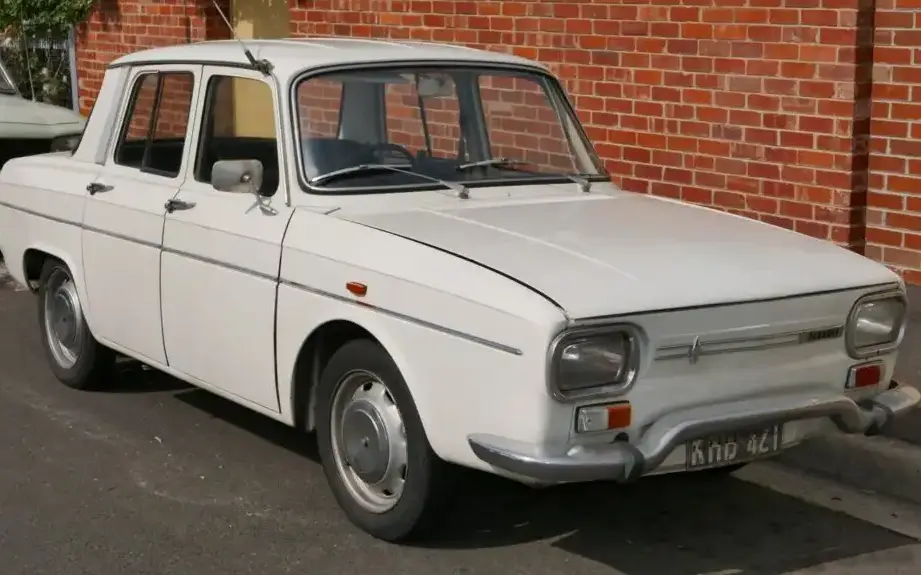
The Renault 10, specifically the Phase II model produced between 1967 and 1971, represented a significant step forward for the French automaker in the small family car segment. This variant, equipped with a 1.1-liter engine producing 46 horsepower and paired with a three-speed automatic transmission, was positioned as a more convenient, albeit less sporty, option within the Renault 10 lineup. It aimed to appeal to buyers prioritizing ease of driving over outright performance. The Phase II updates brought subtle styling revisions and refinements to the original 1961 design, solidifying the Renault 10’s place as a popular choice in Europe during its production run.
Technical Specifications
| Brand | Renault |
| Model | 10 |
| Generation | 10 (Phase II, 1967) |
| Type (Engine) | 1.1 (46 Hp) Automatic |
| Start of production | 1967 |
| End of production | 1971 |
| Powertrain Architecture | Internal Combustion engine |
| Body type | Sedan |
| Seats | 5 |
| Doors | 4 |
| Fuel Type | Petrol (Gasoline) |
| Power | 46 Hp @ 4600 rpm |
| Power per litre | 41.5 Hp/l |
| Torque | 78 Nm @ 3000 rpm |
| Torque (lb.-ft.) | 57.53 lb.-ft. @ 3000 rpm |
| Engine layout | Rear, Longitudinal |
| Engine Model/Code | 688.01 |
| Engine displacement | 1108 cm3 |
| Engine displacement (cu. in.) | 67.61 cu. in. |
| Number of cylinders | 4 |
| Engine configuration | Inline |
| Cylinder Bore | 70 mm |
| Cylinder Bore (in.) | 2.76 in. |
| Piston Stroke | 72 mm |
| Piston Stroke (in.) | 2.83 in. |
| Compression ratio | 8.5:1 |
| Number of valves per cylinder | 2 |
| Fuel injection system | Carburettor |
| Engine aspiration | Naturally aspirated engine |
| Valvetrain | OHV |
| Engine oil capacity | 2.5 l |
| Engine oil capacity (US qt) | 2.64 US qt |
| Engine oil capacity (UK qt) | 2.2 UK qt |
| Coolant | 7.6 l |
| Coolant (US qt) | 8.03 US qt |
| Coolant (UK qt) | 6.69 UK qt |
| Trunk (boot) space – minimum | 315 l |
| Trunk (boot) space – minimum (cu. ft.) | 11.12 cu. ft. |
| Fuel tank capacity | 32 l |
| Fuel tank capacity (US gal) | 8.45 US gal |
| Fuel tank capacity (UK gal) | 7.04 UK gal |
| Length | 4191 mm |
| Length (in.) | 165 in. |
| Width | 1524 mm |
| Width (in.) | 60 in. |
| Height | 1411 mm |
| Height (in.) | 55.55 in. |
| Wheelbase | 2270 mm |
| Wheelbase (in.) | 89.37 in. |
| Front track | 1254 mm |
| Front track (in.) | 49.37 in. |
| Rear (Back) track | 1219 mm |
| Rear (Back) track (in.) | 47.99 in. |
| Ride height (ground clearance) | 127 mm |
| Ride height (ground clearance) (in.) | 5 in. |
| Minimum turning circle (turning diameter) | 9.2 m |
| Minimum turning circle (turning diameter) (ft.) | 30.18 ft. |
| Drivetrain Architecture | The Internal combustion engine (ICE) drives the rear wheels of the vehicle. |
| Drive wheel | Rear wheel drive |
| Number of gears and type of gearbox | 3 gears, automatic transmission |
| Front suspension | Independent coil spring, Transverse stabilizer |
| Rear suspension | Independent coil spring |
| Front brakes | Disc, 259 mm |
| Rear brakes | Disc, 259 mm |
| Steering type | Steering rack and pinion |
| Tires size | 145/80 R15 |
| Wheel rims size | 4J x 15 |
Powertrain & Engine Architecture
The heart of this Renault 10 variant is the 688.01 engine, a 1,108cc inline-four cylinder unit. This engine utilized an overhead valve (OHV) configuration, a relatively simple and robust design common for the era. Fuel delivery was managed by a single carburetor, providing adequate, though not exceptional, fuel atomization. The engine produced 46 horsepower at 4,600 rpm and 78 Nm (57.53 lb-ft) of torque at 3,000 rpm. The engine’s longitudinal rear-wheel-drive layout was typical for European cars of the time, offering a balanced weight distribution. The three-speed automatic transmission, while offering convenience, was a relatively early design and lacked the sophistication of modern automatics. It featured a torque converter and planetary gearsets, providing smooth, but not particularly quick, shifts.
Driving Characteristics
The 1.1-liter automatic Renault 10 offered a comfortable, if unhurried, driving experience. Acceleration was modest, with the car taking a considerable amount of time to reach highway speeds. The automatic transmission’s gear ratios were optimized for fuel economy and smooth cruising rather than spirited performance. Compared to the manual transmission versions of the Renault 10, or those equipped with the larger 1.3-liter engine, this variant felt noticeably slower. However, the automatic transmission made it significantly easier to drive in urban environments, eliminating the need for constant gear changes. The rear-wheel-drive configuration provided predictable handling, but the relatively narrow tires and basic suspension setup limited grip in cornering.
Equipment & Trim Levels
The 1.1 Automatic Renault 10 typically came with a fairly basic level of equipment. Standard features included cloth upholstery, a simple dashboard layout with basic instrumentation (speedometer, fuel gauge, and temperature gauge), and manually operated windows. Optional extras included a radio, a heater, and upgraded interior trim. The interior was functional and durable, prioritizing practicality over luxury. The Phase II models received minor updates to the dashboard and interior trim compared to the earlier versions.
Chassis & Braking
The Renault 10 featured an independent coil spring suspension at both the front and rear, providing a reasonably comfortable ride. A transverse stabilizer bar was fitted to the front suspension to reduce body roll during cornering. Braking was accomplished via disc brakes on all four wheels, a relatively advanced feature for a car in this class during the 1960s. However, the braking system lacked power assistance, requiring a firm pedal effort. The steering was a rack and pinion system, providing precise and responsive steering feel.
Market Reception & Comparison
The Renault 10 1.1 Automatic was generally well-received as a practical and affordable family car. Critics praised its comfortable ride, ease of driving, and relatively spacious interior. However, the engine’s lack of power and the automatic transmission’s sluggishness were common criticisms. Compared to the manual transmission versions, the automatic offered less engaging driving experience. Compared to competitors like the Peugeot 204 and the Citroën Ami, the Renault 10 offered a good balance of price, practicality, and comfort. Fuel economy was reasonable for the time, but not exceptional.
Legacy
The Renault 10, particularly the 1.1 Automatic variant, remains a popular classic car among enthusiasts. The engine and transmission, while not particularly powerful, are known for their reliability and durability. Parts availability is generally good, making it relatively easy to maintain and repair. Today, these cars are often sought after for their charming retro styling and simple mechanicals. While not a performance icon, the Renault 10 1.1 Automatic represents a significant chapter in Renault’s history and a testament to the enduring appeal of classic European automobiles. The automatic transmission, while not a performance enhancer, broadened the car’s appeal to a wider range of drivers, contributing to its overall success in the European market.
