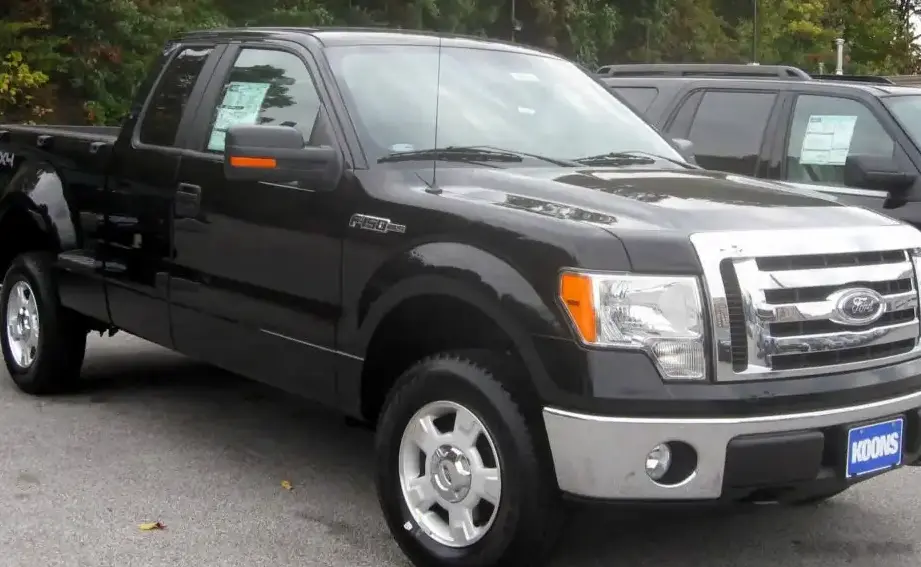
The Ford F-Series F-150 XII SuperCab, equipped with the 5.4-liter V8 engine producing 310 horsepower and paired with a four-wheel-drive system and automatic transmission, was a significant offering in the American full-size pickup truck market from 2008 to 2010. This variant occupied a mid-to-upper position within the F-150 lineup, appealing to buyers needing substantial towing capacity and power without opting for the range-topping models. It represented the twelfth generation (F-150 XII) of Ford’s best-selling truck, building upon the foundation laid by previous generations while introducing updated styling and features.
Technical Specifications
| Brand | Ford |
| Model | F-Series F-100/F-150 |
| Generation | F-Series F-150 XII SuperCab |
| Type (Engine) | 5.4 V8 (310 Hp) 4×4 Automatic |
| Start of production | October, 2008 |
| End of production | 2010 |
| Powertrain Architecture | Internal Combustion engine |
| Body type | Pick-up |
| Seats | 5-6 |
| Doors | 2 |
| Fuel consumption (urban) | 16.8 l/100 km (14 US mpg, 16.8 UK mpg) |
| Fuel consumption (extra urban) | 13.1 l/100 km (18 US mpg, 21.6 UK mpg) |
| Fuel Type | Petrol (Gasoline) |
| Power | 310 Hp @ 5000 rpm |
| Power per litre | 57.3 Hp/l |
| Torque | 495 Nm @ 3500 rpm (365.09 lb.-ft. @ 3500 rpm) |
| Engine layout | Front, Longitudinal |
| Engine displacement | 5408 cm3 (330.02 cu. in.) |
| Number of cylinders | 8 |
| Engine configuration | V-engine |
| Cylinder Bore | 90.17 mm (3.55 in.) |
| Piston Stroke | 105.66 mm (4.16 in.) |
| Compression ratio | 9.8:1 |
| Number of valves per cylinder | 3 |
| Fuel injection system | Multi-port manifold injection |
| Engine aspiration | Naturally aspirated engine |
| Valvetrain | SOHC, VCT |
| Engine oil capacity | 6.6 l (6.97 US qt | 5.81 UK qt) |
| Coolant | 19.6 l (20.71 US qt | 17.25 UK qt) |
| Max. weight | 3266 kg (7200.3 lbs.) |
| Trunk (boot) space – minimum | 1572 l (55.51 cu. ft.) |
| Trunk (boot) space – maximum | 1855 l (65.51 cu. ft.) |
| Fuel tank capacity | 98 l (25.89 US gal | 21.56 UK gal) |
| Permitted trailer load with brakes (12%) | 4400 kg (9700.34 lbs.) |
| Length | 5585-5885 mm (219.88 – 231.69 in.) |
| Width | 2004 mm (78.9 in.) |
| Width with mirrors folded | 2123 mm (83.58 in.) |
| Width including mirrors | 2464 mm (97.01 in.) |
| Height | 1928-1938 mm (75.91 – 76.3 in.) |
| Wheelbase | 3366-3670 mm (132.52 – 144.49 in.) |
| Ride height (ground clearance) | 221-249 mm (8.7 – 9.8 in.) |
| Minimum turning circle (turning diameter) | 13.3-14.3 m (43.64 – 46.92 ft.) |
| Approach angle | 23.7-25° |
| Departure angle | 20.4-20.7° |
| Ramp-over (brakeover) angle | 18-19.8° |
| Drivetrain Architecture | The Internal combustion engine (ICE) drives the rear wheels permanently, and the front wheels are driven through an electrically or mechanically operated clutch if necessary. |
| Drive wheel | All wheel drive (4×4) |
| Number of gears and type of gearbox | 6 gears, automatic transmission |
| Front suspension | Double wishbone |
| Rear suspension | Leaf spring |
| Front brakes | Ventilated discs, 330 mm |
| Rear brakes | Ventilated discs, 348 mm |
| Assisting systems | ABS (Anti-lock braking system) |
| Steering type | Steering rack and pinion |
| Power steering | Electric Steering |
| Tires size | 255/70 R17; 275/65 R18; 275/55 R20 |
| Wheel rims size | 17; 18; 20 |
Powertrain & Engine Architecture
The heart of this F-150 variant is the 5.4-liter Triton V8 engine. This engine, part of Ford’s modular engine family, featured a cast-iron block with aluminum cylinder heads. The engine code varied, but commonly seen were variations within the earlier Triton family. It utilized a single overhead camshaft (SOHC) design with variable valve timing (VCT) on intake camshafts to optimize performance and fuel efficiency. Fuel delivery was managed by a multi-port fuel injection system. The 5.4L Triton was known for its robust construction, but also for potential spark plug issues in earlier iterations, which Ford addressed with revised designs over the years. The engine was longitudinally mounted in the chassis. The automatic transmission was a 6-speed unit, providing smooth shifts and optimized gear ratios for both towing and everyday driving. This transmission was designed to handle the substantial torque output of the 5.4L V8.
Driving Characteristics
The 5.4L V8 with the automatic transmission delivered a balance of power and usability. While not as quick as the higher-output engines available in the F-150 lineup (like the 6.2L), it provided ample torque for hauling and towing. The automatic transmission, while smooth, wasn’t particularly sporty, prioritizing efficiency and ease of use. The 6-speed configuration offered a wider range of gear ratios compared to older 4-speed automatics, improving both fuel economy and acceleration. Compared to the manual transmission versions of the 5.4L, the automatic offered a more relaxed driving experience, especially in city traffic. However, the manual transmission provided more direct control and potentially slightly better fuel economy. The 4×4 system provided enhanced traction in various conditions, making it suitable for both on-road and off-road use.
Equipment & Trim Levels
The SuperCab configuration offered extended rear seating, providing more passenger space than the standard cab. Standard features typically included air conditioning, power windows and locks, and a basic audio system. Higher trim levels, such as the XLT and Lariat, added features like leather upholstery, upgraded audio systems, power-adjustable seats, and chrome exterior trim. Optional extras included a navigation system, sunroof, and various towing packages. The interior design was functional and durable, reflecting the truck’s work-oriented nature. The dashboard layout was straightforward, with easy-to-read gauges and intuitive controls.
Chassis & Braking
The F-150’s chassis was a body-on-frame construction, providing a robust and durable platform. The front suspension utilized a double wishbone design, while the rear suspension employed leaf springs. This combination offered a good balance of ride comfort and load-carrying capacity. The braking system featured ventilated discs on all four wheels, providing ample stopping power. An Anti-lock Braking System (ABS) was standard, enhancing safety and control during emergency braking. The rear axle ratio varied depending on the specific configuration and towing package, influencing both acceleration and fuel economy.
Market Reception & Comparison
The 5.4L V8/automatic combination was a popular choice among F-150 buyers who needed a capable truck for work and recreation. Critics generally praised the engine’s power and torque, but noted that fuel economy was not a strong point. Compared to the smaller V6 engines, the 5.4L offered significantly more power and towing capacity. However, it came at the cost of increased fuel consumption and a higher price tag. Compared to the 6.2L V8, the 5.4L was less powerful but more affordable. Reliability was generally good, although some owners reported issues with spark plugs and the timing chain tensioners.
Legacy
The 5.4L Triton V8, while eventually superseded by newer engine designs, remains a common sight on the road today. Its robust construction and readily available parts contribute to its longevity. In the used car market, F-150s equipped with this engine are often sought after by buyers looking for a capable and affordable truck. While maintenance costs can be higher than those of newer vehicles, the 5.4L Triton V8 has proven to be a durable and reliable powerplant when properly maintained. The 2008-2010 F-150 SuperCab 5.4L 4×4 Automatic represents a solid and capable truck from a pivotal era in Ford’s F-Series history.