
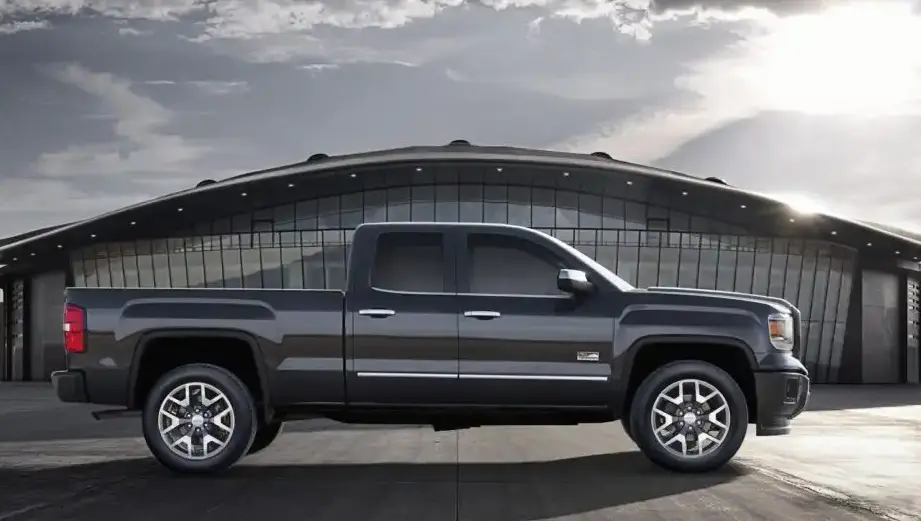
Technical Specifications
| Brand | GMC |
| Model | Sierra 1500 |
| Generation | Sierra 1500 IV (GMTK2XX) Double Cab |
| Type (Engine) | 5.3 EcoTec3 V8 (355/380 Hp) Automatic FlexFuel |
| Start of production | 2013 |
| End of production | 2015 |
| Powertrain Architecture | Internal Combustion engine |
| Body type | Pick-up |
| Seats | 5 |
| Doors | 4 |
| Fuel consumption (urban) | 14.7 l/100 km (16 US mpg, 19.2 UK mpg) |
| Fuel consumption (extra urban) | 10.2 l/100 km (23.1 US mpg, 27.7 UK mpg) |
| Fuel Type | Petrol / Ethanol – E85 |
| Weight-to-power ratio | 6.3 kg/Hp, 157.7 Hp/tonne |
| Weight-to-torque ratio | 4.3 kg/Nm, 230.6 Nm/tonne |
| Power | 355 Hp @ 5600 rpm |
| Power per litre | 66.6 Hp/l |
| Power (Ethanol – E85) | 380 Hp @ 5600 rpm |
| Power per litre (Ethanol – E85) | 71.3 Hp/l |
| Torque | 519 Nm @ 4100 rpm (382.79 lb.-ft. @ 4100 rpm) |
| Torque (Ethanol – E85) | 564 Nm @ 4100 rpm |
| Maximum engine speed | 5800 rpm |
| Engine layout | Front, Longitudinal |
| Engine Model/Code | L83 |
| Engine displacement | 5328 cm3 (325.13 cu. in.) |
| Number of cylinders | 8 |
| Engine configuration | V-engine |
| Cylinder Bore | 96 mm (3.78 in.) |
| Piston Stroke | 92 mm (3.62 in.) |
| Compression ratio | 11:1 |
| Number of valves per cylinder | 2 |
| Fuel injection system | Direct injection |
| Engine aspiration | Naturally aspirated engine |
| Valvetrain | OHV |
| Engine oil capacity | 8 l (8.45 US qt | 7.04 UK qt) |
| Coolant | 14.8 l (15.64 US qt | 13.02 UK qt) |
| Kerb Weight | 2251 kg (4962.61 lbs.) |
| Max. weight | 3175 kg (6999.68 lbs.) |
| Max load | 924 kg (2037.07 lbs.) |
| Trunk (boot) space – minimum | 1728 l (61.02 cu. ft.) |
| Fuel tank capacity | 98 l (25.89 US gal | 21.56 UK gal) |
| Permitted trailer load with brakes (12%) | 4490 kg (9898.76 lbs.) |
| Length | 5829 mm (229.49 in.) |
| Width including mirrors | 2032 mm (80 in.) |
| Height | 1876 mm (73.86 in.) |
| Wheelbase | 3645 mm (143.5 in.) |
| Front track | 1750 mm (68.9 in.) |
| Rear (Back) track | 1716 mm (67.56 in.) |
| Ride height (ground clearance) | 216 mm (8.5 in.) |
| Minimum turning circle (turning diameter) | 14.3 m (46.92 ft.) |
| Approach angle | 16.2° |
| Departure angle | 23.1° |
| Ramp-over (brakeover) angle | 18.9° |
| Drivetrain Architecture | Rear wheel drive |
| Drive wheel | Rear wheel drive |
| Number of gears and type of gearbox | 6 gears, automatic transmission Hydra-Matic |
| Front suspension | Independent coil spring |
| Rear suspension | Rigid axle suspension, Leaf spring |
| Front brakes | Ventilated discs, 330×30 mm |
| Rear brakes | Ventilated discs, 345×20 mm |
| Assisting systems | ABS (Anti-lock braking system) |
| Steering type | Steering rack and pinion |
| Power steering | Electric Steering |
| Tires size | 245/70 R17; 265/70 R17 |
| Wheel rims size | 8J x 17 |
The GMC Sierra 1500 IV (GMTK2XX) Double Cab, specifically equipped with the 5.3 EcoTec3 V8 engine and a six-speed automatic transmission, represents a significant iteration in GMC’s full-size pickup truck lineage. Produced from 2013 through 2015, this variant occupied a sweet spot in the Sierra 1500 lineup, offering a balance of capability, comfort, and fuel efficiency for the American truck buyer. It was positioned as a mainstream offering, appealing to both personal and commercial users who needed a versatile vehicle without the premium price tag of the Denali trim or the specialized focus of the work truck (WT) models.
Powertrain & Engine Architecture
At the heart of this Sierra 1500 Double Cab lies the 5.3-liter L83 EcoTec3 V8 engine. This engine is a member of GM’s fifth-generation small-block V8 family, known for its robust construction and relatively simple design. The “EcoTec3” designation refers to a suite of technologies aimed at improving fuel efficiency, including direct fuel injection, variable valve timing, and cylinder deactivation. The direct injection system, operating at a pressure of 220 bar (3,200 psi), precisely meters fuel into the combustion chambers, enhancing combustion efficiency and power output. The overhead valve (OHV) valvetrain, while traditional, proved reliable and cost-effective. The L83 is a naturally aspirated engine, meaning it doesn’t utilize forced induction like a turbocharger or supercharger. The six-speed Hydra-Matic automatic transmission was the standard pairing for this engine. This transmission offered smooth shifts and a wide gear ratio spread, contributing to both acceleration and highway cruising efficiency. The transmission was electronically controlled, adapting shift points based on driving conditions and throttle input.
Driving Characteristics
The 5.3L V8 with the six-speed automatic provided a comfortable and capable driving experience. While not a performance-oriented setup, the engine delivered adequate power for everyday driving and towing. The automatic transmission was tuned for smooth operation, prioritizing comfort over aggressive shifting. Acceleration from a standstill was respectable, but the truck’s weight (around 4,963 lbs) was noticeable. The gear ratios were optimized for towing and hauling, with a lower first gear for getting heavier loads moving and a higher overdrive gear for efficient highway cruising. Compared to the available 4.3L V6, the 5.3L offered significantly more power and torque, making it a better choice for those who frequently towed or carried heavy payloads. Compared to the 6.2L V8, the 5.3L was less powerful but more fuel-efficient, and less expensive to purchase.
Equipment & Trim Levels
The Double Cab configuration offered a spacious interior with seating for five passengers. Standard features on the 2013-2015 Sierra 1500 Double Cab with the 5.3L engine typically included air conditioning, power windows and locks, a tilt steering wheel, and a basic audio system. Higher trim levels, such as the SLE and SLT, added features like leather upholstery, heated seats, a premium audio system, and a navigation system. Optional extras included a sunroof, a rear-seat entertainment system, and various towing packages. The interior materials were generally durable and well-assembled, reflecting GMC’s positioning as a more premium brand than Chevrolet.
Chassis & Braking
The Sierra 1500 IV (GMTK2XX) utilized a fully boxed frame for enhanced rigidity and durability. The front suspension featured independent coil springs, providing a comfortable ride and good handling. The rear suspension employed a traditional leaf spring setup, which was well-suited for carrying heavy loads. Brakes were ventilated discs at all four corners, providing adequate stopping power. An Anti-lock Braking System (ABS) was standard. The steering system was a rack-and-pinion setup with electric power steering, offering responsive handling and reduced driver effort.
Market Reception & Comparison
The GMC Sierra 1500 with the 5.3L V8 and automatic transmission was generally well-received by critics and consumers. It was praised for its comfortable ride, spacious interior, and capable towing capacity. Fuel economy was considered average for a full-size pickup truck, but the FlexFuel capability allowed owners to utilize ethanol blends for potential cost savings. Compared to the Ford F-150 and Ram 1500, the Sierra 1500 offered a competitive combination of features, performance, and value. Reliability was generally good, although some owners reported minor issues with the cylinder deactivation system.
Legacy
The L83 5.3L EcoTec3 V8 proved to be a durable and reliable engine, and many examples are still on the road today. The six-speed Hydra-Matic automatic transmission also has a good reputation for longevity. In the used car market, these Sierra 1500s represent a good value for buyers seeking a capable and comfortable full-size pickup truck. Maintenance costs are generally reasonable, and parts availability is excellent. The combination of a proven powertrain, a spacious interior, and a strong chassis makes this Sierra 1500 a practical and dependable choice for a wide range of buyers.

