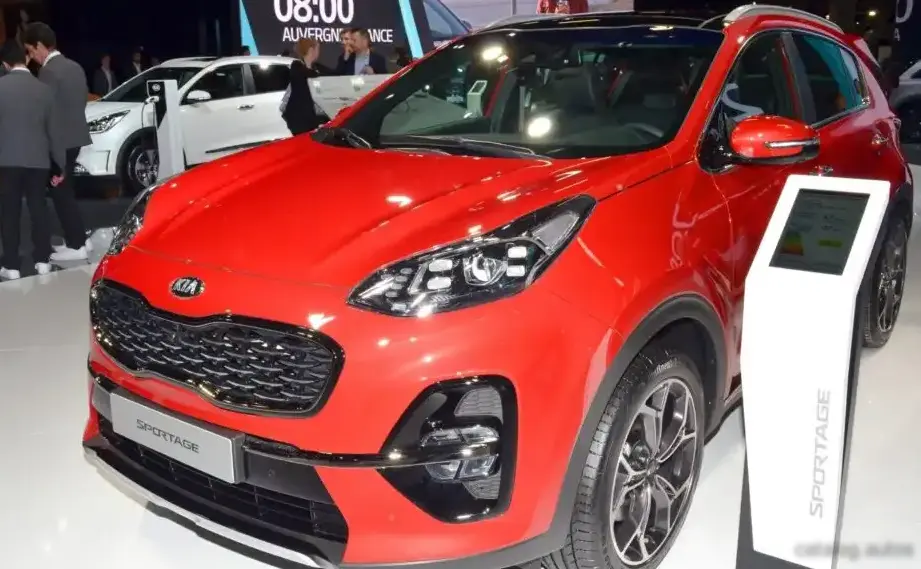
The Kia Sportage IV, specifically the facelifted version introduced in 2018, represented a significant step forward for the South Korean automaker in the highly competitive compact SUV segment. Produced from 2020 through July 2021 in this configuration, the 2.0 T-GDI (240 Hp) Automatic variant occupied a premium position within the Sportage lineup, offering a blend of performance, technology, and comfort. This model aimed to attract buyers seeking a more engaging driving experience than the base engine options provided, while still prioritizing the practicality and versatility expected of a modern SUV. It was primarily marketed towards families and individuals desiring a stylish and well-equipped vehicle for daily commuting and weekend adventures.
Technical Specifications
| Brand | Kia |
| Model | Sportage |
| Generation | Sportage IV (facelift 2018) |
| Type (Engine) | 2.0 T-GDI (240 Hp) Automatic |
| Start of production | 2020 |
| End of production | July, 2021 |
| Powertrain Architecture | Internal Combustion engine |
| Body type | SUV |
| Seats | 5 |
| Doors | 5 |
| Fuel consumption (economy) – urban | 11.8 l/100 km (19.9 US mpg, 23.9 UK mpg, 8.5 km/l) |
| Fuel consumption (economy) – extra urban | 8.4 l/100 km (28 US mpg, 33.6 UK mpg, 11.9 km/l) |
| Fuel consumption (economy) – combined | 10.2 l/100 km (23.1 US mpg, 27.7 UK mpg, 9.8 km/l) |
| Fuel Type | Petrol (Gasoline) |
| Emission standard | WCC+UCC |
| Weight-to-power ratio | 6.9 kg/Hp, 144.3 Hp/tonne |
| Weight-to-torque ratio | 4.7 kg/Nm, 212.3 Nm/tonne |
| Power | 240 Hp @ 6000 rpm |
| Power per litre | 120.1 Hp/l |
| Torque | 353 Nm @ 1450-3500 rpm (260.36 lb.-ft. @ 1450-3500 rpm) |
| Engine layout | Front, Transverse |
| Engine Model/Code | G4KH |
| Engine displacement | 1998 cm3 (121.93 cu. in.) |
| Number of cylinders | 4 |
| Engine configuration | Inline |
| Cylinder Bore | 86 mm (3.39 in.) |
| Piston Stroke | 86 mm (3.39 in.) |
| Compression ratio | 10:1 |
| Number of valves per cylinder | 4 |
| Fuel injection system | Direct injection |
| Engine aspiration | Turbocharger, Intercooler |
| Valvetrain | DOHC, CVVT |
| Engine oil capacity | 4.8 l (5.07 US qt | 4.22 UK qt) |
| Coolant | 7.2 l (7.61 US qt | 6.34 UK qt) |
| Kerb Weight | 1663-1768 kg (3666.29 – 3897.77 lbs.) |
| Trunk (boot) space – minimum | 869 l (30.69 cu. ft.) |
| Trunk (boot) space – maximum | 1702 l (60.11 cu. ft.) |
| Fuel tank capacity | 62 l (16.38 US gal | 13.64 UK gal) |
| Permitted trailer load with brakes (12%) | 907 kg (1999.59 lbs.) |
| Permitted trailer load without brakes | 750 kg (1653.47 lbs.) |
| Length | 4481 mm (176.42 in.) |
| Width | 1854 mm (72.99 in.) |
| Height | 1646 mm (64.8 in.) |
| Wheelbase | 2670 mm (105.12 in.) |
| Front track | 1608 mm (63.31 in.) |
| Rear (Back) track | 1621 mm (63.82 in.) |
| Ride height (ground clearance) | 163 mm (6.42 in.) |
| Minimum turning circle (turning diameter) | 10.6 m (34.78 ft.) |
| Approach angle | 16.7° |
| Departure angle | 23.9° |
| Ramp-over (brakeover) angle | 18.6° |
| Drivetrain Architecture | The Internal combustion engine (ICE) drives the front wheels of the vehicle. |
| Drive wheel | Front wheel drive |
| Number of gears and type of gearbox | 6 gears, automatic transmission |
| Front suspension | Independent type McPherson |
| Rear suspension | Independent multi-link suspension |
| Assisting systems | ABS (Anti-lock braking system) |
| Steering type | Steering rack and pinion |
| Power steering | Electric Steering |
| Tires size | 245/45 R19 |
| Wheel rims size | 7.5J x 19 |
INTRODUCTION
The 2020-2021 Kia Sportage IV 2.0 T-GDI Automatic represents the culmination of Kia’s efforts to establish itself as a major player in the global SUV market. Following the facelift in 2018, this variant built upon the already successful fourth-generation Sportage (QL), offering a more powerful engine option paired with a convenient automatic transmission. Positioned as a mid-to-upper trim level, it catered to buyers who desired a more spirited driving experience without sacrificing the comfort and practicality of a family SUV. The Sportage IV, built on the 1HX0/A3 platform, was designed to appeal to a broad audience, and the 2.0 T-GDI Automatic aimed for those seeking a balance between performance and efficiency.
Powertrain & Engine Architecture
At the heart of the Sportage 2.0 T-GDI Automatic lies the G4KH engine, a 1.998-liter (121.93 cubic inches) turbocharged inline-four cylinder gasoline engine. This engine utilizes direct fuel injection, a technology that improves fuel efficiency and power output by injecting fuel directly into the combustion chamber. The engine also features a Double Overhead Camshaft (DOHC) valvetrain with Continuously Variable Valve Timing (CVVT) on both the intake and exhaust sides, optimizing engine performance across a wider RPM range. The turbocharger, coupled with an intercooler, forces more air into the engine, significantly boosting power. The engine produces 240 horsepower at 6000 rpm and 353 Nm (260.36 lb-ft) of torque between 1450 and 3500 rpm. This power is delivered through a six-speed automatic transmission, chosen for its smooth shifting and ease of use. While not a dual-clutch transmission, it was well-matched to the engine’s torque curve, providing adequate responsiveness for everyday driving.
Driving Characteristics
The 2.0 T-GDI Automatic Sportage offered a noticeable improvement in performance compared to the base engine options. Acceleration was brisk, making highway merging and overtaking maneuvers effortless. The automatic transmission, while not offering the sportiness of a manual or dual-clutch system, provided smooth and predictable gear changes. The gear ratios were tuned for a balance between fuel economy and performance, with a focus on providing ample torque in the lower and mid-range. Compared to the naturally aspirated 2.4L engine, the turbocharger provided a more immediate power delivery. However, it didn’t quite match the responsiveness of the higher-performance trims available in some markets. The front-wheel-drive configuration contributed to a slightly less engaging driving experience than all-wheel-drive variants, but it also helped to improve fuel efficiency.
Equipment & Trim Levels
The 2.0 T-GDI Automatic trim typically included a generous array of standard features. Interior appointments generally featured cloth or leather upholstery, depending on optional packages. Standard equipment often included a touchscreen infotainment system with Apple CarPlay and Android Auto compatibility, a rearview camera, automatic climate control, and power windows and locks. Optional extras could include a panoramic sunroof, heated and ventilated front seats, a premium sound system, and advanced driver-assistance systems such as lane departure warning, blind-spot monitoring, and automatic emergency braking. The overall interior design was modern and functional, with a focus on providing a comfortable and user-friendly experience.
Chassis & Braking
The Sportage IV utilized an independent McPherson strut suspension in the front and an independent multi-link suspension in the rear. This suspension setup provided a comfortable ride quality while maintaining reasonable handling characteristics. The chassis was tuned to balance ride comfort with stability, making it suitable for both city driving and highway cruising. Braking duties were handled by disc brakes on all four wheels, equipped with an Anti-lock Braking System (ABS) to prevent wheel lockup during hard braking. The brake system provided adequate stopping power for the vehicle’s weight and performance capabilities. Stabilizer bars were included both front and rear to reduce body roll during cornering.
Market Reception & Comparison
The Kia Sportage IV 2.0 T-GDI Automatic was generally well-received by automotive critics. Reviewers praised its stylish design, spacious interior, and generous feature set. The engine was lauded for its strong performance and relatively good fuel economy. Compared to competitors like the Honda CR-V and Toyota RAV4, the Sportage offered a more distinctive design and a more engaging driving experience. However, some critics noted that the interior materials weren’t quite as premium as those found in some of its rivals. In terms of fuel economy, the 2.0 T-GDI Automatic offered comparable figures to other turbocharged SUVs in its class, but it was less fuel-efficient than the base engine options. Reliability reports were generally positive, with few major issues reported.
Legacy
The G4KH engine and the six-speed automatic transmission pairing in the Sportage IV have proven to be relatively reliable powertrains. While some owners have reported minor issues with the turbocharger or fuel injectors, these are not widespread problems. On the used car market, the 2020-2021 Sportage 2.0 T-GDI Automatic holds its value well, thanks to its strong performance, attractive styling, and reputation for reliability. It remains a popular choice for buyers seeking a well-rounded and affordable compact SUV. The Sportage IV, and this variant in particular, helped solidify Kia’s position as a serious contender in the automotive industry, demonstrating the brand’s ability to produce vehicles that are both stylish and capable.