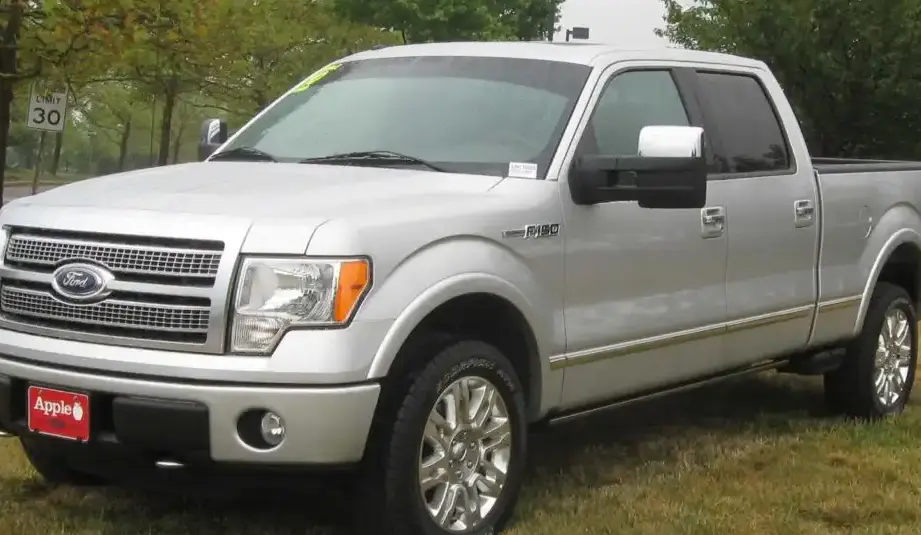
The Ford F-150 XII SuperCrew, produced from 2008 to 2010, represented the twelfth generation of the iconic Ford F-Series pickup truck. This iteration continued the F-150’s dominance in the full-size pickup segment in North America, offering a blend of capability, comfort, and technology. The SuperCrew configuration, characterized by its four full-size doors and spacious rear seating, catered to families and those needing passenger capacity alongside truck functionality. Within the F-150 lineup, the 4.6-liter V8 engine paired with an automatic transmission occupied a middle ground, offering a balance between power, fuel economy, and affordability. It served as a step up from the base V6 models, while remaining more accessible than the higher-performance 5.4-liter V8 and diesel options.
Technical Specifications
| Brand | Ford |
| Model | F-Series F-100/F-150 |
| Generation | F-Series F-150 XII SuperCrew |
| Type (Engine) | 4.6 V8 (292 Hp) Automatic |
| Start of production | October, 2008 |
| End of production | 2010 |
| Powertrain Architecture | Internal Combustion engine |
| Body type | Pick-up |
| Seats | 5-6 |
| Doors | 4 |
| Fuel consumption (urban) | 15.7 l/100 km (15 US mpg, 18 UK mpg, 6.4 km/l) |
| Fuel consumption (extra urban) | 11.2-11.8 l/100 km (21 – 19.9 US mpg, 25.2 – 23.9 UK mpg, 8.9 – 8.5 km/l) |
| Fuel Type | Petrol (Gasoline) |
| Power | 292 Hp @ 5700 rpm |
| Power per litre | 63.4 Hp/l |
| Torque | 434 Nm @ 4000 rpm (320.1 lb.-ft. @ 4000 rpm) |
| Engine layout | Front, Longitudinal |
| Engine displacement | 4606 cm3 (281.08 cu. in.) |
| Number of cylinders | 8 |
| Engine configuration | V-engine |
| Cylinder Bore | 90.17 mm (3.55 in.) |
| Piston Stroke | 90.17 mm (3.55 in.) |
| Compression ratio | 9.8:1 |
| Number of valves per cylinder | 3 |
| Fuel injection system | Multi-port manifold injection |
| Engine aspiration | Naturally aspirated engine |
| Valvetrain | SOHC |
| Engine oil capacity | 5.7 l (6.02 US qt | 5.02 UK qt) |
| Coolant | 15 l (15.85 US qt | 13.2 UK qt) |
| Max. weight | 3130 kg (6900.47 lbs.) |
| Trunk (boot) space – minimum | 1572 l (55.51 cu. ft.) |
| Trunk (boot) space – maximum | 1855 l (65.51 cu. ft.) |
| Fuel tank capacity | 98 l (25.89 US gal | 21.56 UK gal) |
| Permitted trailer load with brakes (12%) | 4309 kg (9499.72 lbs.) |
| Length | 5885-6190 mm (231.69 – 243.7 in.) |
| Width | 2004 mm (78.9 in.) |
| Width with mirrors folded | 2123 mm (83.58 in.) |
| Width including mirrors | 2464 mm (97.01 in.) |
| Height | 1887 mm (74.29 in.) |
| Wheelbase | 3670-3975 mm (144.49 – 156.5 in.) |
| Ride height (ground clearance) | 198-211 mm (7.8 – 8.31 in.) |
| Minimum turning circle (turning diameter) | 14.3-15.4 m (46.92 – 50.52 ft.) |
| Approach angle | 21.2-22.4° |
| Departure angle | 17.7-18.1° |
| Ramp-over (brakeover) angle | 14.5-15.2° |
| Drivetrain Architecture | The Internal combustion engine (ICE) drives the rear wheels of the vehicle. |
| Drive wheel | Rear wheel drive |
| Number of gears and type of gearbox | 6 gears, automatic transmission |
| Front suspension | Double wishbone |
| Rear suspension | Leaf spring |
| Front brakes | Ventilated discs, 330 mm |
| Rear brakes | Ventilated discs, 348 mm |
| Assisting systems | ABS (Anti-lock braking system) |
| Steering type | Steering rack and pinion |
| Power steering | Electric Steering |
| Tires size | 255/65 R17; 265/60 R18; 275/55 R20 |
| Wheel rims size | 17; 18; 20 |
Powertrain & Engine Architecture
The heart of this F-150 variant was the 4.6-liter Modular V8 engine, specifically the version designated as the 2V. This engine, part of Ford’s long-running Modular engine family, featured a cast iron block with aluminum cylinder heads. The “2V” designation indicated a two-valve per cylinder configuration, utilizing a single overhead camshaft (SOHC) design. Fuel delivery was managed by a multi-port fuel injection system, providing precise fuel metering for optimal combustion. The engine’s 9.8:1 compression ratio was a compromise between performance and the ability to run on readily available gasoline. The 4.6L V8 was known for its relatively smooth operation and decent low-end torque. The automatic transmission paired with this engine was typically a 6-speed unit, offering smooth shifts and a wide gear ratio spread. This transmission was designed to balance fuel efficiency with the demands of towing and hauling.
Driving Characteristics
The 4.6-liter V8 with the automatic transmission delivered a comfortable and capable driving experience. While not as quick as the 5.4-liter V8 or the diesel options, it provided sufficient power for everyday driving and moderate towing needs. Acceleration from a standstill was adequate, and the automatic transmission generally shifted smoothly, although it could sometimes feel hesitant during quick overtaking maneuvers. The 6-speed automatic’s gear ratios were tuned for a balance of fuel economy and usability, with a relatively tall final drive ratio. Compared to the manual transmission versions of the 4.6L, the automatic offered greater convenience, especially in stop-and-go traffic, but at the expense of some driver engagement and potentially slightly lower fuel economy. The overall driving experience was geared towards comfort and practicality rather than outright performance.
Equipment & Trim Levels
The 4.6-liter V8 SuperCrew typically came standard with features like air conditioning, power windows and locks, a basic audio system, and cloth upholstery. Higher trim levels, such as the XLT and Lariat, added features like alloy wheels, upgraded audio systems, leather upholstery, power-adjustable seats, and advanced safety features. Optional extras included a navigation system, a sunroof, and various towing packages. The SuperCrew configuration itself was a significant feature, offering a spacious cabin with ample room for passengers and cargo. The interior design was functional and durable, reflecting the truck’s work-oriented nature.
Chassis & Braking
The F-150 XII SuperCrew utilized a body-on-frame construction, providing a robust and durable platform. The front suspension featured an independent double wishbone design, while the rear suspension employed a traditional leaf spring setup. This combination offered a good balance of ride comfort and load-carrying capacity. Braking duties were handled by ventilated disc brakes on all four wheels, providing adequate stopping power for the truck’s weight. An Anti-lock Braking System (ABS) was standard, enhancing safety during emergency braking situations. Steering was rack-and-pinion with power assist, offering responsive and precise handling.
Market Reception & Comparison
The 4.6-liter V8 F-150 SuperCrew was generally well-received by critics and consumers alike. It was praised for its comfortable ride, spacious interior, and capable performance. However, some reviewers noted that the engine could feel underpowered when towing heavy loads or driving in hilly terrain. Fuel economy was considered average for a full-size pickup truck. Compared to the 5.4-liter V8, the 4.6-liter offered better fuel economy but less power. Compared to the diesel options, it provided a lower initial cost but lacked the diesel’s superior torque and fuel efficiency. The 4.6L automatic was often seen as a good all-around choice for buyers who prioritized comfort and convenience over outright performance.
Legacy
The 4.6-liter Modular V8 engine proved to be a reliable and durable powerplant, and many examples are still on the road today. While not without its quirks, such as potential for spark plug issues and oil consumption in some cases, the engine is generally considered to be relatively easy to maintain and repair. The F-150 XII SuperCrew, particularly with the 4.6-liter V8 and automatic transmission, remains a popular choice in the used truck market, offering a good balance of capability, comfort, and affordability. Its enduring appeal is a testament to Ford’s successful formula for the F-150 – a truck that consistently delivers on its promise of toughness, reliability, and versatility.