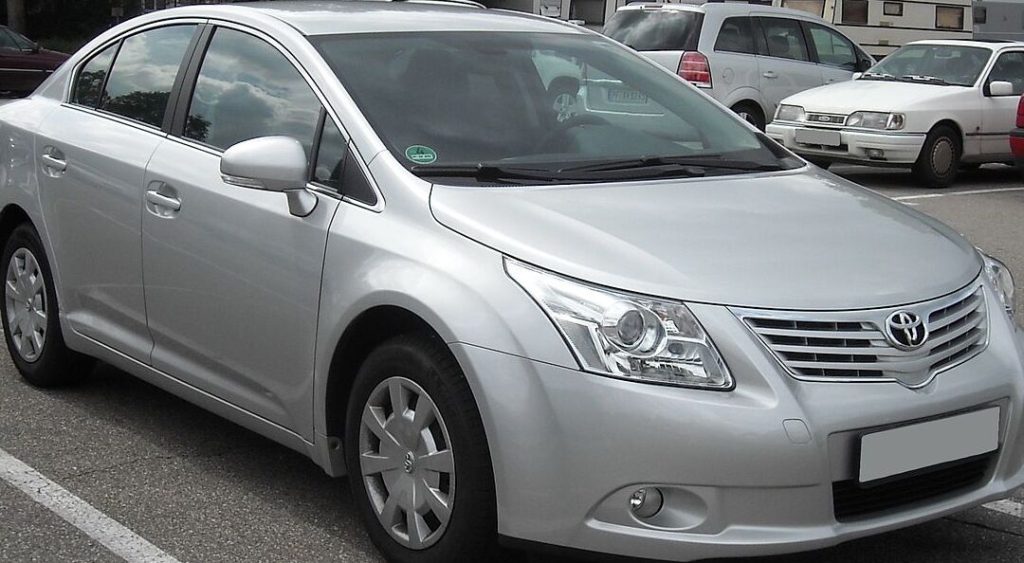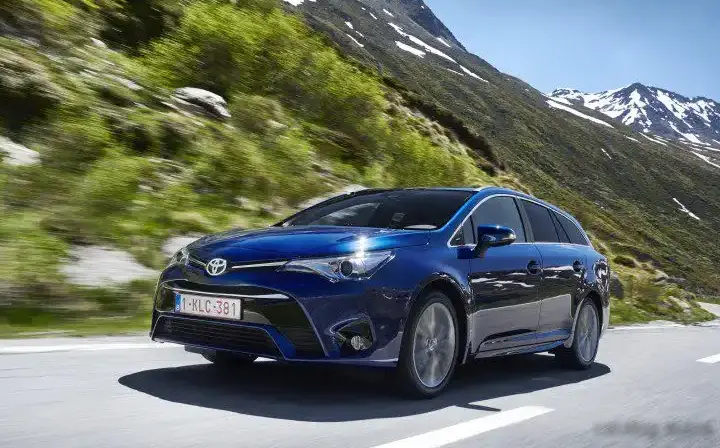
The Toyota Avensis III Wagon, specifically the facelifted model produced from 2015 to 2018, represented Toyota’s offering in the mid-size station wagon segment. This variant, equipped with the 2.0-liter Valvematic engine producing 152 horsepower and paired with a Multidrive S continuously variable transmission (CVT), was positioned as a well-rounded option appealing to families and drivers prioritizing comfort and fuel efficiency. It served as a key model within the broader Avensis III range, which aimed to provide a reliable and practical alternative to European and domestic competitors.
Technical Specifications
| Brand | Toyota |
| Model | Avensis |
| Generation | Avensis III Wagon (facelift 2015) |
| Type (Engine) | 2.0 Valvematic (152 Hp) Multidrive S |
| Start of production | 2015 |
| End of production | 2018 |
| Powertrain Architecture | Internal Combustion engine |
| Body type | Station wagon (estate) |
| Seats | 5 |
| Doors | 5 |
| Fuel consumption (urban) | 8.7 l/100 km (27 US mpg, 32.5 UK mpg, 11.5 km/l) |
| Fuel consumption (extra urban) | 5.1 l/100 km (46.1 US mpg, 55.4 UK mpg, 19.6 km/l) |
| Fuel consumption (combined) | 6.4 l/100 km (36.8 US mpg, 44.1 UK mpg, 15.6 km/l) |
| CO2 emissions | 148 g/km |
| Fuel Type | Petrol (Gasoline) |
| Acceleration 0 – 100 km/h | 10.3 sec |
| Acceleration 0 – 62 mph | 10.3 sec |
| Acceleration 0 – 60 mph | 9.8 sec |
| Maximum speed | 200 km/h (124.27 mph) |
| Emission standard | Euro 6 W |
| Power | 152 Hp @ 6200 rpm |
| Power per litre | 76.5 Hp/l |
| Torque | 196 Nm @ 4000 rpm (144.56 lb.-ft. @ 4000 rpm) |
| Engine layout | Front, Transverse |
| Engine Model/Code | 3ZR-FAE |
| Engine displacement | 1987 cm3 (121.25 cu. in.) |
| Number of cylinders | 4 |
| Engine configuration | Inline |
| Cylinder Bore | 80.5 mm (3.17 in.) |
| Piston Stroke | 97.6 mm (3.84 in.) |
| Compression ratio | 10.5:1 |
| Number of valves per cylinder | 4 |
| Fuel injection system | Multi-port manifold injection |
| Engine aspiration | Naturally aspirated engine |
| Valvetrain | DOHC |
| Engine oil capacity | 4.2 l (4.44 US qt | 3.7 UK qt) |
| Coolant capacity | 6.2 l (6.55 US qt | 5.46 UK qt) |
| Max. weight | 2050 kg (4519.48 lbs.) |
| Trunk (boot) space – minimum | 543 l (19.18 cu. ft.) |
| Trunk (boot) space – maximum | 1609 l (56.82 cu. ft.) |
| Fuel tank capacity | 60 l (15.85 US gal | 13.2 UK gal) |
| Permitted trailer load with brakes (12%) | 1800 kg (3968.32 lbs.) |
| Permitted trailer load without brakes | 500 kg (1102.31 lbs.) |
| Length | 4820 mm (189.76 in.) |
| Width | 1810 mm (71.26 in.) |
| Height | 1480 mm (58.27 in.) |
| Wheelbase | 2700 mm (106.3 in.) |
| Drag coefficient (Cd) | 0.29 |
| Minimum turning circle | 10.8 m (35.43 ft.) |
INTRODUCTION
The 2015-2018 Toyota Avensis III Wagon 2.0 Valvematic Multidrive S represents a refinement of Toyota’s D-segment wagon offering. Built on the Avensis T27 platform (also known as the 1HX0 in some markets), this facelift brought updated styling, improved efficiency, and enhanced standard equipment. The 2.0 Valvematic engine and Multidrive S transmission combination aimed to deliver a balance between performance and economy, making it a popular choice for those seeking a practical and reliable family vehicle. This particular configuration occupied a mid-range position within the Avensis lineup, offering more power than the 1.6-liter models but remaining more affordable and fuel-efficient than the higher-spec 2.2-liter diesel options.
Powertrain & Engine Architecture
At the heart of this Avensis variant lies the 3ZR-FAE 2.0-liter inline-four cylinder engine. This engine utilizes Toyota’s Valvematic technology, a variable valve lift and timing system that optimizes engine performance and fuel efficiency across a wider range of engine speeds. Unlike traditional VVT-i systems, Valvematic continuously adjusts valve lift according to driving conditions, resulting in improved throttle response and reduced pumping losses. The engine employs multi-port fuel injection and a compression ratio of 10.5:1. The Multidrive S transmission is a CVT, offering seamless and stepless gear changes. It features a simulated shift mode to provide a more conventional driving experience when desired. The transmission is known for its smoothness and contribution to fuel economy, though it doesn’t offer the sporty feel of a traditional automatic or dual-clutch transmission.
Driving Characteristics
The 152 horsepower and 196 Nm (144.56 lb-ft) of torque delivered by the 2.0 Valvematic engine, coupled with the Multidrive S transmission, provides adequate performance for everyday driving. Acceleration from 0-60 mph takes approximately 9.8 seconds, and top speed is limited to 124.27 mph. While not a particularly sporty vehicle, the Avensis Wagon offers smooth and predictable power delivery. The CVT transmission prioritizes efficiency, and while it can be programmed for more aggressive responses, it generally operates in a way that minimizes engine revs and maximizes fuel economy. Compared to the manual transmission versions, the Multidrive S offers greater convenience, especially in urban traffic. However, it lacks the direct feel and engagement of a manual gearbox. Compared to the diesel variants, this petrol engine provides a quieter and more refined driving experience, but sacrifices some low-end torque and overall fuel economy.
Equipment & Trim Levels
The 2.0 Valvematic Multidrive S trim typically included a generous level of standard equipment. Features commonly found in this variant include air conditioning, a touchscreen infotainment system with Bluetooth connectivity, alloy wheels, cruise control, and automatic headlights. Higher trim levels offered additional features such as leather upholstery, a sunroof, and advanced safety systems like lane departure warning and adaptive cruise control. Interior upholstery was typically cloth, with options for partial leather. The dashboard layout was functional and well-designed, prioritizing ease of use and practicality.
Chassis & Braking
The Avensis Wagon features a McPherson strut front suspension and an independent multi-link rear suspension, providing a comfortable and controlled ride. Stabilizer bars are fitted to both axles to reduce body roll during cornering. Braking duties are handled by ventilated discs at the front and solid discs at the rear. Anti-lock Braking System (ABS) is standard. The suspension setup is tuned for comfort rather than outright sportiness, prioritizing a smooth ride over sharp handling. The steering is light and precise, making it easy to maneuver in urban environments.
Market Reception & Comparison
The Avensis III Wagon 2.0 Valvematic Multidrive S was generally well-received by automotive critics. It was praised for its reliability, spacious interior, comfortable ride, and good fuel economy. However, some reviewers noted that the CVT transmission could feel somewhat detached and lacked the responsiveness of a traditional automatic. Compared to rivals like the Ford Mondeo and Volkswagen Passat, the Avensis offered a strong value proposition, particularly in terms of reliability and long-term ownership costs. The fuel economy of around 36.8 US mpg combined was competitive within its class, though diesel variants offered significantly better figures.
Legacy
The Toyota Avensis III Wagon, including the 2.0 Valvematic Multidrive S variant, has established a reputation for exceptional reliability and durability. The 3ZR-FAE engine is known for its longevity, and the Multidrive S transmission, while not without its critics, has proven to be generally dependable. In the used car market, these Avensis wagons are often sought after by buyers looking for a practical, reliable, and affordable family vehicle. Maintenance costs are typically reasonable, and parts availability is good. While no longer in production (the Avensis was discontinued in Europe in 2018), the Avensis III Wagon remains a popular choice for those seeking a well-built and dependable estate car.