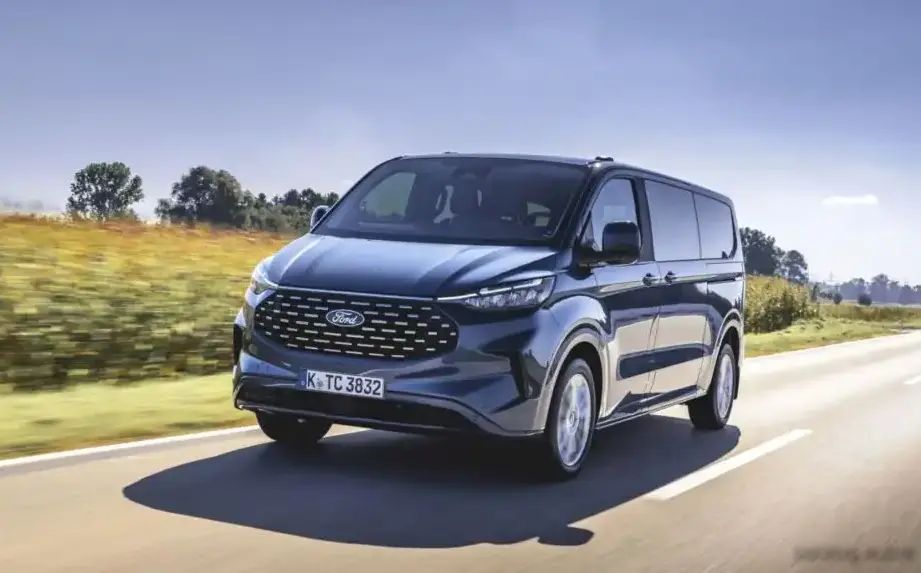
The Ford Tourneo Custom II L2 2.0 EcoBlue (150 hp) represents a significant iteration in Ford’s European van lineup, introduced in July 2023. Positioned as a versatile passenger vehicle, the Tourneo Custom II builds upon the success of its predecessor, offering increased space, improved efficiency, and modern technology. The “L2” designation indicates a long wheelbase version, providing enhanced cargo and passenger capacity. This particular variant, equipped with the 2.0 EcoBlue diesel engine producing 150 horsepower, serves as a mid-range option within the Tourneo Custom II series, balancing performance with fuel economy and practicality for both commercial and family use. It primarily targets the European market, where multi-purpose vehicles and vans are highly popular for their adaptability.
Technical Specifications
| Brand | Ford |
| Model | Tourneo Custom |
| Generation | Tourneo Custom II L2 |
| Type (Engine) | 2.0 EcoBlue (150 Hp) |
| Start of production | July, 2023 |
| Powertrain Architecture | Internal Combustion engine |
| Body type | Van |
| Seats | 8-9 |
| Doors | 4-5 |
| Fuel consumption at Low speed (WLTP) | 9.6-10.4 l/100 km (24.5 – 22.6 US mpg, 29.4 – 27.2 UK mpg, 10.4 – 9.6 km/l) |
| Fuel consumption at Medium speed (WLTP) | 7-7.5 l/100 km (33.6 – 31.4 US mpg, 40.4 – 37.7 UK mpg, 14.3 – 13.3 km/l) |
| Fuel consumption at high speed (WLTP) | 6.2-6.8 l/100 km (37.9 – 34.6 US mpg, 45.6 – 41.5 UK mpg, 16.1 – 14.7 km/l) |
| Fuel consumption at very high speed (WLTP) | 7.8-8.4 l/100 km (30.2 – 28 US mpg, 36.2 – 33.6 UK mpg, 12.8 – 11.9 km/l) |
| Combined fuel consumption (WLTP) | 7.4-8 l/100 km (31.8 – 29.4 US mpg, 38.2 – 35.3 UK mpg, 13.5 – 12.5 km/l) |
| CO2 emissions (WLTP) | 193-208 g/km |
| Fuel Type | Diesel |
| Emission standard | Euro 6.2 |
| Weight-to-power ratio | 14.4 kg/Hp, 69.3 Hp/tonne |
| Weight-to-torque ratio | 6 kg/Nm, 166.3 Nm/tonne |
| Power | 150 Hp |
| Power per litre | 75.2 Hp/l |
| Torque | 360 Nm (265.52 lb.-ft.) |
| Engine layout | Front, Transverse |
| Engine Model/Code | BKFB |
| Engine displacement | 1996 cm3 (121.8 cu. in.) |
| Number of cylinders | 4 |
| Engine configuration | Inline |
| Cylinder Bore | 84.01 mm (3.31 in.) |
| Piston Stroke | 90.03 mm (3.54 in.) |
| Compression ratio | 16.5:1 |
| Number of valves per cylinder | 4 |
| Fuel injection system | Diesel Commonrail |
| Engine aspiration | Turbocharger, Intercooler |
| Valvetrain | DOHC |
| Engine oil capacity | 9.6 l (10.14 US qt | 8.45 UK qt) |
| Coolant | 12.3 l (13 US qt | 10.82 UK qt) |
| Kerb Weight | 2165-2235 kg (4773.01 – 4927.33 lbs.) |
| Max. weight | 3225 kg (7109.91 lbs.) |
| Max load | 990-1060 kg (2182.58 – 2336.9 lbs.) |
| Trunk (boot) space – minimum | 819 l (28.92 cu. ft.) |
| Trunk (boot) space – maximum | 5472 l (193.24 cu. ft.) |
| Fuel tank capacity | 55 l (14.53 US gal | 12.1 UK gal) |
| AdBlue tank | 20 l (5.28 US gal | 4.4 UK gal) |
| Permitted trailer load with brakes (12%) | 2500 kg (5511.56 lbs.) |
| Permitted trailer load without brakes | 750 kg (1653.47 lbs.) |
| Length | 5450 mm (214.57 in.) |
| Width | 2032 mm (80 in.) |
| Width with mirrors folded | 2148 mm (84.57 in.) |
| Width including mirrors | 2275 mm (89.57 in.) |
| Height | 1963-2031 mm (77.28 – 79.96 in.) |
| Wheelbase | 3500 mm (137.8 in.) |
| Front track | 1730 mm (68.11 in.) |
| Rear (Back) track | 1721 mm (67.76 in.) |
| Front overhang | 958 mm (37.72 in.) |
| Rear overhang | 992 mm (39.06 in.) |
| Ride height (ground clearance) | 140 mm (5.51 in.) |
| Minimum turning circle (turning diameter) | 12.8 m (41.99 ft.) |
| Approach angle | 17.2° |
| Departure angle | 16.4° |
| Drivetrain Architecture | The Internal combustion engine (ICE) drives the front wheels of the vehicle. |
| Drive wheel | Front wheel drive |
| Number of gears and type of gearbox | 6 gears, manual transmission |
| Front suspension | Independent, type McPherson with coil spring and anti-roll bar |
| Rear suspension | Independent coil spring, Trailing arm |
| Front brakes | Ventilated discs, 308 mm |
| Rear brakes | Ventilated discs, 304 mm |
| Assisting systems | ABS (Anti-lock braking system) |
| Steering type | Steering rack and pinion |
| Power steering | Electric Steering |
| Tires size | 215/60 R17 |
| Wheel rims size | 6.5J x 17 |
Powertrain & Engine Architecture
The heart of this Tourneo Custom variant is the 2.0-liter EcoBlue diesel engine, specifically the BKFB code. This engine is part of Ford’s EcoBlue family, known for its focus on efficiency and reduced emissions. The 2.0L EcoBlue utilizes a common-rail direct fuel injection system, delivering fuel directly into the cylinders at extremely high pressure for optimized combustion. The engine features a single turbocharger with an intercooler, enhancing power output and reducing turbo lag. The valvetrain employs a Double Overhead Camshaft (DOHC) configuration with four valves per cylinder, contributing to improved breathing and overall engine performance. The engine’s 16.5:1 compression ratio is relatively high for a diesel, aiding in thermal efficiency. The engine is transversely mounted at the front of the vehicle, driving the front wheels. This engine is paired with a 6-speed manual transmission, chosen for its balance of fuel efficiency and driver control.
Driving Characteristics
The 150 hp EcoBlue engine, coupled with the 6-speed manual gearbox, provides adequate performance for typical van duties. Acceleration is not brisk, but sufficient for merging onto highways and maintaining speed with a moderate load. The engine delivers its peak torque of 360 Nm (265.52 lb.-ft.) relatively low in the rev range, providing good pulling power for carrying passengers or cargo. The manual transmission allows for precise gear selection, enabling drivers to optimize fuel economy or extract more power when needed. Compared to higher-output versions of the 2.0 EcoBlue, this variant feels less strained during uphill climbs or when fully loaded. However, it lacks the outright speed and responsiveness of those more powerful options. The gear ratios are tuned for a balance between fuel efficiency and usability, with a relatively long sixth gear for comfortable cruising on the highway.
Equipment & Trim Levels
The Tourneo Custom II L2 2.0 EcoBlue (150 hp) typically comes equipped with a respectable level of standard features. These generally include air conditioning, power windows, a basic audio system with Bluetooth connectivity, and a driver information display. Safety features such as ABS, Electronic Stability Control (ESC), and multiple airbags are standard. Interior upholstery is typically cloth, with durable and practical materials used throughout the cabin. Optional extras often include navigation system, parking sensors, a rearview camera, upgraded audio systems, and various driver-assistance technologies like lane-keeping assist and adaptive cruise control. Trim levels above this base specification add features like alloy wheels, upgraded interior trim, and more sophisticated infotainment systems.
Chassis & Braking
The Tourneo Custom II L2 utilizes an independent suspension setup on both the front and rear axles. The front suspension employs a McPherson strut design with coil springs and an anti-roll bar, while the rear suspension features an independent coil spring and trailing arm configuration. This setup provides a reasonable balance between ride comfort and handling stability. The braking system consists of ventilated discs on all four wheels, providing adequate stopping power for the vehicle’s weight. ABS (Anti-lock Braking System) is standard, enhancing braking performance in emergency situations. The electric power steering provides light and precise steering feel, making it easy to maneuver in urban environments.
Market Reception & Comparison
The Ford Tourneo Custom II L2 2.0 EcoBlue (150 hp) has been generally well-received in the European market. Critics praise its spacious interior, comfortable ride, and improved fuel efficiency compared to older models. The 150 hp engine is considered a good compromise for those who prioritize fuel economy and practicality over outright performance. Compared to the higher-powered 185 hp version of the 2.0 EcoBlue, this variant offers lower running costs but sacrifices some performance. The 1.5 EcoBlue engine, while even more fuel-efficient, is often considered underpowered for fully loaded vehicles or frequent highway driving. Reliability reports suggest that the EcoBlue engine is generally robust, but regular maintenance is crucial to ensure long-term durability.
Legacy
The 2.0 EcoBlue engine has become a mainstay in Ford’s commercial vehicle lineup, and the Tourneo Custom II L2 2.0 EcoBlue (150 hp) is expected to maintain a strong presence in the used car market for years to come. Its combination of practicality, fuel efficiency, and reasonable running costs makes it an attractive option for families and businesses alike. The availability of spare parts and a widespread dealer network should ensure that maintenance and repairs remain relatively straightforward. As with any diesel vehicle, proper maintenance, including regular oil changes and AdBlue refills, is essential to maximize the engine’s lifespan and minimize the risk of costly repairs.