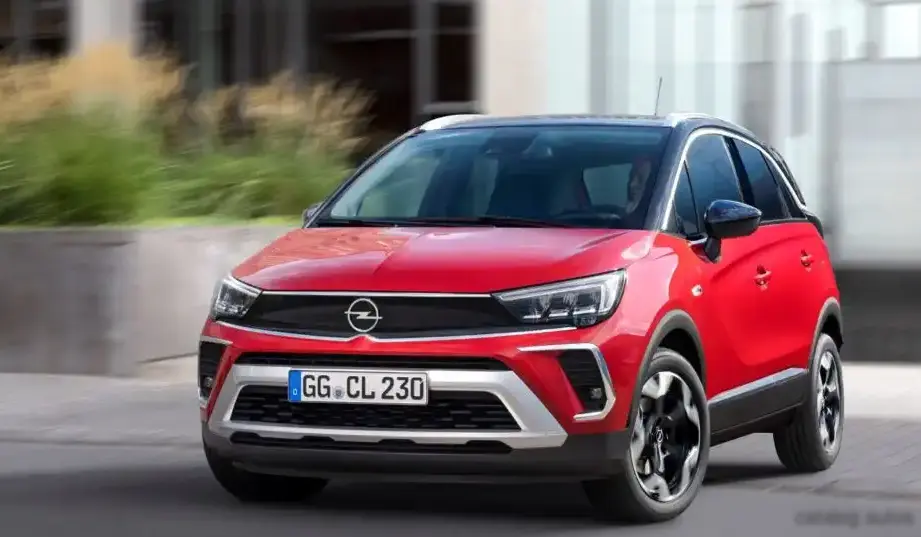
The Opel Crossland X 1.2 Turbo (130 hp) Automatic, produced from June 2019 to October 2020, represents a key variant within the Crossland X model range. Positioned as a mid-range offering, this version aimed to balance fuel efficiency with adequate performance for everyday driving. It falls within the first generation of the Crossland X (B24), a subcompact crossover SUV designed to appeal to families and individuals seeking a practical and versatile vehicle. The Crossland X was a collaborative effort between Opel (Vauxhall in the UK) and PSA Peugeot Citroën, sharing its platform with the Peugeot 2008 and Citroën C3 Aircross.
Technical Specifications
| Brand | Opel |
| Model | Crossland |
| Generation | Crossland X |
| Type (Engine) | 1.2 Turbo (130 Hp) Automatic |
| Start of production | June, 2019 |
| End of production | October, 2020 |
| Powertrain Architecture | Internal Combustion engine |
| Body type | SUV |
| Seats | 5 |
| Doors | 5 |
| Combined fuel consumption (WLTP) | 6.4-6.7 l/100 km (36.8 – 35.1 US mpg, 44.1 – 42.2 UK mpg, 15.6 – 14.9 km/l) |
| CO2 emissions (WLTP) | 145-152 g/km |
| Fuel consumption (economy) – urban (NEDC) | 5.9 l/100 km (39.9 US mpg, 47.9 UK mpg, 16.9 km/l) |
| Fuel consumption (economy) – extra urban (NEDC) | 4.5 l/100 km (52.3 US mpg, 62.8 UK mpg, 22.2 km/l) |
| Fuel consumption (economy) – combined (NEDC) | 5 l/100 km (47 US mpg, 56.5 UK mpg, 20 km/l) |
| CO2 emissions (NEDC) | 113-114 g/km |
| Fuel Type | Petrol (Gasoline) |
| Acceleration 0 – 100 km/h | 10.2 sec |
| Acceleration 0 – 62 mph | 10.2 sec |
| Acceleration 0 – 60 mph | 9.7 sec |
| Maximum speed | 198 km/h (123.03 mph) |
| Emission standard | Euro 6d |
| Weight-to-power ratio | 9.9 kg/Hp, 100.7 Hp/tonne |
| Weight-to-torque ratio | 5.6 kg/Nm, 178.2 Nm/tonne |
| Power | 130 Hp @ 5500 rpm |
| Power per litre | 108.4 Hp/l |
| Torque | 230 Nm @ 1750 rpm (169.64 lb.-ft. @ 1750 rpm) |
| Engine layout | Front, Transverse |
| Engine Model/Code | F12XHT |
| Engine displacement | 1199 cm3 (73.17 cu. in.) |
| Number of cylinders | 3 |
| Engine configuration | Inline |
| Cylinder Bore | 75 mm (2.95 in.) |
| Piston Stroke | 90.5 mm (3.56 in.) |
| Compression ratio | 10.5:1 |
| Number of valves per cylinder | 4 |
| Fuel injection system | Direct injection |
| Engine aspiration | Turbocharger, Intercooler |
| Engine oil capacity | 3.5 l (3.7 US qt | 3.08 UK qt) |
| Coolant | 5.7 l (6.02 US qt | 5.02 UK qt) |
| Kerb Weight | 1291 kg (2846.17 lbs.) |
| Max. weight | 1835 kg (4045.48 lbs.) |
| Max load | 544 kg (1199.31 lbs.) |
| Trunk (boot) space – minimum | 410 l (14.48 cu. ft.) |
| Trunk (boot) space – maximum | 1255 l (44.32 cu. ft.) |
| Fuel tank capacity | 45 l (11.89 US gal | 9.9 UK gal) |
| Max. roof load | 65 kg (143.3 lbs.) |
| Permitted trailer load with brakes (12%) | 840 kg (1851.88 lbs.) |
| Permitted trailer load without brakes | 600 kg (1322.77 lbs.) |
| Length | 4212 mm (165.83 in.) |
| Width | 1765 mm (69.49 in.) |
| Width with mirrors folded | 1825 mm (71.85 in.) |
| Width including mirrors | 1976 mm (77.8 in.) |
| Height | 1605 mm (63.19 in.) |
| Wheelbase | 2604 mm (102.52 in.) |
| Front track | 1513 mm (59.57 in.) |
| Rear (Back) track | 1491 mm (58.7 in.) |
| Minimum turning circle | 11.2 m (36.75 ft.) |
| Drivetrain Architecture | The Internal combustion engine (ICE) drives the front wheels of the vehicle. |
| Drive wheel | Front wheel drive |
| Number of gears and type of gearbox | 6 gears, automatic transmission |
Powertrain & Engine Architecture
The heart of the Crossland X 1.2 Turbo Automatic is the F12XHT engine, a 1.2-liter, three-cylinder turbocharged gasoline engine. This engine is part of Opel/PSA’s “PureTech” family, known for its compact size and efficiency. The engine utilizes direct fuel injection, delivering fuel directly into the combustion chamber for improved combustion and reduced emissions. It also features a turbocharger with an intercooler, which forces more air into the engine, boosting power output. The engine produces 130 horsepower at 5500 rpm and 230 Nm (169.64 lb-ft) of torque at 1750 rpm. This torque figure is particularly noteworthy for a small-displacement engine, providing good low-end responsiveness. The engine is paired with a six-speed automatic transmission, designed to provide smooth and convenient gear changes. This transmission is a traditional torque-converter automatic, prioritizing comfort over outright performance.
Driving Characteristics
The 1.2 Turbo Automatic offers a comfortable and generally adequate driving experience. Acceleration from 0-60 mph takes around 9.7 seconds, and 0-100 km/h in 10.2 seconds, which is typical for a vehicle in this class. The automatic transmission contributes to a relaxed driving style, particularly in urban environments. However, compared to the manual transmission versions or the more powerful 1.5 Diesel, the 1.2 Turbo Automatic feels less eager to accelerate, especially when fully loaded or tackling uphill climbs. The gear ratios are tuned for fuel efficiency rather than sporty performance. The engine is relatively quiet at cruising speeds, but can become noticeable under hard acceleration. The front-wheel-drive configuration provides predictable handling, but lacks the all-weather capability of an all-wheel-drive system.
Equipment & Trim Levels
The Crossland X 1.2 Turbo Automatic typically came equipped with a reasonable level of standard features. These included air conditioning, a touchscreen infotainment system with Apple CarPlay and Android Auto compatibility, Bluetooth connectivity, and a suite of safety features such as ABS, ESP (Electronic Stability Program), and multiple airbags. Higher trim levels offered additional features like automatic climate control, a rearview camera, parking sensors, and alloy wheels. Interior upholstery was typically cloth, with options for leather upgrades. The dashboard layout was functional and straightforward, prioritizing ease of use. Optional extras included a panoramic sunroof, heated seats, and a more advanced navigation system.
Chassis & Braking
The Crossland X utilizes a front-wheel-drive chassis with a MacPherson strut suspension at the front and a torsion beam suspension at the rear. This setup provides a good balance between ride comfort and handling. The torsion beam rear suspension is a cost-effective solution, but it doesn’t offer the same level of sophistication as a multi-link setup. Braking duties are handled by disc brakes at the front and drum brakes at the rear. While adequate for everyday driving, the rear drum brakes are less effective than disc brakes, particularly under heavy braking. Electric power steering provides light and easy steering, making it ideal for maneuvering in tight spaces.
Market Reception & Comparison
The Opel Crossland X 1.2 Turbo Automatic received mixed reviews from automotive critics. While praised for its fuel efficiency and comfortable ride, it was often criticized for its lack of outright performance and somewhat basic interior. Compared to its siblings, the 1.5 Diesel offered better fuel economy and more torque, making it a better choice for long-distance driving. The more powerful petrol engines provided quicker acceleration, but at the expense of fuel efficiency. The Crossland X competed with other subcompact crossovers such as the Renault Captur, Nissan Juke, and Hyundai Kona. In terms of fuel economy, the 1.2 Turbo Automatic performed competitively, achieving between 35.1 and 36.8 US mpg on the combined cycle.
Legacy
The F12XHT engine has proven to be generally reliable, although some owners have reported issues with the timing chain. Regular maintenance, including oil changes and timing chain inspections, is crucial for ensuring long-term reliability. The six-speed automatic transmission is also generally dependable, but like any automatic transmission, it requires regular fluid changes. On the used car market, the Crossland X 1.2 Turbo Automatic represents a relatively affordable and practical option for buyers seeking a small crossover SUV. Its fuel efficiency and comfortable ride make it well-suited for urban commuting and family use. However, potential buyers should be aware of the engine’s potential timing chain issues and ensure that the vehicle has been properly maintained.