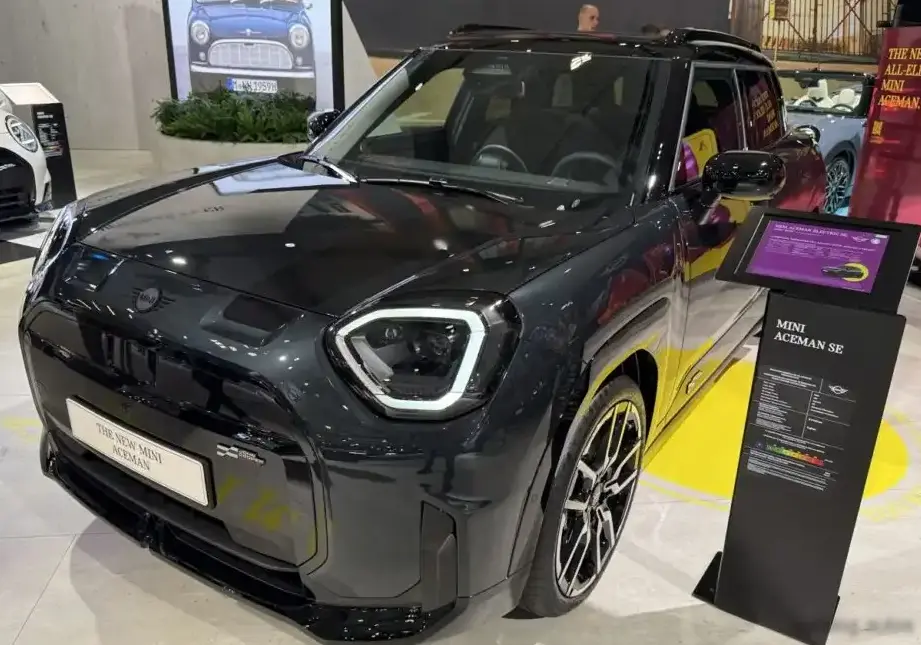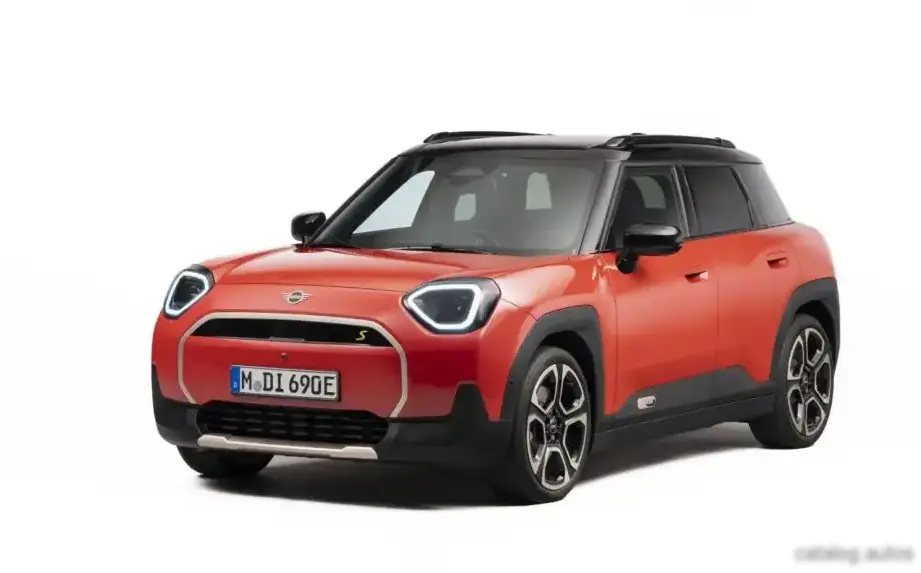
The Mini Aceman (J05) E 38.5 kWh (184 Hp) Electric represents Mini’s entry into the all-electric small crossover segment, commencing production in September 2024. Positioned as a subcompact SUV, the Aceman aims to broaden Mini’s appeal beyond its iconic hatchback and convertible models, offering a blend of distinctive styling, modern technology, and zero-emission driving. It’s built on Mini’s new electric vehicle architecture, designed to maximize interior space and driving enjoyment. The Aceman is intended to be a key model in Mini’s transition towards becoming a fully electric brand.
Technical Specifications
| Brand | Mini |
| Model | Aceman |
| Generation | Aceman (J05) |
| Type (Engine) | E 38.5 kWh (184 Hp) Electric |
| Start of production | September, 2024 |
| Powertrain Architecture | BEV (Electric Vehicle) |
| Body type | SUV, Crossover |
| Seats | 5 |
| Doors | 5 |
| Fuel Type | Electricity |
| Acceleration 0 – 100 km/h | 7.9 sec |
| Acceleration 0 – 62 mph | 7.9 sec |
| Acceleration 0 – 60 mph | 7.5 sec |
| Maximum speed | 160 km/h (99.42 mph) |
| Weight-to-power ratio | 9.3 kg/Hp, 107 Hp/tonne |
| Weight-to-torque ratio | 5.9 kg/Nm, 168.6 Nm/tonne |
| Gross battery capacity | 38.5 kWh |
| Battery technology | Lithium-ion (Li-Ion) |
| Battery location | Below the floor |
| All-electric range (WLTP) | 298-309 km (185.17 – 192 mi) |
| Average Energy consumption (WLTP) | 14.1-14.7 kWh/100 km (22.69 – 23.66 kWh/100 mi) |
| MPGe | 149 – 142 |
| km/kWh | 7.1 – 6.8 |
| mi/kWh | 4.4 – 4.2 |
| Electric motor power | 184 Hp |
| Electric motor Torque | 290 Nm (213.89 lb.-ft.) |
| Electric motor model/code | HC0001N0 |
| Electric motor location | Front axle, Transverse |
| Electric motor type | Synchronous |
| System power | 184 Hp |
| System torque | 290 Nm (213.89 lb.-ft.) |
| Kerb Weight | 1720 kg (3791.95 lbs.) |
| Trunk (boot) space – minimum | 300 l (10.59 cu. ft.) |
| Trunk (boot) space – maximum | 1005 l (35.49 cu. ft.) |
| Length | 4079 mm (160.59 in.) |
| Width | 1754 mm (69.06 in.) |
| Height | 1514 mm (59.61 in.) |
| Wheelbase | 2606 mm (102.6 in.) |
| Drivetrain Architecture | One electric motor drives the front wheels. |
| Drive wheel | Front wheel drive |
| Number of gears and type of gearbox | 1 gears, automatic transmission |
| Front brakes | Disc |
| Rear brakes | Disc |
| Assisting systems | ABS (Anti-lock braking system) |
| Steering type | Steering rack and pinion |
| Power steering | Electric Steering |
| Tires size | 205/55 R17 95H; 225/45 R18 95H; 225/40 R19 93V |
| Wheel rims size | 17; 18; 19 |
Powertrain & Engine Architecture
The Mini Aceman E utilizes a single electric motor driving the front wheels, a configuration common in the entry-level EV market. The motor, designated HC0001N0, is a synchronous motor producing 184 horsepower and 290 Nm (213.89 lb.-ft.) of torque. Power is drawn from a 38.5 kWh lithium-ion battery pack located under the vehicle floor, contributing to a low center of gravity and improved handling. The single-speed automatic transmission provides seamless acceleration. The Aceman doesn’t employ a multi-gear system as is typical with internal combustion engines, relying instead on the electric motor’s broad torque curve for responsive performance. The battery supports DC fast charging, allowing for a significant charge in a relatively short period, though specific charging times vary depending on the charging station’s capabilities.
Driving Characteristics
The Aceman E delivers brisk acceleration, achieving 0-60 mph in approximately 7.5 seconds. While not a performance-oriented vehicle, the instant torque characteristic of electric motors provides a lively driving experience, particularly in urban environments. The single-speed transmission offers linear power delivery, and the vehicle’s relatively low weight (1720 kg / 3791.95 lbs.) contributes to its agility. Compared to potential future, higher-output Aceman variants, this base model prioritizes efficiency and affordability over outright speed. The front-wheel-drive configuration provides predictable handling, though it may exhibit some torque steer under hard acceleration.
Equipment & Trim Levels
The standard equipment on the Mini Aceman E is expected to be comprehensive, reflecting its modern design and target audience. Features include a digital instrument cluster, a central infotainment touchscreen with Mini’s latest operating system, and smartphone integration via Apple CarPlay and Android Auto. Standard safety features encompass ABS, stability control, and a suite of driver-assistance systems. Interior upholstery is likely to be a combination of cloth and synthetic leather, with options for premium leather upgrades. Available options may include a panoramic sunroof, upgraded audio system, and advanced driver-assistance features like adaptive cruise control and lane-keeping assist. Trim levels will likely offer varying degrees of customization and feature content.
Chassis & Braking
The Aceman E utilizes a MacPherson strut front suspension and a multi-link rear suspension, providing a balance of ride comfort and handling precision. Disc brakes are fitted on all four wheels, ensuring adequate stopping power. The electric steering system offers precise and responsive control. Tire sizes vary depending on the trim level, ranging from 205/55 R17 to 225/40 R19. The vehicle’s low center of gravity, thanks to the underfloor battery pack, contributes to its stability and cornering ability. Stabilizer bars are included to minimize body roll during spirited driving.
Market Reception & Comparison
Early reviews of the Mini Aceman E have praised its stylish design, spacious interior, and engaging driving dynamics. Critics have noted its competitive range and relatively quick charging times. Compared to other subcompact electric crossovers like the Hyundai Kona Electric and the Chevrolet Bolt EUV, the Aceman E aims to differentiate itself through its premium brand image and distinctive Mini styling. Fuel economy, expressed as MPGe, is estimated to be between 142 and 149, and energy consumption ranges from 14.1 to 14.7 kWh per 100 kilometers. The Aceman’s pricing is expected to be competitive within the electric crossover segment.
Legacy
The Mini Aceman E represents a significant step in Mini’s electrification strategy. The longevity of the powertrain will depend on battery health and maintenance, but lithium-ion batteries are generally expected to retain a significant portion of their capacity after several years of use. As an early adopter of the all-electric crossover format, the Aceman E is poised to become a popular choice in the used car market, particularly among buyers seeking a stylish, efficient, and environmentally friendly vehicle. Its success will likely influence the development of future Mini electric models and contribute to the broader adoption of electric vehicles.