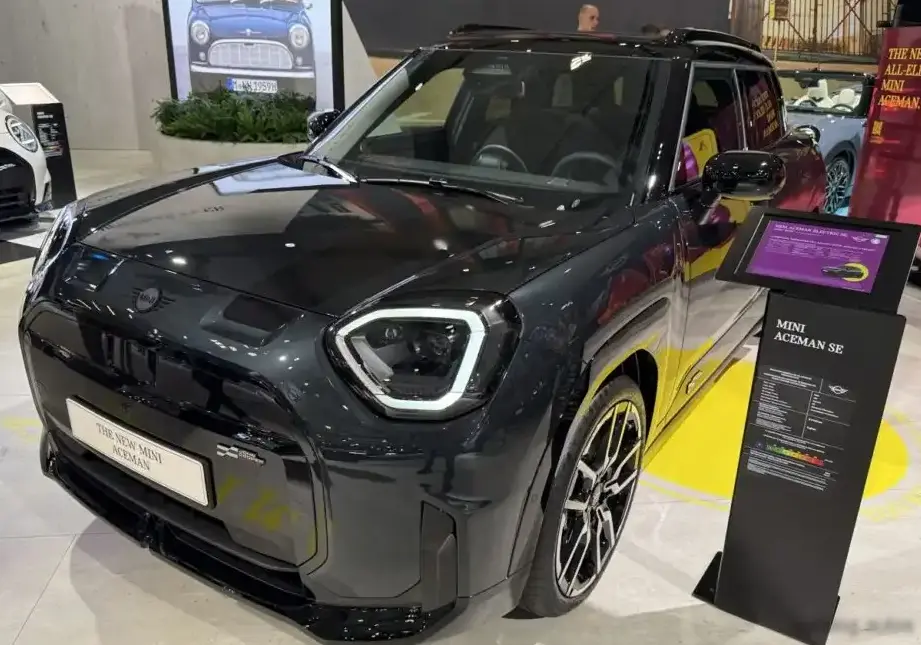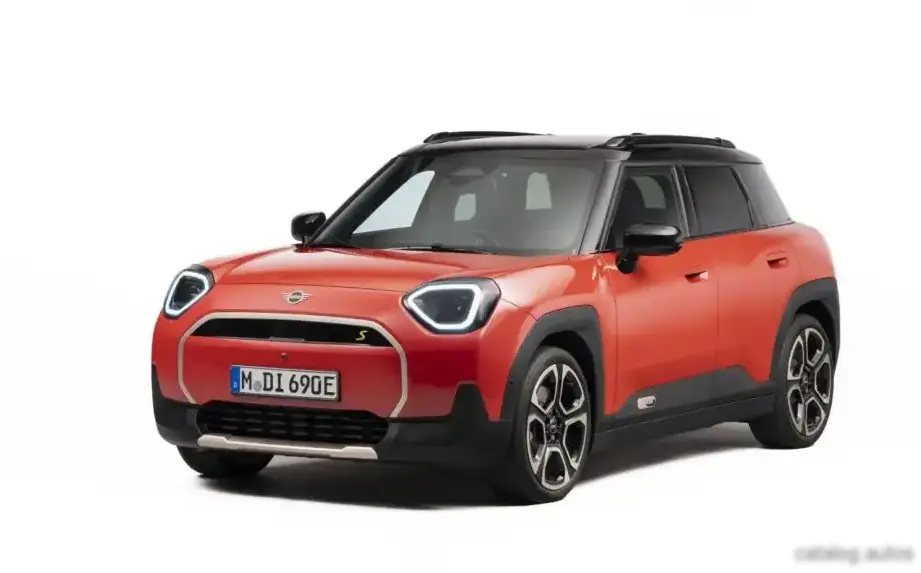
The Mini Aceman JCW 54.2 kWh represents Mini’s foray into the all-electric subcompact crossover segment, slated for production starting in January 2025. Positioned as the performance-oriented variant within the J05 Aceman range, it aims to deliver a blend of Mini’s signature driving dynamics with the instant torque and zero-emission benefits of a battery-electric vehicle (BEV). This model is a key component of Mini’s broader strategy to transition to an all-electric lineup, targeting a younger, environmentally conscious demographic. The Aceman, while sharing some platform elements with BMW’s electric offerings, distinguishes itself through its unique styling and focus on urban agility.
Technical Specifications
| Brand | Mini |
| Model | Aceman |
| Generation | Aceman (J05) |
| Type (Engine) | JCW 54.2 kWh (258 Hp) Electric |
| Start of production | January, 2025 |
| Powertrain Architecture | BEV (Electric Vehicle) |
| Body type | SUV, Crossover |
| Seats | 5 |
| Doors | 5 |
| Fuel Type | Electricity |
| Acceleration 0 – 100 km/h | 6.4 sec |
| Acceleration 0 – 62 mph | 6.4 sec |
| Acceleration 0 – 60 mph | 6.1 sec |
| Maximum speed | 200 km/h (124.27 mph) |
| Weight-to-power ratio | 6.8 kg/Hp, 147.4 Hp/tonne |
| Weight-to-torque ratio | 5 kg/Nm, 200 Nm/tonne |
| Gross battery capacity | 54.2 kWh |
| Net (usable) battery capacity | 49.2 kWh |
| Battery voltage | 398.2 V |
| Battery technology | Lithium-ion (Li-Ion) |
| Battery location | Below the floor |
| All-electric range (WLTP) | 355 km (220.59 mi) |
| Average Energy consumption (WLTP) | 16-16.4 kWh/100 km (25.75 – 26.39 kWh/100 mi) |
| Average Energy consumption (MPGe) | 131 – 128 |
| Average Energy consumption (km/kWh) | 6.3 – 6.1 |
| Average Energy consumption (mi/kWh) | 3.9 – 3.8 |
| Electric motor power | 258 Hp @ 5000 rpm (258.15 lb.-ft. @ 50-5000 rpm) |
| Electric motor Torque | 350 Nm @ 50-5000 rpm |
| Electric motor model/code | HC0002N0 |
| Electric motor location | Front axle, Transverse |
| Electric motor type | Synchronous |
| System power | 258 Hp @ 5000 rpm |
| System torque | 350 Nm @ 50-5000 rpm (258.15 lb.-ft. @ 50-5000 rpm) |
| Kerb Weight | 1750 kg (3858.09 lbs.) |
| Max. weight | 2355 kg (5191.89 lbs.) |
| Max load | 605 kg (1333.8 lbs.) |
| Trunk (boot) space – minimum | 300 l (10.59 cu. ft.) |
| Trunk (boot) space – maximum | 1005 l (35.49 cu. ft.) |
| Max. roof load | 75 kg (165.35 lbs.) |
| Permitted trailer load with brakes (12%) | 750 kg (1653.47 lbs.) |
| Permitted trailer load without brakes | 750 kg (1653.47 lbs.) |
| Length | 4079 mm (160.59 in.) |
| Width | 1754 mm (69.06 in.) |
| Height | 1514 mm (59.61 in.) |
| Wheelbase | 2606 mm (102.6 in.) |
| Front track | 1519 mm (59.8 in.) |
| Rear (Back) track | 1515 mm (59.65 in.) |
| Ride height (ground clearance) | 143 mm (5.63 in.) |
| Minimum turning circle (turning diameter) | 11.1 m (36.42 ft.) |
| Drivetrain Architecture | One electric motor drives the front wheels. |
| Drive wheel | Front wheel drive |
| Number of gears and type of gearbox | 1 gears, automatic transmission |
| Front suspension | Spring Strut, Transverse stabilizer |
| Rear suspension | Independent multi-link spring suspension with stabilizer |
| Front brakes | Ventilated discs |
| Rear brakes | Ventilated discs |
| Assisting systems | ABS (Anti-lock braking system) |
| Steering type | Steering rack and pinion |
| Power steering | Electric Steering |
| Tires size | 225/40 R19 |
| Wheel rims size | 7.5J x 19 |
Powertrain & Engine Architecture
The Mini Aceman JCW is powered by a single electric motor, designated HC0002N0, producing 258 horsepower and 350 Nm (258.15 lb.-ft.) of torque. This synchronous motor is mounted transversely on the front axle, driving the front wheels. The vehicle utilizes a 54.2 kWh gross (49.2 kWh net) lithium-ion battery pack positioned under the floor, contributing to a low center of gravity and optimized weight distribution. The battery operates at 398.2V. The single-speed automatic transmission is inherent to electric vehicle architecture, providing seamless acceleration. The power electronics and control systems are integrated to manage energy flow and optimize efficiency.
Driving Characteristics
The Aceman JCW delivers brisk acceleration, achieving 0-60 mph in approximately 6.1 seconds and 0-100 km/h in 6.4 seconds. The instant torque characteristic of electric motors provides responsive acceleration in everyday driving situations. While the single-speed transmission simplifies the driving experience, it lacks the gear ratios found in traditional internal combustion engine vehicles. This can result in a slightly less engaging driving experience for enthusiasts accustomed to shifting gears. The front-wheel-drive configuration, while adequate for most conditions, may exhibit some torque steer under hard acceleration. The low center of gravity contributes to stable handling and reduced body roll.
Equipment & Trim Levels
The JCW trim level, being the performance-focused variant, includes standard features such as sport seats, a JCW-specific steering wheel, and unique exterior styling elements. Interior upholstery is expected to feature premium materials and distinctive design cues. Standard technology includes a large central infotainment display, digital instrument cluster, and advanced driver-assistance systems (ADAS). Optional extras may include a panoramic sunroof, premium audio system, and advanced parking assistance features. Specific trim details and available options will be confirmed closer to the vehicle’s launch date.
Chassis & Braking
The Aceman JCW utilizes a spring strut suspension with a transverse stabilizer at the front and an independent multi-link spring suspension with a stabilizer at the rear. This setup is tuned to provide a balance between comfort and handling. Ventilated disc brakes are employed on all four wheels, providing ample stopping power. The inclusion of ABS (Anti-lock Braking System) enhances safety and stability during emergency braking maneuvers. The vehicle’s relatively low curb weight of 1750 kg (3858.09 lbs.) contributes to its agility and responsiveness.
Market Reception & Comparison
As a pre-production model, the Aceman JCW has not yet been subjected to extensive independent reviews. However, initial impressions suggest that it will be a competitive offering in the electric subcompact crossover segment. Compared to other Mini variants, the JCW trim offers a significant performance upgrade. Its fuel economy, measured in kWh/100km, is competitive with other electric vehicles in its class. Long-term reliability remains to be seen, but Mini’s reputation for build quality and BMW’s expertise in electric vehicle technology suggest a promising outlook.
Legacy
The Mini Aceman JCW 54.2 kWh represents a significant step in Mini’s transition to an all-electric future. Its success will be crucial in establishing Mini as a leading player in the electric vehicle market. The powertrain technology and design elements incorporated into the Aceman are likely to influence future Mini models. The long-term reliability of the electric motor and battery pack will be key factors in determining the vehicle’s resale value and overall legacy. As electric vehicle technology continues to evolve, the Aceman JCW will serve as a benchmark for future generations of Mini electric vehicles.