
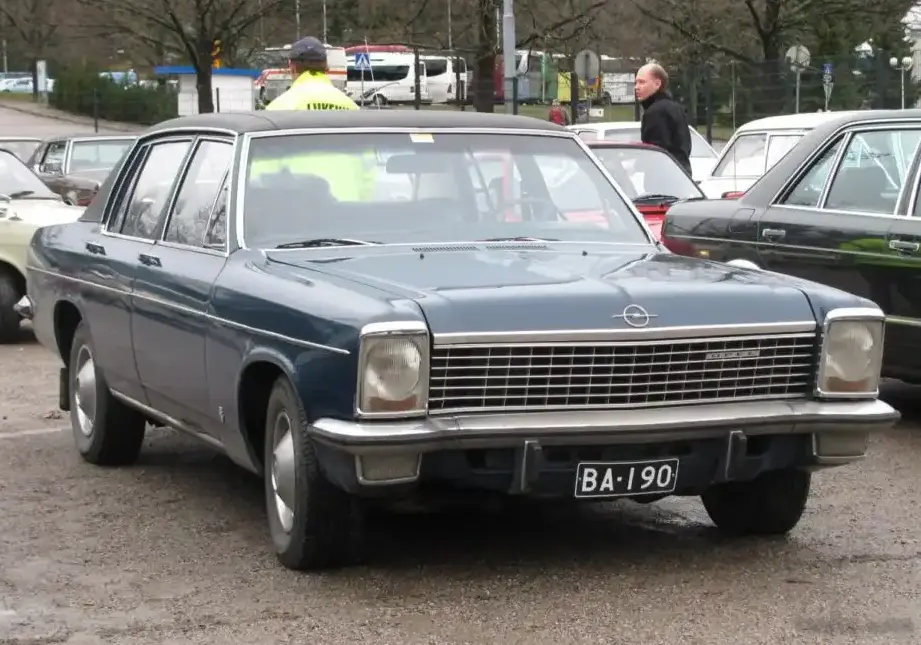
The Opel Diplomat B 2.8 E, produced between 1969 and 1975, represented a significant evolution in Opel’s flagship sedan line. Positioned as a luxury vehicle aimed at executives and government officials, the Diplomat B sought to offer a blend of spaciousness, comfort, and performance. It was built upon the General Motors A-platform, shared with other GM vehicles of the era, and served as Opel’s top-of-the-line offering during a period of growing prosperity in post-war Germany. The 2.8 E variant, with its 165 horsepower engine, occupied a middle ground within the Diplomat B range, offering a balance between power and fuel economy compared to the larger displacement options.
Technical Specifications
| Brand | Opel |
| Model | Diplomat |
| Generation | Diplomat B |
| Type (Engine) | 2.8 E (165 Hp) |
| Start of production | 1969 |
| End of production | 1975 |
| Powertrain Architecture | Internal Combustion engine |
| Body type | Sedan |
| Seats | 5 |
| Doors | 4 |
| Fuel Type | Petrol (Gasoline) |
| Acceleration 0 – 100 km/h | 10.5 sec |
| Acceleration 0 – 62 mph | 10.5 sec |
| Acceleration 0 – 60 mph | 10 sec |
| Maximum speed | 190 km/h (118.06 mph) |
| Weight-to-power ratio | 9.3 kg/Hp, 107.8 Hp/tonne |
| Weight-to-torque ratio | 6.7 kg/Nm, 149.7 Nm/tonne |
| Power | 165 Hp @ 5600 rpm |
| Power per litre | 59.3 Hp/l |
| Torque | 229 Nm @ 4100-4600 rpm (168.9 lb.-ft. @ 4100-4600 rpm) |
| Engine Model/Code | 28E |
| Engine displacement | 2784 cm3 (169.89 cu. in.) |
| Number of cylinders | 6 |
| Engine configuration | Inline |
| Cylinder Bore | 92 mm (3.62 in.) |
| Piston Stroke | 69.8 mm (2.75 in.) |
| Compression ratio | 9.5:1 |
| Number of valves per cylinder | 2 |
| Fuel injection system | Multi-port manifold injection |
| Engine aspiration | Naturally aspirated engine |
| Valvetrain | SOHC |
| Engine oil capacity | 4.5 l (4.76 US qt | 3.96 UK qt) |
| Kerb Weight | 1530 kg (3373.07 lbs.) |
| Max. weight | 2030 kg (4475.38 lbs.) |
| Max load | 500 kg (1102.31 lbs.) |
| Trunk (boot) space – minimum | 475 l (16.77 cu. ft.) |
| Fuel tank capacity | 80 l (21.13 US gal | 17.6 UK gal) |
| Permitted trailer load with brakes (12%) | 1400 kg (3086.47 lbs.) |
| Permitted trailer load without brakes | 700 kg (1543.24 lbs.) |
| Length | 4920 mm (193.7 in.) |
| Width | 1852 mm (72.91 in.) |
| Height | 1450 mm (57.09 in.) |
| Wheelbase | 2850 mm (112.2 in.) |
| Front track | 1510 mm (59.45 in.) |
| Rear (Back) track | 1512 mm (59.53 in.) |
| Ride height (ground clearance) | 150 mm (5.91 in.) |
| Drag coefficient (Cd) | 0.45 |
| Minimum turning circle (turning diameter) | 11.8 m (38.71 ft.) |
| Drivetrain Architecture | The Internal combustion engine (ICE) drives the rear wheels of the vehicle. |
| Drive wheel | Rear wheel drive |
| Number of gears and type of gearbox | 4 gears, manual transmission |
| Front brakes | Ventilated discs |
| Rear brakes | Ventilated discs |
Powertrain & Engine Architecture
The heart of the Diplomat B 2.8 E was the 28E inline-six cylinder engine. Displacing 2.8 liters (2784 cc), this engine featured a single overhead camshaft (SOHC) valvetrain operating two valves per cylinder. The engine utilized multi-port fuel injection, a relatively advanced feature for the time, contributing to improved fuel efficiency and smoother power delivery compared to carbureted engines. The 28E produced 165 horsepower at 5600 rpm and 229 Nm (168.9 lb-ft) of torque between 4100 and 4600 rpm. The engine’s design prioritized smooth operation and refinement, characteristics valued in the luxury car segment. The standard transmission for the 2.8 E was a four-speed manual gearbox, although an automatic transmission was available as an option. The automatic, a three-speed unit, was a popular choice for buyers prioritizing ease of use over outright performance.
Driving Characteristics
The 2.8 E variant of the Diplomat B offered a comfortable and composed driving experience. While not a sports car, the 165 horsepower engine provided adequate power for relaxed highway cruising and confident overtaking. Acceleration from 0 to 60 mph took approximately 10 seconds, and the car could reach a top speed of 190 km/h (118 mph). The manual transmission allowed for greater driver control, while the optional automatic provided a more effortless driving experience. The rear-wheel-drive layout contributed to balanced handling, although the Diplomat B’s considerable weight (approximately 1530 kg or 3373 lbs) meant it wasn’t particularly agile. Compared to the larger-displacement engines available in the Diplomat B range, the 2.8 E offered a better balance between performance and fuel economy, making it a practical choice for everyday use.
Equipment & Trim Levels
The Diplomat B 2.8 E was well-equipped for its time, offering a range of comfort and convenience features. Standard equipment typically included power-assisted steering, disc brakes on all four wheels, and a spacious interior upholstered in high-quality cloth. Optional extras included leather upholstery, air conditioning, a sunroof, and a premium sound system. The dashboard layout was typically conservative and functional, with clearly marked gauges and easy-to-use controls. The 2.8 E trim level generally represented a mid-range offering within the Diplomat B lineup, positioned above the base models but below the more luxurious versions equipped with larger engines and more extensive options.
Chassis & Braking
The Diplomat B featured a robust chassis designed to provide a comfortable ride and stable handling. The suspension consisted of independent front suspension with coil springs and a rigid rear axle with leaf springs. The braking system utilized ventilated disc brakes on all four wheels, providing ample stopping power for a car of its size and weight. Stabilizer bars were fitted to both the front and rear axles to reduce body roll during cornering. The steering was power-assisted, making it easier to maneuver the car in tight spaces. The Diplomat B’s suspension tuning prioritized ride comfort over sporty handling, resulting in a smooth and refined driving experience.
Market Reception & Comparison
The Opel Diplomat B 2.8 E was generally well-received by automotive critics, who praised its spacious interior, comfortable ride, and refined engine. However, some critics noted that the car’s styling was somewhat conservative and that its handling wasn’t as sharp as some of its competitors. Compared to other trims in the Diplomat B lineup, the 2.8 E offered a good balance between performance, fuel economy, and price. It was a popular choice for buyers who wanted a luxurious and comfortable sedan without the expense of the larger-displacement engines. In terms of reliability, the Diplomat B was generally considered to be a well-built car, although maintenance costs could be relatively high due to its complex engine and sophisticated features.
Legacy
The Opel Diplomat B, including the 2.8 E variant, holds a significant place in Opel’s history as its flagship sedan of the late 1960s and early 1970s. While not as numerous today as some other classic Opel models, the Diplomat B has gained a following among collectors and enthusiasts. The 28E engine, while not known for being particularly high-performance, is generally considered to be a reliable and durable unit. Finding well-maintained examples can be challenging, and parts availability can be limited. However, the Diplomat B 2.8 E remains a desirable classic car, offering a glimpse into a bygone era of German automotive luxury.
