
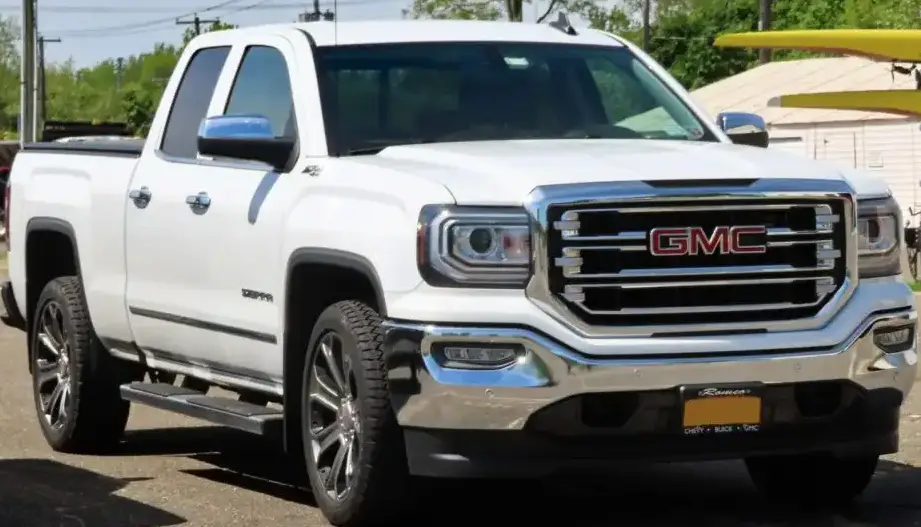
The GMC Sierra 1500 IV, specifically the Double Cab configuration with the 4.3 EcoTec3 V6 engine and four-wheel drive, represents a significant iteration in GMC’s full-size pickup truck lineage. Produced from 2016 to 2018 as part of the GMTK2XX platform’s facelift, this variant aimed to balance capability with efficiency and affordability within the Sierra 1500 range. It occupied a middle ground in the lineup, offering a step up from the base 2.7L four-cylinder engine while remaining more accessible than the larger 5.3L and 6.2L V8 options. The FlexFuel capability added versatility, allowing operation on gasoline or ethanol blends up to E85.
Technical Specifications
| Brand | GMC |
| Model | Sierra 1500 |
| Generation | Sierra 1500 IV (GMTK2XX, facelift 2016) Double Cab |
| Type (Engine) | 4.3 EcoTec3 V6 (285/297 Hp) 4WD Automatic FlexFuel |
| Start of production | 2016 |
| End of production | 2018 |
| Powertrain Architecture | Internal Combustion engine |
| Body type | Pick-up |
| Seats | 5 |
| Doors | 4 |
| Fuel consumption (urban) | 13.8 l/100 km (17 US mpg) |
| Fuel consumption (extra urban) | 10.7 l/100 km (22 US mpg) |
| Fuel Type | Petrol / Ethanol – E85 |
| Weight-to-power ratio | 8.4 kg/Hp |
| Weight-to-torque ratio | 5.8 kg/Nm |
| Power | 285 Hp @ 5300 rpm |
| Power per litre | 66.3 Hp/l |
| Power (Ethanol – E85) | 297 Hp @ 5300 rpm |
| Power per litre (Ethanol – E85) | 69.1 Hp/l |
| Torque | 413 Nm @ 3900 rpm (304.61 lb.-ft. @ 3900 rpm) |
| Torque (Ethanol – E85) | 447 Nm @ 3900 rpm |
| Maximum engine speed | 5800 rpm |
| Engine layout | Front, Longitudinal |
| Engine Model/Code | LV3 |
| Engine displacement | 4300 cm3 (262.4 cu. in.) |
| Number of cylinders | 6 |
| Engine configuration | V-engine |
| Cylinder Bore | 99.6 mm (3.92 in.) |
| Piston Stroke | 92 mm (3.62 in.) |
| Compression ratio | 11:1 |
| Number of valves per cylinder | 2 |
| Fuel injection system | Direct injection |
| Engine aspiration | Naturally aspirated engine |
| Valvetrain | OHV |
| Engine oil capacity | 5.7 l (6.02 US qt | 5.02 UK qt) |
| Coolant | 14 l (14.79 US qt | 12.32 UK qt) |
| Kerb Weight | 2387 kg (5262.43 lbs.) |
| Max. weight | 3220 kg (7098.88 lbs.) |
| Max load | 833 kg (1836.45 lbs.) |
| Trunk (boot) space – minimum | 1728 l (61.02 cu. ft.) |
| Fuel tank capacity | 98 l (25.89 US gal | 21.56 UK gal) |
| Permitted trailer load with brakes (12%) | 3220 kg (7098.88 lbs.) |
| Length | 5828 mm (229.45 in.) |
| Width including mirrors | 2032 mm (80 in.) |
| Height | 1877 mm (73.9 in.) |
| Wheelbase | 3645 mm (143.5 in.) |
| Front track | 1750 mm (68.9 in.) |
| Rear (Back) track | 1716 mm (67.56 in.) |
| Ride height (ground clearance) | 231 mm (9.09 in.) |
| Minimum turning circle (turning diameter) | 14.3 m (46.92 ft.) |
| Approach angle | 17.9° |
| Departure angle | 23.1° |
| Ramp-over (brakeover) angle | 19.1° |
| Drivetrain Architecture | The Internal combustion engine (ICE) drives the rear wheels permanently, and the front wheels are driven through an electrically or mechanically operated clutch if necessary. |
| Drive wheel | All wheel drive (4×4) |
| Number of gears and type of gearbox | 6 gears, automatic transmission Hydra-Matic |
| Front suspension | Independent coil spring |
| Rear suspension | Rigid axle suspension, Leaf spring |
| Front brakes | Ventilated discs, 330×30 mm |
| Rear brakes | Ventilated discs, 345×20 mm |
| Assisting systems | ABS (Anti-lock braking system) |
| Steering type | Steering rack and pinion |
| Power steering | Electric Steering |
| Tires size | 245/70 R17; 265/70 R17 |
| Wheel rims size | 8J x 17 |
Powertrain & Engine Architecture
The heart of this Sierra 1500 variant is the 4.3L LV3 EcoTec3 V6 engine. This engine is a naturally aspirated, direct-injected powerplant featuring a 90-degree V6 configuration. The EcoTec3 family was designed for a balance of power and efficiency, incorporating features like active fuel management (cylinder deactivation) to improve fuel economy during light-load driving. The direct injection system optimizes combustion, contributing to both power and reduced emissions. The engine utilizes an overhead valve (OHV) valvetrain, a design choice that prioritized compactness and cost-effectiveness. The 6-speed Hydra-Matic automatic transmission was the sole transmission option for this configuration. This transmission is known for its smooth shifting and durability, offering a good balance between performance and fuel efficiency. The 4WD system is a traditional part-time system, allowing the driver to switch between two-wheel drive and four-wheel drive as needed.
Driving Characteristics
The 4.3L V6 with the 6-speed automatic delivers adequate performance for everyday driving and typical pickup truck tasks. While not as quick as the larger V8 engines, it provides sufficient power for towing moderate loads and navigating highway speeds. The automatic transmission is tuned for smooth operation, prioritizing comfort over aggressive shifting. The gear ratios are optimized for towing and hauling, providing good low-end torque. Compared to the 5.3L V8, the 4.3L feels noticeably less powerful, especially when fully loaded. However, it offers better fuel economy. The 4WD system provides enhanced traction in slippery conditions, making it suitable for off-road use, though it’s not designed for extreme rock crawling.
Equipment & Trim Levels
The Double Cab 4.3L 4WD Sierra 1500 typically came standard with features like air conditioning, power windows and locks, a basic infotainment system with a touchscreen display, and a rearview camera. Higher trim levels, such as the SLE and SLT, added features like leather upholstery, heated seats, a premium sound system, and advanced safety technologies. Optional extras included a navigation system, a sunroof, and various towing packages. Interior upholstery was typically cloth on the base models, with leather available on higher trims. The dashboard layout was functional and straightforward, prioritizing ease of use.
Chassis & Braking
The Sierra 1500 IV utilizes a body-on-frame construction, providing a robust and durable platform. The front suspension features independent coil springs, while the rear suspension employs a traditional leaf spring setup. This configuration is designed to handle heavy loads and provide a comfortable ride. Braking duties are handled by ventilated disc brakes on all four wheels, providing adequate stopping power. An Anti-lock Braking System (ABS) is standard. The rear leaf springs are tuned to support heavier payloads, and stabilizer bars are used to reduce body roll during cornering.
Market Reception & Comparison
The 4.3L V6 Sierra 1500 was generally well-received as a value-oriented option in the full-size pickup truck segment. Critics praised its fuel efficiency and adequate power for most tasks. However, some noted that it lacked the outright performance of the larger V8 engines. Compared to the 5.3L V8, the 4.3L offered significantly better fuel economy, but at the cost of towing capacity and acceleration. The 4.3L also proved to be a more reliable option than some of the more complex V8 engines, with fewer reported issues.
Legacy
The 4.3L EcoTec3 V6 paired with the 6-speed automatic has proven to be a relatively reliable powertrain. Used examples are readily available and generally offer good value for the money. While not as sought-after as the V8 models, the 4.3L Sierra 1500 remains a capable and practical pickup truck. Common maintenance items include regular oil changes, transmission fluid flushes, and brake pad replacements. The cylinder deactivation system can sometimes experience issues, but these are typically minor and relatively inexpensive to repair. Overall, this variant represents a solid choice for buyers seeking a dependable and affordable full-size pickup truck.

