
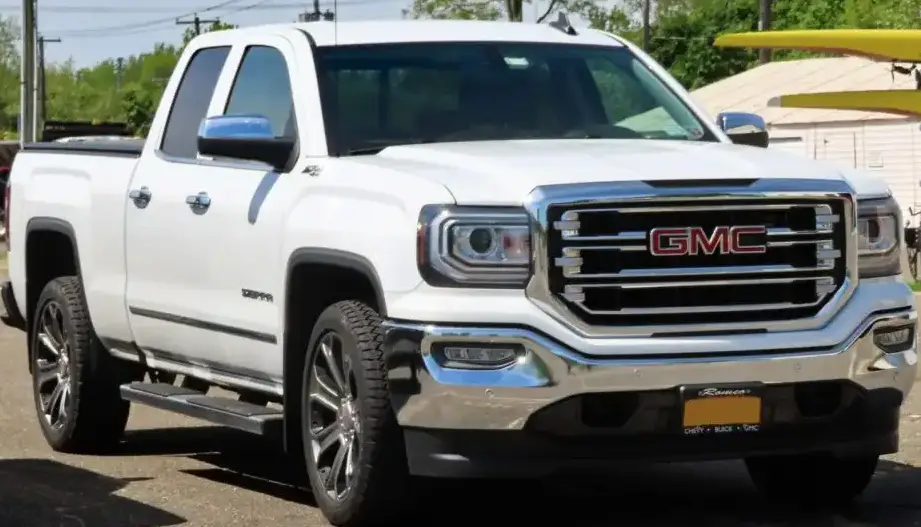
The GMC Sierra 1500 IV, specifically the Double Cab configuration with the 5.3 EcoTec3 V8 engine, 4WD, and 8-speed automatic transmission, represents a significant iteration of GMC’s full-size pickup truck. Produced from 2016 to 2018 as part of the GMTK2XX platform’s facelift, this variant aimed to balance capability, comfort, and efficiency within the highly competitive American truck market. This model year saw updates to the exterior styling, interior features, and technology, building upon the foundation laid by the previous generation. The 5.3L V8/8-speed automatic combination positioned itself as a popular mid-range option, appealing to buyers who needed substantial towing and hauling capacity without opting for the more expensive and powerful 6.2L engine.
Technical Specifications
| Brand | GMC |
| Model | Sierra 1500 |
| Generation | Sierra 1500 IV (GMTK2XX, facelift 2016) Double Cab |
| Type (Engine) | 5.3 EcoTec3 V8 (355/380 Hp) 4WD 8 Automatic FlexFuel |
| Start of production | 2016 |
| End of production | 2018 |
| Powertrain Architecture | Internal Combustion engine |
| Body type | Pick-up |
| Seats | 5 |
| Doors | 4 |
| Fuel consumption (urban) | 15.7 l/100 km (15 US mpg, 18 UK mpg) |
| Fuel consumption (extra urban) | 11.2 l/100 km (21 US mpg, 25.2 UK mpg) |
| Fuel Type | Petrol / Ethanol – E85 |
| Weight-to-power ratio | 6.8 kg/Hp, 146.3 Hp/tonne |
| Weight-to-torque ratio | 4.7 kg/Nm, 213.9 Nm/tonne |
| Power | 355 Hp @ 5600 rpm |
| Power per litre | 66.6 Hp/l |
| Power (Ethanol – E85) | 380 Hp @ 5600 rpm |
| Power per litre (Ethanol – E85) | 71.3 Hp/l |
| Torque | 519 Nm @ 4100 rpm (382.79 lb.-ft. @ 4100 rpm) |
| Torque (Ethanol – E85) | 564 Nm @ 4100 rpm |
| Maximum engine speed | 5800 rpm |
| Engine layout | Front, Longitudinal |
| Engine Model/Code | L83 |
| Engine displacement | 5328 cm3 (325.13 cu. in.) |
| Number of cylinders | 8 |
| Engine configuration | V-engine |
| Cylinder Bore | 96 mm (3.78 in.) |
| Piston Stroke | 92 mm (3.62 in.) |
| Compression ratio | 11:1 |
| Number of valves per cylinder | 2 |
| Fuel injection system | Direct injection |
| Engine aspiration | Naturally aspirated engine |
| Valvetrain | OHV |
| Engine oil capacity | 8 l (8.45 US qt | 7.04 UK qt) |
| Coolant | 14.8 l (15.64 US qt | 13.02 UK qt) |
| Kerb Weight | 2426 kg (5348.41 lbs.) |
| Max. weight | 3447 kg (7599.33 lbs.) |
| Max load | 1021 kg (2250.92 lbs.) |
| Trunk (boot) space – minimum | 1728 l (61.02 cu. ft.) |
| Fuel tank capacity | 98 l (25.89 US gal | 21.56 UK gal) |
| Permitted trailer load with brakes (12%) | 4899 kg (10800.45 lbs.) |
| Length | 5828 mm (229.45 in.) |
| Width including mirrors | 2032 mm (80 in.) |
| Height | 1877 mm (73.9 in.) |
| Wheelbase | 3645 mm (143.5 in.) |
| Front track | 1750 mm (68.9 in.) |
| Rear (Back) track | 1716 mm (67.56 in.) |
| Ride height (ground clearance) | 231 mm (9.09 in.) |
| Minimum turning circle (turning diameter) | 14.3 m (46.92 ft.) |
| Approach angle | 17.9° |
| Departure angle | 23.1° |
| Ramp-over (brakeover) angle | 19.1° |
| Drivetrain Architecture | The Internal combustion engine (ICE) drives the rear wheels permanently, and the front wheels are driven through an electrically or mechanically operated clutch if necessary. |
| Drive wheel | All wheel drive (4×4) |
| Number of gears and type of gearbox | 8 gears, automatic transmission Hydra-Matic |
| Front suspension | Independent coil spring |
| Rear suspension | Rigid axle suspension, Leaf spring |
| Front brakes | Ventilated discs, 330×30 mm |
| Rear brakes | Ventilated discs, 345×20 mm |
| Assisting systems | ABS (Anti-lock braking system) |
| Steering type | Steering rack and pinion |
| Power steering | Electric Steering |
| Tires size | 245/70 R17; 265/70 R17 |
| Wheel rims size | 8J x 17 |
Powertrain & Engine Architecture
At the heart of this Sierra 1500 Double Cab lies the 5.3-liter EcoTec3 V8 engine, designated as the L83. This engine is a naturally aspirated, direct-injection powerplant featuring Active Fuel Management (cylinder deactivation) to improve fuel economy. The EcoTec3 family represented a significant advancement in GM’s engine technology, utilizing aluminum cylinder heads and a cast iron block for a balance of weight savings and durability. The direct injection system, coupled with a relatively high 11:1 compression ratio, contributes to both power and efficiency. The engine produces 355 horsepower at 5600 rpm and 382.79 lb-ft of torque at 4100 rpm. When running on E85 fuel, output increases to 380 horsepower and 424 lb-ft of torque. The engine is paired with an 8-speed Hydra-Matic automatic transmission, which provides a wide range of gear ratios for optimized acceleration, towing, and fuel efficiency. This transmission replaced the older 6-speed unit, offering smoother shifts and improved responsiveness.
Driving Characteristics
The 5.3L V8 and 8-speed automatic combination delivers a capable and comfortable driving experience. While not as quick as the 6.2L V8, the 5.3L provides ample power for everyday driving and towing. The 8-speed transmission helps keep the engine in its optimal power band, resulting in decent acceleration. The automatic transmission is tuned for smooth shifts, prioritizing comfort over aggressive performance. The 4WD system provides enhanced traction in various conditions, making it suitable for both on-road and light off-road use. Compared to the manual transmission options available on other Sierra 1500 trims, the automatic offers greater convenience, especially in stop-and-go traffic. However, it does slightly diminish fuel economy and driver engagement.
Equipment & Trim Levels
The Double Cab configuration offered a spacious interior with seating for five passengers. Standard features typically included air conditioning, power windows and locks, a basic infotainment system with a touchscreen display, and a rearview camera. Higher trim levels, such as the SLT and Denali, added features like leather upholstery, heated and ventilated seats, a premium sound system, and advanced safety technologies. The 5.3L V8 was often paired with the SLT trim, offering a good balance of features and value. Optional extras included a navigation system, a sunroof, and various towing packages.
Chassis & Braking
The Sierra 1500 IV utilizes a body-on-frame construction, providing a robust and durable platform. The front suspension features independent coil springs, while the rear suspension employs a traditional leaf spring setup. This configuration is designed to handle heavy loads and provide a comfortable ride. Braking duties are handled by ventilated disc brakes on all four wheels, with ABS as standard. The braking system is adequately sized for the truck’s weight and provides confident stopping power. The Double Cab configuration’s longer wheelbase contributes to a more stable and comfortable ride compared to the standard cab models.
Market Reception & Comparison
The GMC Sierra 1500 with the 5.3L V8 and 8-speed automatic was well-received by critics and consumers alike. It was praised for its comfortable ride, spacious interior, and capable towing capacity. Fuel economy was considered average for a full-size pickup truck, but the Active Fuel Management system helped to improve efficiency. Compared to the 4.3L V6, the 5.3L offered a significant increase in power and towing capacity. Compared to the 6.2L V8, it provided a more affordable option with slightly less performance. Reliability reports generally indicate that the L83 engine and 8-speed transmission are relatively reliable, although some owners have reported issues with the Active Fuel Management system.
Legacy
The 2016-2018 GMC Sierra 1500 Double Cab with the 5.3L EcoTec3 V8 and 8-speed automatic remains a popular choice in the used truck market. Its combination of capability, comfort, and value makes it an attractive option for buyers seeking a versatile full-size pickup. The L83 engine has proven to be reasonably durable, and parts availability is good. While not the most fuel-efficient option, the Sierra 1500 offers a compelling package for those who need a truck that can handle a variety of tasks. The introduction of the 8-speed transmission was a key improvement, enhancing both performance and fuel economy compared to previous generations.

