
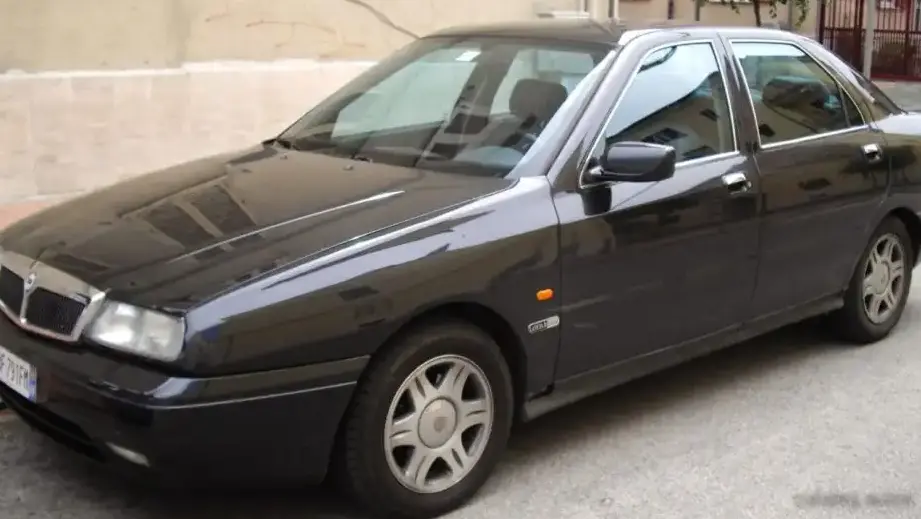
The Lancia Kappa 2.0 20V (155 hp) was a significant offering in Lancia’s lineup during its production run from July 1996 to July 2000. Part of the 838 series, the Kappa represented Lancia’s attempt to recapture a segment of the executive car market, offering a blend of Italian styling, comfort, and technology. This particular 2.0-liter, 20-valve variant occupied a middle ground within the Kappa range, positioned above the base 1.8-liter models but below the more powerful 3.0-liter V6. It was designed to appeal to buyers seeking a balance between performance, fuel economy, and price. The Kappa, as a whole, was intended to replace the aging Lancia Delta and Thema, and aimed to compete with vehicles like the Alfa Romeo 166, BMW 3 Series, and Mercedes-Benz C-Class.
Technical Specifications
| Brand | Lancia |
| Model | Kappa |
| Generation | Kappa (838) |
| Type (Engine) | 2.0 20V (155 Hp) |
| Start of production | July, 1996 |
| End of production | July, 2000 |
| Powertrain Architecture | Internal Combustion engine |
| Body type | Sedan |
| Seats | 5 |
| Doors | 4 |
| Fuel consumption (urban) | 14.8 l/100 km (15.9 US mpg, 19.1 UK mpg, 6.8 km/l) |
| Fuel consumption (extra urban) | 8.3 l/100 km (28.3 US mpg, 34 UK mpg, 12 km/l) |
| Fuel Type | Petrol (Gasoline) |
| Acceleration 0 – 100 km/h | 9.2 sec |
| Acceleration 0 – 62 mph | 9.2 sec |
| Acceleration 0 – 60 mph | 8.7 sec |
| Maximum speed | 212 km/h (131.73 mph) |
| Weight-to-power ratio | 9.3 kg/Hp, 107.6 Hp/tonne |
| Weight-to-torque ratio | 7.7 kg/Nm, 129.2 Nm/tonne |
| Power | 155 Hp @ 6500 rpm |
| Power per litre | 77.6 Hp/l |
| Torque | 186 Nm @ 4000 rpm (137.19 lb.-ft. @ 4000 rpm) |
| Engine layout | Front, Transverse |
| Engine Model/Code | 838 A6.000 |
| Engine displacement | 1998 cm3 (121.93 cu. in.) |
| Number of cylinders | 5 |
| Engine configuration | Inline |
| Cylinder Bore | 82 mm (3.23 in.) |
| Piston Stroke | 75.65 mm (2.98 in.) |
| Compression ratio | 10.4:1 |
| Number of valves per cylinder | 4 |
| Fuel injection system | Multi-port manifold injection |
| Engine aspiration | Naturally aspirated engine |
| Valvetrain | DOHC |
| Engine oil capacity | 5.4 l (5.71 US qt | 4.75 UK qt) |
| Coolant | 8.3 l (8.77 US qt | 7.3 UK qt) |
| Kerb Weight | 1440 kg (3174.66 lbs.) |
| Max. weight | 1990 kg (4387.2 lbs.) |
| Max load | 550 kg (1212.54 lbs.) |
| Trunk (boot) space – minimum | 526 l (18.58 cu. ft.) |
| Fuel tank capacity | 70 l (18.49 US gal | 15.4 UK gal) |
| Length | 4687 mm (184.53 in.) |
| Width | 1826 mm (71.89 in.) |
| Height | 1462 mm (57.56 in.) |
| Wheelbase | 2700 mm (106.3 in.) |
| Front track | 1547 mm (60.91 in.) |
| Rear (Back) track | 1535 mm (60.43 in.) |
| Drivetrain Architecture | The Internal combustion engine (ICE) drives the front wheels of the vehicle. |
| Drive wheel | Front wheel drive |
| Number of gears and type of gearbox | 5 gears, manual transmission |
| Front suspension | Wishbone |
| Rear suspension | Spring Strut |
| Front brakes | Ventilated discs |
| Rear brakes | Disc |
| Assisting systems | ABS (Anti-lock braking system) |
| Steering type | Steering rack and pinion |
| Power steering | Hydraulic Steering |
| Tires size | 195/65 R15 |
| Wheel rims size | 15 |
Powertrain & Engine Architecture
The heart of the Kappa 2.0 20V is the 838 A6.000 engine, a 1998cc inline-five cylinder powerplant. This engine was notable for its relatively sophisticated design, featuring a double overhead camshaft (DOHC) valvetrain and multi-port fuel injection. The 20 valves (four per cylinder) contributed to improved breathing and higher-end power delivery. The inline-five configuration, while less common than inline-fours or V6s, offered a unique engine note and a good balance between smoothness and performance. The engine produced 155 horsepower at 6500 rpm and 186 Nm (137 lb-ft) of torque at 4000 rpm. The five-speed manual transmission was the standard offering, providing drivers with full control over the engine’s power. The transmission was chosen for its durability and relatively direct feel, although it wasn’t particularly sporty in its ratios.
Driving Characteristics
The Kappa 2.0 20V offered a comfortable and refined driving experience. While not a sports car, the 155 hp engine provided adequate performance for everyday driving and even some spirited acceleration. The 0-60 mph time of around 8.7 seconds was respectable for its time. The five-speed manual transmission allowed for precise gear changes, and the engine’s torque curve provided good responsiveness in most situations. Compared to the base 1.8-liter Kappa, the 2.0 20V offered a noticeable improvement in acceleration and overall power. However, it didn’t possess the outright performance of the 3.0-liter V6. The Kappa’s front-wheel-drive layout contributed to predictable handling, but it could exhibit some understeer when pushed hard. The suspension was tuned for comfort, absorbing bumps and imperfections in the road effectively.
Equipment & Trim Levels
The Kappa 2.0 20V typically came equipped with a reasonable level of standard features. These included power windows, central locking, air conditioning, and an AM/FM radio. Higher trim levels offered options such as leather upholstery, a sunroof, alloy wheels, and upgraded audio systems. Interior appointments were generally well-executed, with a focus on comfort and ergonomics. The dashboard layout was clean and functional, although some materials felt less premium than those found in competing German vehicles. The Kappa prioritized a comfortable cabin over a particularly driver-focused cockpit.
Chassis & Braking
The Kappa 2.0 20V utilized a front-wheel-drive chassis with independent wishbone suspension at the front and a spring strut rear suspension. This setup provided a good balance between ride comfort and handling. The braking system consisted of ventilated discs at the front and solid discs at the rear. Anti-lock braking system (ABS) was standard, enhancing safety and control during emergency braking situations. The steering was rack and pinion with hydraulic power assistance, offering a light and responsive feel. The Kappa’s suspension was tuned to prioritize comfort, resulting in a softer ride compared to some of its more performance-oriented rivals.
Market Reception & Comparison
The Lancia Kappa 2.0 20V received mixed reviews from automotive critics. While praised for its stylish design, comfortable interior, and refined driving experience, it was often criticized for its relatively high price and perceived lack of brand prestige compared to German competitors. Fuel economy was reasonable for a vehicle of its class, averaging around 28.3 US mpg on the highway. Reliability was a concern for some owners, with reports of electrical issues and occasional mechanical problems. Compared to the 1.8-liter Kappa, the 2.0 20V offered a significant performance upgrade, making it a more appealing option for drivers who prioritized power and responsiveness. However, the 3.0-liter V6 provided even more performance, albeit at a higher price point.
Legacy
The Lancia Kappa, while not a commercial success in the same vein as some of its rivals, remains a fondly remembered vehicle among Lancia enthusiasts. The 2.0 20V variant, in particular, is appreciated for its balanced performance and comfortable driving experience. Today, well-maintained examples are becoming increasingly rare and sought after by collectors. The inline-five engine, while potentially requiring more specialized maintenance than a four-cylinder, is generally considered to be a durable and reliable unit when properly cared for. The Kappa’s unique styling and Italian flair continue to set it apart from more conventional executive cars of its era, ensuring its place in automotive history.
