
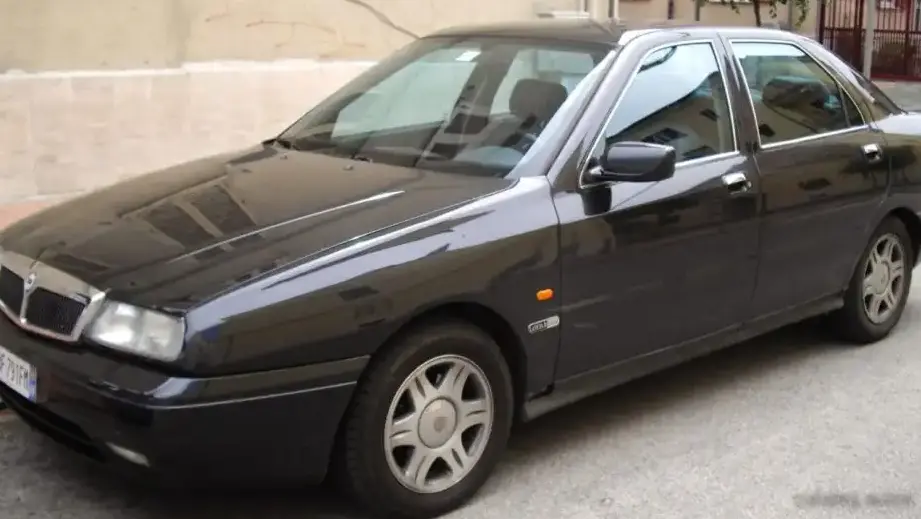
The Lancia Kappa 2.0 20V Automatic, produced between 1996 and 2000, represented a mid-range offering within the 838 series Kappa lineup. Positioned above the base 1.8-liter models and below the more potent 3.0 V6 variants, this version aimed to balance performance with comfort and fuel efficiency for the European market. The Kappa, intended as a flagship sedan for Lancia, sought to recapture the brand’s reputation for innovative engineering and sophisticated design. This particular 2.0-liter, five-cylinder configuration paired with a four-speed automatic transmission offered a refined driving experience, though it wasn’t focused on outright speed. It was a popular choice for buyers prioritizing ease of use and a comfortable ride over sporty handling.
Technical Specifications
| Brand | Lancia |
| Model | Kappa |
| Generation | Kappa (838) |
| Type (Engine) | 2.0 20V (155 Hp) Automatic |
| Start of production | July, 1996 |
| End of production | July, 2000 |
| Powertrain Architecture | Internal Combustion engine |
| Body type | Sedan |
| Seats | 5 |
| Doors | 4 |
| Fuel consumption (urban) | 14.9 l/100 km (15.8 US mpg, 19 UK mpg, 6.7 km/l) |
| Fuel consumption (extra urban) | 8.8 l/100 km (26.7 US mpg, 32.1 UK mpg, 11.4 km/l) |
| Fuel Type | Petrol (Gasoline) |
| Acceleration 0 – 100 km/h | 12.1 sec |
| Acceleration 0 – 62 mph | 12.1 sec |
| Acceleration 0 – 60 mph | 11.5 sec |
| Maximum speed | 210 km/h (130.49 mph) |
| Weight-to-power ratio | 9.3 kg/Hp, 107.6 Hp/tonne |
| Weight-to-torque ratio | 7.7 kg/Nm, 129.2 Nm/tonne |
| Power | 155 Hp @ 6500 rpm |
| Power per litre | 77.6 Hp/l |
| Torque | 186 Nm @ 4000 rpm (137.19 lb.-ft. @ 4000 rpm) |
| Engine layout | Front, Transverse |
| Engine Model/Code | 838 A6.000 |
| Engine displacement | 1998 cm3 (121.93 cu. in.) |
| Number of cylinders | 5 |
| Engine configuration | Inline |
| Cylinder Bore | 82 mm (3.23 in.) |
| Piston Stroke | 75.65 mm (2.98 in.) |
| Compression ratio | 10.4:1 |
| Number of valves per cylinder | 4 |
| Fuel injection system | Multi-port manifold injection |
| Engine aspiration | Naturally aspirated engine |
| Valvetrain | DOHC |
| Engine oil capacity | 5.4 l (5.71 US qt | 4.75 UK qt) |
| Coolant | 8.3 l (8.77 US qt | 7.3 UK qt) |
| Kerb Weight | 1440 kg (3174.66 lbs.) |
| Max. weight | 1990 kg (4387.2 lbs.) |
| Max load | 550 kg (1212.54 lbs.) |
| Trunk (boot) space – minimum | 526 l (18.58 cu. ft.) |
| Fuel tank capacity | 70 l (18.49 US gal | 15.4 UK gal) |
| Length | 4687 mm (184.53 in.) |
| Width | 1826 mm (71.89 in.) |
| Height | 1462 mm (57.56 in.) |
| Wheelbase | 2700 mm (106.3 in.) |
| Front track | 1547 mm (60.91 in.) |
| Rear (Back) track | 1535 mm (60.43 in.) |
| Drivetrain Architecture | The Internal combustion engine (ICE) drives the front wheels of the vehicle. |
| Drive wheel | Front wheel drive |
| Number of gears and type of gearbox | 4 gears, automatic transmission |
| Front suspension | Wishbone |
| Rear suspension | Spring Strut |
| Front brakes | Ventilated discs |
| Rear brakes | Disc |
| Assisting systems | ABS (Anti-lock braking system) |
| Steering type | Steering rack and pinion |
| Power steering | Hydraulic Steering |
| Tires size | 195/65 R15 |
| Wheel rims size | 15 |
Powertrain & Engine Architecture
The heart of the Kappa 2.0 20V Automatic is the 838 A6.000 engine, a 1998cc inline five-cylinder powerplant. This engine utilized a dual overhead camshaft (DOHC) valvetrain operating 20 valves (four per cylinder) to maximize breathing and efficiency. The engine employed multi-port fuel injection, delivering fuel directly to each intake port for precise control. The five-cylinder configuration, while less common than inline-fours or V6s, offered a good compromise between smoothness and power delivery. The automatic transmission was a conventional four-speed unit, designed for smooth shifts and ease of use. While not particularly advanced by modern standards, it was well-suited to the engine’s torque characteristics. The transmission’s gear ratios were tuned for comfortable cruising rather than aggressive acceleration.
Driving Characteristics
The 155 horsepower and 186 Nm (137 lb-ft) of torque produced by the 2.0-liter engine, when coupled with the four-speed automatic, resulted in a 0-60 mph time of around 11.5 seconds and a top speed of 130 mph. Compared to the manual transmission version of the same engine, acceleration was slightly slower due to the inherent power loss in the torque converter. The automatic transmission prioritized smooth shifts and ease of driving, making it ideal for city commuting and long highway journeys. However, it lacked the responsiveness and driver engagement of a manual gearbox. The Kappa 2.0 Automatic wasn’t a sports sedan; its focus was on providing a comfortable and refined driving experience. The steering was light and precise, and the suspension offered a good balance between ride comfort and handling.
Equipment & Trim Levels
The Kappa 2.0 20V Automatic typically came equipped with a respectable level of standard features. These included power windows, central locking, air conditioning, and an AM/FM radio. Higher trim levels offered options such as leather upholstery, a sunroof, and upgraded audio systems. Interior appointments were generally well-executed, with a focus on comfort and ergonomics. The dashboard layout was clean and functional, though some materials felt less premium than those found in competing German or Japanese sedans. The Kappa aimed for a sophisticated, Italian aesthetic, prioritizing style and comfort over outright luxury.
Chassis & Braking
The Kappa 2.0 Automatic featured a front-wheel-drive layout with independent wishbone suspension at the front and a spring strut rear suspension. This setup provided a comfortable ride and predictable handling. Braking duties were handled by ventilated discs at the front and solid discs at the rear, supplemented by an Anti-lock Braking System (ABS). The braking system was adequate for the car’s weight and performance, but it wasn’t particularly powerful. The Kappa’s chassis was designed to prioritize ride comfort and noise isolation, resulting in a relatively quiet and refined driving experience.
Market Reception & Comparison
The Lancia Kappa 2.0 20V Automatic received mixed reviews from automotive critics. While praised for its comfortable ride, stylish interior, and refined engine, it was often criticized for its relatively high price and somewhat uninspired handling. Compared to the 1.8-liter Kappa, the 2.0-liter offered a noticeable performance improvement, but at a higher cost. The 3.0 V6 models provided significantly more power but were considerably more expensive and less fuel-efficient. Fuel economy for the 2.0-liter automatic was around 15.8 US mpg in the city and 26.7 US mpg on the highway, which was typical for a car of its size and class at the time. Reliability was generally considered average, with some reports of electrical issues and problems with the automatic transmission.
Legacy
Today, the Lancia Kappa 2.0 20V Automatic is a relatively rare sight on the roads. While not a particularly collectible model, well-maintained examples are gaining interest among enthusiasts who appreciate its unique styling and Italian character. The 838 A6.000 engine is generally considered to be a durable unit, but the automatic transmission can be prone to issues if not properly maintained. Parts availability can be a challenge, as Lancia has withdrawn from many markets. The Kappa represents a fascinating chapter in Lancia’s history, a bold attempt to revive the brand’s fortunes with a stylish and technologically advanced sedan. It remains a testament to Italian automotive design and engineering, even if it didn’t achieve the commercial success that Lancia had hoped for.
