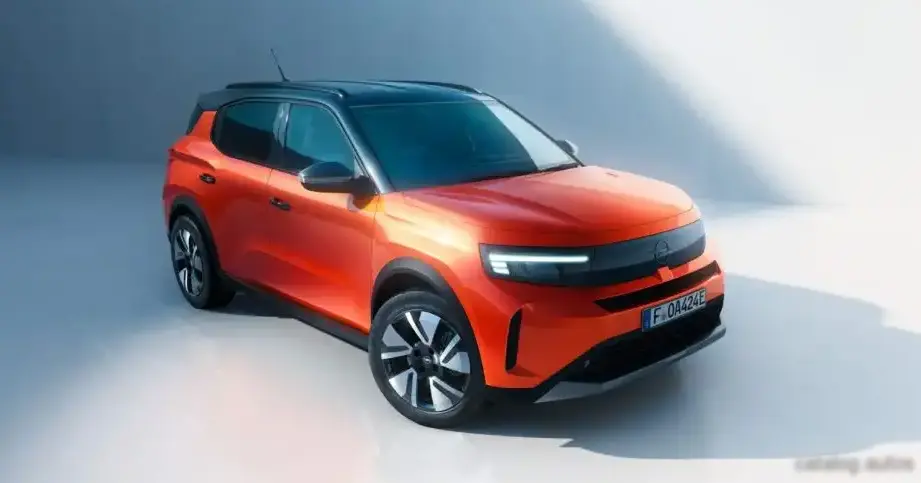
The Opel Frontera, reintroduced in 2024, represents a revival of a nameplate popular in the late 20th century. This latest iteration is a compact SUV positioned as an affordable and practical family vehicle, primarily aimed at the European market. Production commenced in March 2025, and the 1.2 Turbo (145 hp) Hybrid eDCT variant occupies a key position in the lineup, offering a balance between fuel efficiency and performance. It serves as a stepping stone for buyers seeking a more economical option than the potentially higher-powered trims, while still providing modern features and a comfortable driving experience. The Frontera shares its platform with the Peugeot 3008 and Citroën C5 Aircross, benefiting from Stellantis’s modular CMP architecture.
Technical Specifications
| Brand | Opel |
| Model | Frontera |
| Generation | Frontera (2024) |
| Type (Engine) | 1.2 Turbo (145 Hp) Hybrid eDCT |
| Start of production | March, 2025 |
| Powertrain Architecture | MHEV (Mild Hybrid Electric Vehicle) |
| Body type | SUV |
| Seats | 5 |
| Doors | 5 |
| Fuel consumption at Low speed (WLTP) | 4.5-4.6 l/100 km (52.3 – 51.1 US mpg) |
| Fuel consumption at Medium speed (WLTP) | 4.8-4.9 l/100 km (49 – 48 US mpg) |
| Fuel consumption at high speed (WLTP) | 4.7-4.8 l/100 km (50 – 49 US mpg) |
| Fuel consumption at very high speed (WLTP) | 6.2-6.3 l/100 km (37.9 – 37.3 US mpg) |
| Combined fuel consumption (WLTP) | 5.2-5.3 l/100 km (45.2 – 44.4 US mpg) |
| CO2 emissions (WLTP) | 118-120 g/km |
| Fuel Type | Petrol (Gasoline) |
| Acceleration 0 – 100 km/h | 9 sec |
| Acceleration 0 – 62 mph | 9 sec |
| Acceleration 0 – 60 mph | 8.6 sec |
| Maximum speed | 194 km/h (120.55 mph) |
| Emission standard | Euro 6e |
| Weight-to-power ratio | 8.8 kg/Hp |
| Weight-to-torque ratio | 5.5 kg/Nm |
| Battery voltage | 48 V |
| Battery technology | Lithium-ion (Li-Ion) |
| Electric motor power | 21 Hp @ 4265 rpm |
| Electric motor location | Integrated into the transmission |
| Electric motor type | Synchronous |
| System power | 145 Hp |
| Power | 136 Hp @ 5500 rpm |
| Power per litre | 113.4 Hp/l |
| Torque | 230 Nm @ 1750 rpm (169.64 lb.-ft. @ 1750 rpm) |
| Engine layout | Front, Transverse |
| Engine Model/Code | HN09 |
| Engine displacement | 1199 cm3 (73.17 cu. in.) |
| Number of cylinders | 3 |
| Engine configuration | Inline |
| Number of valves per cylinder | 4 |
| Fuel injection system | Direct injection |
| Engine aspiration | Turbocharger, Intercooler |
| Valvetrain | DOHC |
| Engine oil capacity | 3.5 l (3.7 US qt | 3.08 UK qt) |
| Kerb Weight | 1269 kg (2797.67 lbs.) |
| Max. weight | 1830 kg (4034.46 lbs.) |
| Max load | 561 kg (1236.79 lbs.) |
| Trunk (boot) space – minimum | 460 l (16.24 cu. ft.) |
| Trunk (boot) space – maximum | 1600 l (56.5 cu. ft.) |
| Fuel tank capacity | 44 l (11.62 US gal | 9.68 UK gal) |
| Max. roof load | 75 kg (165.35 lbs.) |
| Permitted trailer load with brakes (12%) | 1250 kg (2755.78 lbs.) |
| Permitted trailer load without brakes | 610 kg (1344.82 lbs.) |
| Permitted towbar download | 65 kg (143.3 lbs.) |
| Length | 4385 mm (172.64 in.) |
| Width | 1795 mm (70.67 in.) |
| Width with mirrors folded | 1849 mm (72.8 in.) |
| Width including mirrors | 2020 mm (79.53 in.) |
| Height | 1655 mm (65.16 in.) |
| Wheelbase | 2670 mm (105.12 in.) |
| Front track | 1552 mm (61.1 in.) |
| Rear (Back) track | 1559 mm (61.38 in.) |
| Minimum turning circle | 11.5 m (37.73 ft.) |
| Drivetrain Architecture | Front wheel drive |
| Number of gears and type of gearbox | 6 gears, automatic transmission eDCT |
| Front suspension | Independent, type McPherson with coil spring and anti-roll bar |
| Rear suspension | Torsion |
| Tires size | 215/65 R16 98H; 215/60 R17 96H |
| Wheel rims size | 16; 17 |
Powertrain & Engine Architecture
The Frontera 1.2 Turbo Hybrid utilizes the HN09 engine, a three-cylinder, 1.2-liter turbocharged gasoline engine. This engine is part of Stellantis’s PureTech family, known for its compact size and efficiency. It produces 136 horsepower at 5500 rpm and 230 Nm (169.64 lb-ft) of torque at 1750 rpm. The “Hybrid” designation refers to a 48-volt mild hybrid system. This system incorporates a small electric motor integrated into the transmission, providing a power boost during acceleration and enabling start-stop functionality for improved fuel economy. The electric motor contributes an additional 21 hp at 4265 rpm. The combined system output is 145 hp. The engine employs direct fuel injection and a double overhead camshaft (DOHC) valvetrain. The eDCT (efficient Dual-Clutch Transmission) is a six-speed automatic, chosen for its smooth shifting and contribution to fuel efficiency. The particulate filter is standard, helping to reduce emissions and meet Euro 6e standards.
Driving Characteristics
The 1.2 Turbo Hybrid eDCT Frontera offers a comfortable and refined driving experience, prioritizing fuel economy over outright performance. Acceleration from 0-60 mph takes approximately 8.6 seconds, and 0-100 km/h in 9 seconds, making it adequate for everyday driving situations. The eDCT transmission provides quick and seamless gear changes, enhancing responsiveness. Compared to potential higher-output versions (if offered), this variant feels less eager to accelerate, but the electric motor assist does provide a noticeable boost during initial acceleration. The gear ratios are tuned for efficiency, meaning the engine may feel slightly strained when climbing hills or overtaking at higher speeds. The mild hybrid system is most noticeable during start-stop operation, providing a near-silent restart. The front-wheel-drive configuration contributes to lower weight and improved fuel economy, but it may lack the all-weather capability of an all-wheel-drive system.
Equipment & Trim Levels
The standard equipment level for the 1.2 Turbo Hybrid eDCT Frontera typically includes air conditioning, a touchscreen infotainment system with smartphone integration (Apple CarPlay and Android Auto), and a suite of safety features such as automatic emergency braking, lane departure warning, and traffic sign recognition. Interior upholstery is generally cloth, with options for upgraded materials available on higher trim levels. Dashboard configuration is modern and functional, with a focus on ease of use. Optional extras may include a larger touchscreen display, navigation system, parking sensors, a rearview camera, and alloy wheels. Specific trim levels (e.g., Edition, Business, Elite) will dictate the level of standard equipment and available options.
Chassis & Braking
The Frontera utilizes a McPherson strut front suspension with a coil spring and anti-roll bar, providing a comfortable ride and predictable handling. The rear suspension employs a torsion beam setup, which is cost-effective and space-efficient. Braking is typically handled by disc brakes on the front wheels and drum brakes on the rear, a configuration chosen to balance cost and performance for this weight class. The electric power steering provides light and precise steering feel. Stabilizer bars are fitted to both the front and rear axles to reduce body roll during cornering.
Market Reception & Comparison
Early reviews of the Opel Frontera 1.2 Turbo Hybrid eDCT have praised its fuel efficiency and comfortable ride. Critics have noted that the engine, while adequate, isn’t particularly powerful, and may feel underpowered when fully loaded or driving on steep inclines. Compared to other trims in the Frontera lineup (if available), this variant offers the best fuel economy and lowest price point, making it an attractive option for budget-conscious buyers. Its fuel consumption figures of 5.2-5.3 l/100 km (45.2 – 44.4 US mpg) are competitive within the compact SUV segment. Reliability data is still emerging, but the PureTech engine has a mixed reputation, with some reports of timing chain issues in earlier iterations. The mild hybrid system is generally considered reliable.
Legacy
The long-term reliability of the Frontera 1.2 Turbo Hybrid powertrain remains to be seen, as it is a relatively new engine and transmission combination. However, the 48-volt mild hybrid technology is becoming increasingly common and is generally considered to be a robust system. The used car market for this variant will likely be competitive, with demand driven by its fuel efficiency and affordability. Proper maintenance, including regular oil changes and adherence to the manufacturer’s service schedule, will be crucial to ensuring the longevity of the engine and transmission. The Frontera’s revival represents Opel’s commitment to offering practical and affordable vehicles in the competitive European SUV market.