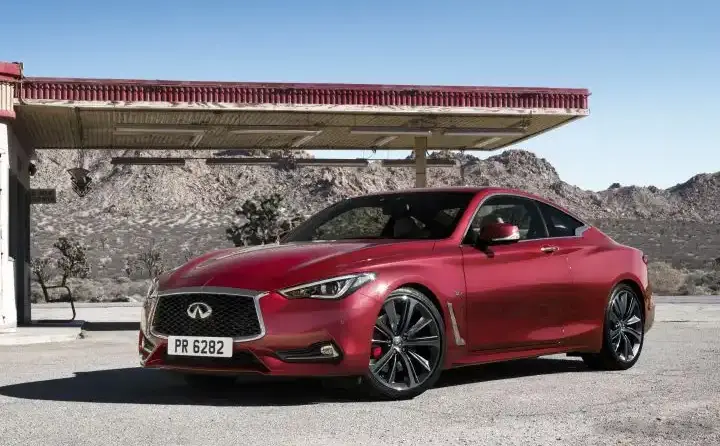
The Infiniti Q60 II Coupe 3.0 V6 (304 Hp) Automatic, produced from 2016 to 2018, represents a significant iteration in Infiniti’s luxury sports coupe lineage. Positioned as a direct successor to the Q60 3.7L model, the Q60 II was built upon the shared FM platform with the Nissan 370Z and offered a more refined and technologically advanced package. This particular variant, featuring the VR30DDTT 3.0-liter twin-turbocharged V6 engine paired with a seven-speed automatic transmission, served as the mid-range offering in the Q60 lineup, bridging the gap between the base 2.0t models and the higher-performance Red Sport 400. The Q60 aimed to compete with established players in the luxury coupe segment, such as the BMW 4 Series, Audi A5, and Lexus RC.
Technical Specifications
| Brand | Infiniti |
| Model | Q60 |
| Generation | Q60 II Coupe |
| Type (Engine) | 3.0 V6 (304 Hp) Automatic |
| Start of production | 2016 |
| End of production | 2018 |
| Powertrain Architecture | Internal Combustion engine |
| Body type | Coupe |
| Seats | 4 |
| Doors | 2 |
| Fuel consumption (urban) | 12.4 l/100 km (19 US mpg) |
| Fuel consumption (extra urban) | 8.4 l/100 km (28 US mpg) |
| Fuel Type | Petrol (Gasoline) |
| Weight-to-power ratio | 5.6 kg/Hp |
| Weight-to-torque ratio | 4.3 kg/Nm |
| Power | 304 Hp @ 6400 rpm |
| Power per litre | 101.4 Hp/l |
| Torque | 400 Nm @ 1600-5200 rpm (295.02 lb.-ft. @ 1600-5200 rpm) |
| Engine layout | Front, Longitudinal |
| Engine Model/Code | VR30DDTT |
| Engine displacement | 2997 cm3 (182.89 cu. in.) |
| Number of cylinders | 6 |
| Engine configuration | V-engine |
| Cylinder Bore | 86 mm (3.39 in.) |
| Piston Stroke | 86 mm (3.39 in.) |
| Compression ratio | 10.3:1 |
| Number of valves per cylinder | 4 |
| Fuel injection system | Direct injection |
| Engine aspiration | Twin-Turbo, Intercooler |
| Valvetrain | DOHC-CVVT |
| Engine oil capacity | 4.8 l (5.07 US qt | 4.22 UK qt) |
| Coolant | 8.8 l (9.3 US qt | 7.74 UK qt) |
| Kerb Weight | 1712 kg (3774.31 lbs.) |
| Trunk (boot) space | 246 l (8.69 cu. ft.) |
| Fuel tank capacity | 76 l (20.08 US gal | 16.72 UK gal) |
| Length | 4684 mm (184.41 in.) |
| Width | 1849 mm (72.8 in.) |
| Height | 1384 mm (54.49 in.) |
| Wheelbase | 2850 mm (112.2 in.) |
| Drag coefficient (Cd) | 0.28 |
| Minimum turning circle | 11.2 m (36.75 ft.) |
| Drivetrain Architecture | Rear wheel drive |
| Number of gears | 7 |
| Gearbox type | Automatic transmission |
| Front suspension | Double wishbone |
| Rear suspension | Independent multi-link spring suspension with stabilizer |
| Front brakes | Ventilated discs |
| Rear brakes | Ventilated discs |
| Assisting systems | ABS (Anti-lock braking system) |
| Steering type | Steering rack and pinion |
| Power steering | Electric Steering |
| Tires size | 255/40 R19 |
| Wheel rims size | 9J x 19 |
Powertrain & Engine Architecture
The heart of the Q60 3.0t is the VR30DDTT 3.0-liter V6 engine. This engine represents a departure from the previous 3.7-liter VQ37VHR naturally aspirated engine, embracing forced induction for improved efficiency and power density. The VR30DDTT utilizes twin turbochargers, one for each bank of cylinders, to deliver a broad torque curve and responsive acceleration. Direct injection is employed to optimize fuel combustion and reduce emissions. The engine features a double overhead camshaft (DOHC) valvetrain with Continuously Variable Valve Timing Control (CVVT) on both intake and exhaust valves, further enhancing performance and efficiency. The seven-speed automatic transmission, sourced from Mercedes-Benz (7G-TRONIC), provides smooth and quick shifts, contributing to the overall driving experience. This transmission was chosen for its refinement and ability to handle the engine’s torque output.
Driving Characteristics
The Q60 3.0t Automatic delivers a balanced driving experience. While not as overtly sporty as the Red Sport 400, the 304 horsepower and 295 lb-ft of torque provide ample power for both daily commuting and spirited driving. The automatic transmission is well-tuned, offering responsive shifts and a comfortable driving experience. The gear ratios are optimized for a blend of acceleration and fuel economy. Compared to the base 2.0t models, the 3.0t offers significantly more power and a more engaging driving experience. However, it doesn’t quite match the raw acceleration of the Red Sport 400. The rear-wheel-drive configuration contributes to a balanced chassis and predictable handling.
Equipment & Trim Levels
The Q60 3.0t Automatic typically came standard with features such as leather upholstery, a power-adjustable driver’s seat, dual-zone automatic climate control, a 7-inch touchscreen infotainment system, and a rearview camera. Optional extras included a Bose premium audio system, navigation, heated and ventilated front seats, and a suite of advanced driver-assistance systems (ADAS) like adaptive cruise control, lane departure warning, and blind-spot monitoring. Trim levels beyond the base 3.0t often added features like upgraded interior trim, larger wheels, and performance-oriented suspension components.
Chassis & Braking
The Q60 II Coupe utilizes a double wishbone front suspension and an independent multi-link rear suspension, providing a comfortable ride and responsive handling. Stabilizer bars are fitted to both axles to reduce body roll during cornering. The braking system consists of ventilated discs on all four wheels, providing ample stopping power. Anti-lock braking system (ABS) is standard, enhancing safety and control. The steering is electrically assisted, offering a precise and responsive feel.
Market Reception & Comparison
Critics generally praised the Q60 3.0t for its stylish design, comfortable interior, and strong engine performance. However, some reviewers noted that the infotainment system could be more intuitive and that the rear seats were somewhat cramped. Compared to the 2.0t models, the 3.0t offered a significant performance upgrade, justifying the higher price tag for enthusiasts. Fuel economy was respectable for a luxury sports coupe, but not class-leading. Reliability reports have been mixed, with some owners reporting issues with the turbochargers and infotainment system.
Legacy
The Infiniti Q60 II Coupe 3.0 V6 Automatic remains a desirable used car option for those seeking a stylish and capable luxury sports coupe. The VR30DDTT engine, while complex, offers a good balance of performance and efficiency. The seven-speed automatic transmission is generally considered reliable. However, potential buyers should be aware of the potential for turbocharger issues and carefully inspect the infotainment system. The Q60 represents a transitional period for Infiniti, showcasing its commitment to both luxury and performance, and continues to hold a place in the hearts of many automotive enthusiasts.