
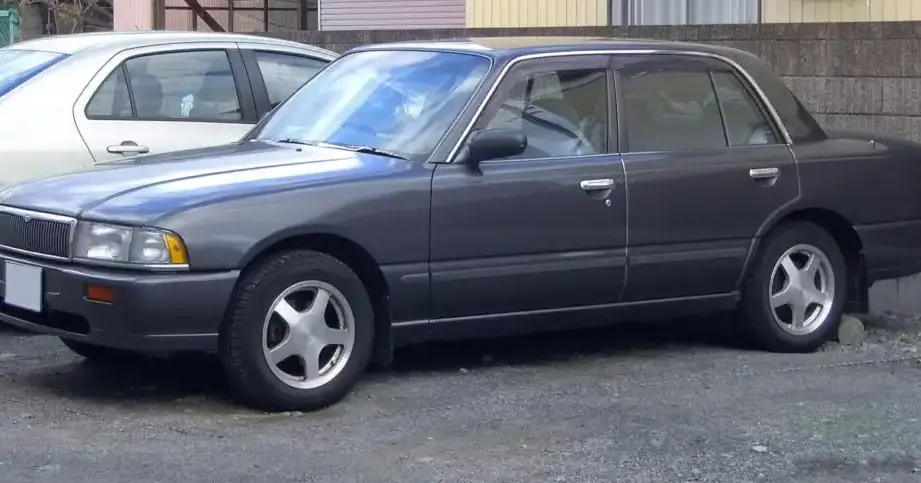
The Nissan Crew (K30) 2.0i 12V Automatic, produced between 1994 and 1998, represented a mid-range offering within the K30 Crew lineup. Positioned as a comfortable and practical sedan, it aimed to provide a balance between performance and fuel efficiency for the Japanese domestic market and select export regions. The K30 Crew, as a whole, was Nissan’s entry into the traditionally conservative “comfort class” sedan segment, offering a more modern alternative to established competitors. This particular variant, with its 2.0-liter inline-six engine and four-speed automatic transmission, was designed to appeal to buyers prioritizing ease of use and a smooth driving experience over outright sportiness.
Technical Specifications
| Brand | Nissan |
| Model | Crew |
| Generation | Crew (K30) |
| Type (Engine) | 2.0 i 12V (130 Hp) Automatic |
| Start of production | 1994 |
| End of production | 1998 |
| Powertrain Architecture | Internal Combustion engine |
| Body type | Sedan |
| Seats | 5 |
| Doors | 4 |
| Fuel consumption (combined) | 7 l/100 km (33.6 US mpg, 40.4 UK mpg, 14.3 km/l) |
| Fuel Type | Petrol (Gasoline) |
| Weight-to-power ratio | 9.5 kg/Hp, 105.7 Hp/tonne |
| Weight-to-torque ratio | 7.2 kg/Nm, 139.8 Nm/tonne |
| Power | 130 Hp @ 5600 rpm |
| Power per litre | 65.1 Hp/l |
| Torque | 172 Nm @ 4400 rpm (126.86 lb.-ft. @ 4400 rpm) |
| Engine layout | Front, Longitudinal |
| Engine displacement | 1998 cm3 (121.93 cu. in.) |
| Number of cylinders | 6 |
| Engine configuration | Inline |
| Cylinder Bore | 78 mm (3.07 in.) |
| Piston Stroke | 69.7 mm (2.74 in.) |
| Compression ratio | 9.5:1 |
| Number of valves per cylinder | 2 |
| Fuel injection system | Multi-port manifold injection |
| Engine aspiration | Naturally aspirated engine |
| Valvetrain | OHC |
| Kerb Weight | 1230 kg (2711.69 lbs.) |
| Max. weight | 1505 kg (3317.96 lbs.) |
| Max load | 275 kg (606.27 lbs.) |
| Fuel tank capacity | 72 l (19.02 US gal | 15.84 UK gal) |
| Length | 4595 mm (180.91 in.) |
| Width | 1695 mm (66.73 in.) |
| Height | 1460 mm (57.48 in.) |
| Wheelbase | 2665 mm (104.92 in.) |
| Front track | 1460 mm (57.48 in.) |
| Rear (Back) track | 1400 mm (55.12 in.) |
| Drivetrain Architecture | The Internal combustion engine (ICE) drives the rear wheels of the vehicle. |
| Drive wheel | Rear wheel drive |
| Number of gears and type of gearbox | 4 gears, automatic transmission |
| Front suspension | Wishbone |
| Rear suspension | Coil spring |
| Front brakes | Ventilated discs |
| Rear brakes | Drum |
| Assisting systems | ABS (Anti-lock braking system) |
| Power steering | Hydraulic Steering |
| Tires size | 185/70 R14 S |
| Wheel rims size | 14 |
Powertrain & Engine Architecture
The heart of the Crew 2.0i Automatic is Nissan’s inline-six cylinder engine, designated as part of the KA series. Specifically, this variant utilizes a 12-valve (two valves per cylinder) configuration. The engine benefits from multi-port fuel injection, a system that delivers fuel directly to each intake port, improving efficiency and throttle response compared to earlier carbureted designs. The 9.5:1 compression ratio was a standard figure for the time, balancing performance with the need to run on the available fuel grades. The four-speed automatic transmission, while not particularly advanced by modern standards, was chosen for its smooth operation and ease of use, aligning with the car’s intended market. It featured a traditional torque converter design and provided relatively conservative gear ratios, prioritizing comfort over aggressive acceleration.
Driving Characteristics
The 130 horsepower and 172 Nm (126.86 lb-ft) of torque delivered by the 2.0-liter engine, coupled with the four-speed automatic, resulted in a driving experience best described as relaxed and refined. Acceleration was adequate for everyday driving, but not particularly brisk. Compared to the manual transmission versions of the same engine, the automatic suffered a slight performance penalty due to the inherent losses within the torque converter and the transmission itself. The automatic’s gear ratios were geared towards fuel economy and smooth cruising, meaning the engine often felt slightly strained during hard acceleration. However, for drivers prioritizing comfort and convenience, the automatic provided a pleasant and effortless driving experience.
Equipment & Trim Levels
The 2.0i Automatic trim typically included features such as power windows, power steering, and an AM/FM radio. Air conditioning was often standard, though sometimes offered as an option depending on the specific market. Interior upholstery was generally cloth, with higher trim levels offering optional leather seating. The dashboard layout was functional and straightforward, with clearly labeled controls. Optional extras could include a sunroof, upgraded audio systems, and alloy wheels. The overall interior ambiance was designed to be comfortable and inviting, rather than overtly luxurious.
Chassis & Braking
The K30 Crew utilized a traditional body-on-frame construction, which contributed to its robust feel and durability. The front suspension employed a wishbone design, providing a comfortable ride and predictable handling. The rear suspension featured a coil spring setup. Braking duties were handled by ventilated discs at the front and drum brakes at the rear. While adequate for the car’s weight and performance, the drum brakes on the rear were a cost-saving measure and didn’t offer the same stopping power as disc brakes. Anti-lock braking system (ABS) was included as a standard safety feature, enhancing braking performance in slippery conditions.
Market Reception & Comparison
The Nissan Crew 2.0i Automatic was generally well-received by critics as a practical and comfortable family sedan. It was praised for its smooth ride, reliable engine, and spacious interior. However, it was often criticized for its somewhat bland styling and lack of sporting pretensions. Compared to other trims in the Crew lineup, such as those equipped with the manual transmission or larger engines, the 2.0i Automatic offered a more accessible price point and a more relaxed driving experience. Fuel economy was considered respectable for the time, though not class-leading. Reliability was a strong point, with the KA series engine being known for its durability.
Legacy
The Nissan Crew K30, and specifically the 2.0i Automatic variant, has developed a modest following among enthusiasts and collectors. The KA series engine is known for its robustness and relative simplicity, making it a relatively easy engine to maintain and repair. While not a particularly rare or valuable classic, well-maintained examples are increasingly sought after by those looking for a reliable and affordable vintage sedan. The automatic transmission, while not the most technologically advanced, has proven to be durable and long-lasting. Today, the K30 Crew 2.0i Automatic represents a snapshot of Japanese automotive engineering from the mid-1990s, offering a blend of comfort, practicality, and reliability.
