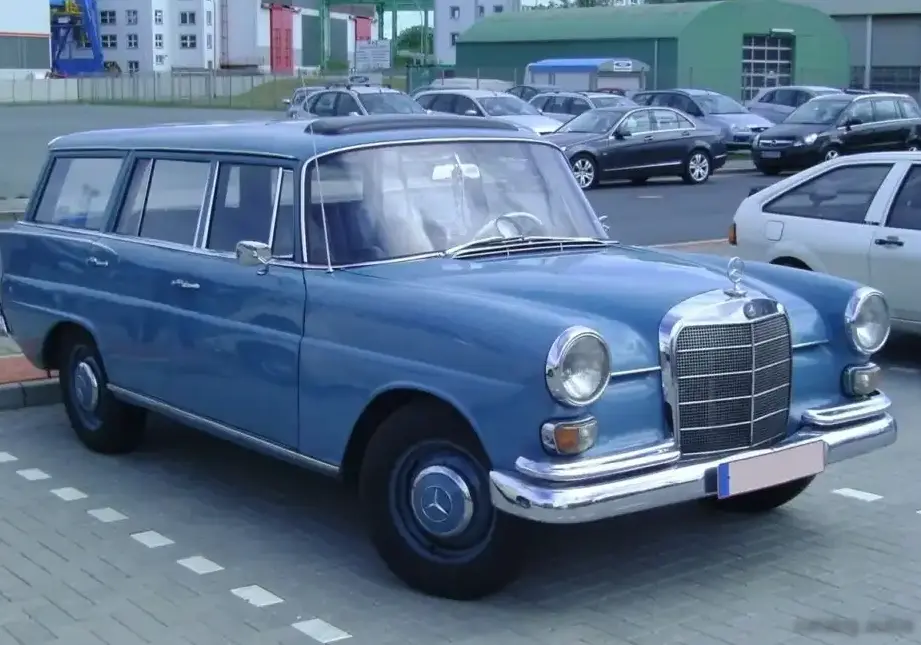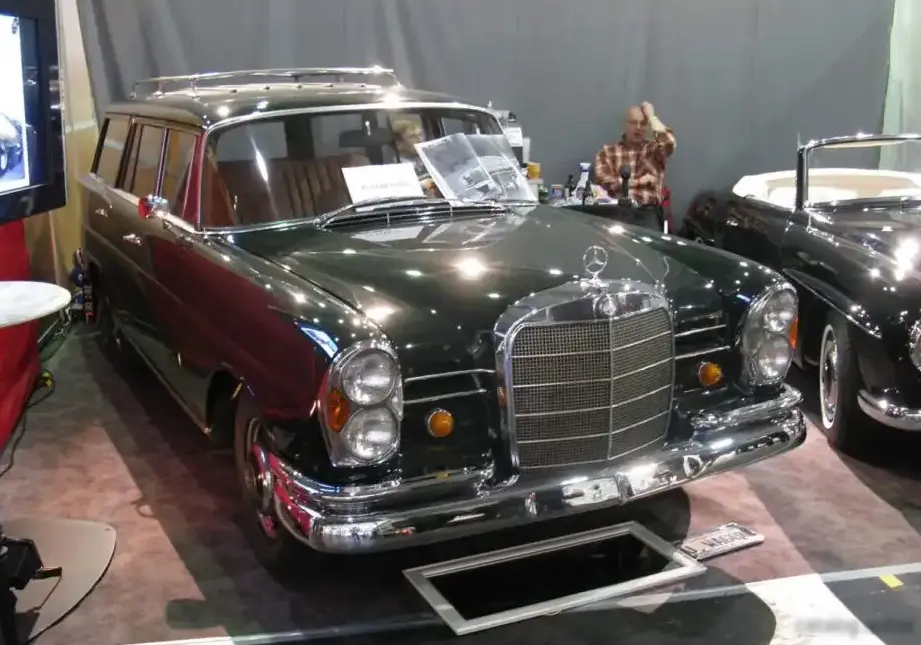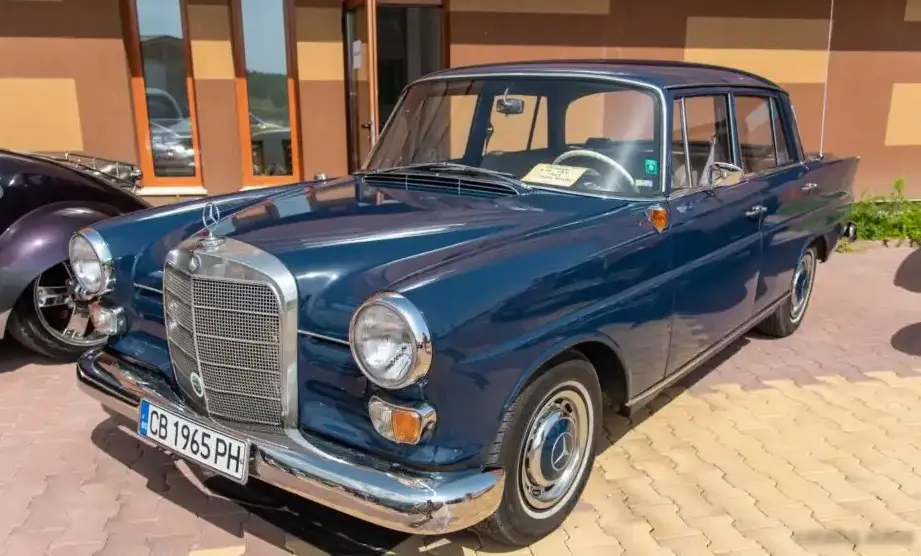
The Mercedes-Benz W110, commonly known as the “Fintail” due to its distinctive rear fin-like extensions, represented a significant step forward for Mercedes-Benz in the mid-1960s. Produced from 1962 to 1968, the W110 was designed as a more affordable and modern alternative to the larger and more luxurious W111 “S-Class” models. The 200 model, equipped with a 2.0-liter engine producing 95 horsepower and paired with an automatic transmission, was introduced in July 1965 and continued through February 1968. This variant occupied a middle ground in the Fintail lineup, offering a balance between performance, comfort, and price, appealing to a broader segment of the market than the more powerful 230 and 280 models.
Technical Specifications
| Brand | Mercedes-Benz |
| Model | Fintail |
| Generation | Fintail (W110) |
| Type (Engine) | 200 (95 Hp) Automatic |
| Start of production | July, 1965 |
| End of production | February, 1968 |
| Powertrain Architecture | Internal Combustion engine |
| Body type | Sedan |
| Seats | 5 |
| Doors | 4 |
| Fuel consumption (combined) | 10.9 l/100 km |
| Fuel consumption (US mpg) | 21.6 US mpg |
| Fuel consumption (UK mpg) | 25.9 UK mpg |
| Fuel consumption (km/l) | 9.2 km/l |
| Fuel Type | Petrol (Gasoline) |
| Acceleration 0 – 100 km/h | 15.1 sec |
| Acceleration 0 – 62 mph | 15.1 sec |
| Acceleration 0 – 60 mph | 14.3 sec |
| Maximum speed | 155 km/h (96.31 mph) |
| Weight-to-power ratio | 13.4 kg/Hp |
| Weight-to-torque ratio | 8.3 kg/Nm |
| Power | 95 Hp @ 5200 rpm |
| Power per litre | 47.8 Hp/l |
| Torque | 154 Nm @ 3600 rpm (113.58 lb.-ft. @ 3600 rpm) |
| Engine layout | Front, Longitudinal |
| Engine Model/Code | M 121 B XI / 121.940 |
| Engine displacement | 1988 cm3 (121.32 cu. in.) |
| Number of cylinders | 4 |
| Engine configuration | Inline |
| Cylinder Bore | 87 mm (3.43 in.) |
| Piston Stroke | 83.6 mm (3.29 in.) |
| Compression ratio | 9:1 |
| Number of valves per cylinder | 2 |
| Fuel injection system | Carburettor |
| Engine aspiration | Naturally aspirated engine |
| Valvetrain | SOHC |
| Kerb Weight | 1275 kg (2810.89 lbs.) |
| Max. weight | 1775 kg (3913.21 lbs.) |
| Max load | 500 kg (1102.31 lbs.) |
| Fuel tank capacity | 65 l (17.17 US gal | 14.3 UK gal) |
| Length | 4730 mm (186.22 in.) |
| Width | 1795 mm (70.67 in.) |
| Height | 1495 mm (58.86 in.) |
| Wheelbase | 2700 mm (106.3 in.) |
| Front track | 1482 mm (58.35 in.) |
| Rear track | 1485 mm (58.46 in.) |
| Drivetrain Architecture | Rear wheel drive |
| Number of gears | 4 |
| Gearbox type | automatic transmission |
| Front suspension | Double wishbone, Transverse stabilizer |
| Rear suspension | Trailing arm |
| Front brakes | Disc |
| Rear brakes | Drum |
| Steering type | Cone worm with recirculation balls |
| Wheel rims size | 5J x 13 |
Powertrain & Engine Architecture
The heart of the W110 200 Automatic was the M121 B XI engine, a 1,988 cc (121.3 cu in) inline-four cylinder unit. This engine featured a single overhead camshaft (SOHC) valvetrain and was fed by a Solex 32 PHH carburetor. The M121 engine was known for its robust construction and relative simplicity, making it a reliable powerplant. The 95 horsepower output was achieved at 5,200 rpm, while peak torque of 154 Nm (113.58 lb-ft) arrived at 3,600 rpm. The engine’s longitudinal front-engine layout was typical for Mercedes-Benz vehicles of the era. Paired with the engine was a four-speed automatic transmission, a relatively advanced feature for the time, offering a smoother driving experience than the standard manual gearbox. This automatic transmission, while improving convenience, did slightly diminish overall performance compared to the manual versions.
Driving Characteristics
The 200 Automatic offered a comfortable and refined driving experience, prioritizing ease of use over outright performance. Acceleration was leisurely, taking approximately 15.1 seconds to reach 100 km/h (62 mph). The automatic transmission, while smooth, had relatively widely spaced gear ratios, which meant the engine could feel strained during quick acceleration. Compared to the manual transmission versions of the 200, or the more powerful 230 and 280 models, the automatic felt noticeably slower. However, for drivers seeking a relaxed and effortless cruising experience, the 200 Automatic proved to be a capable and comfortable choice. The steering, utilizing a cone worm and recirculation balls system, was relatively heavy but provided good feedback.
Equipment & Trim Levels
The W110 200 Automatic typically came equipped with a respectable level of standard features for the mid-1960s. The interior featured cloth upholstery, although optional leather upholstery was available. The dashboard was functional and well-laid-out, with a comprehensive array of gauges. Standard equipment included hydraulic disc brakes on the front wheels and drum brakes on the rear, providing adequate stopping power. Optional extras included a sunroof, whitewall tires, and a radio. The 200 Automatic generally featured a more luxurious interior trim than the base 200 model with a manual transmission, reflecting its higher price point.
Chassis & Braking
The W110 featured a robust chassis with independent front suspension utilizing double wishbones and a transverse stabilizer, providing a comfortable ride and good handling. The rear suspension employed a trailing arm setup. The front brakes were disc brakes, a relatively modern feature for the time, while the rear brakes were drum brakes. This combination provided adequate stopping power for the vehicle’s weight and performance. The chassis was designed to provide a balance between ride comfort and handling, making the W110 a pleasant car to drive on both city streets and highways.
Market Reception & Comparison
The W110 200 Automatic was generally well-received by critics and buyers alike. It was praised for its comfortable ride, refined interior, and ease of use. However, some critics noted its relatively modest performance compared to other models in the lineup. Fuel economy was typical for the era, averaging around 10.9 liters per 100 kilometers (21.6 US mpg). Compared to the manual transmission 200, the automatic version offered less fuel efficiency. The 230 and 280 models, with their larger engines, provided significantly more power but came at a higher price. The 200 Automatic appealed to buyers who prioritized comfort and convenience over outright performance.
Legacy
The Mercedes-Benz W110 Fintail, and specifically the 200 Automatic variant, holds a significant place in automotive history. It represented a crucial step in Mercedes-Benz’s evolution, bridging the gap between the luxury S-Class models and more affordable offerings. The M121 engine proved to be remarkably durable, and many examples are still on the road today. While not as sought-after as the higher-performance models, the 200 Automatic remains a popular choice among classic Mercedes-Benz enthusiasts, appreciated for its reliability, comfortable ride, and distinctive styling. In the used car market, well-maintained examples command reasonable prices, making them an accessible entry point into the world of classic Mercedes-Benz ownership. The Fintail’s design, while initially controversial, has become iconic, and the car is now recognized as a significant example of 1960s automotive design.