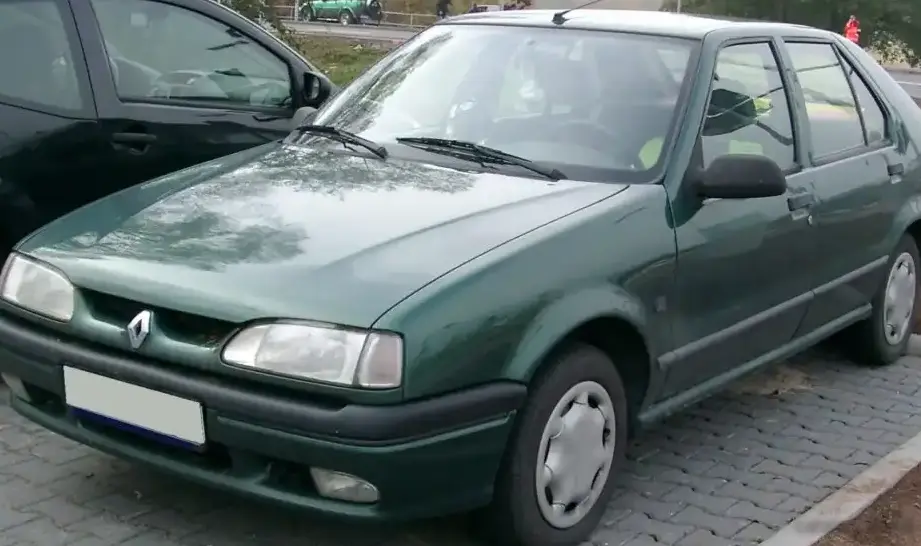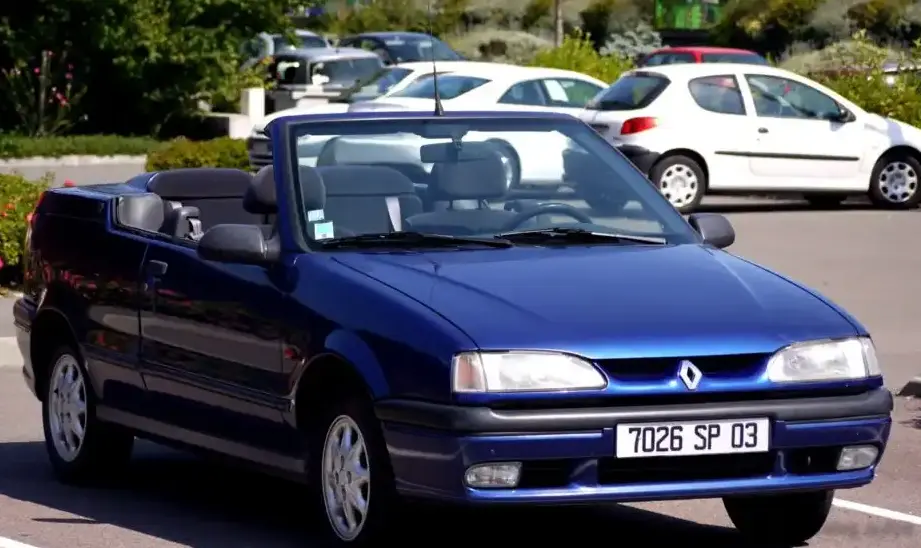
The Renault 19 Cabriolet 1.8 i (90 hp) was a popular open-top variant of Renault’s compact offering, produced from 1992 to 1996. Part of the D53 facelifted series, this model represented a significant update to the original Renault 19, offering a more refined driving experience and a stylish convertible option. Positioned as a mid-range trim within the Cabriolet lineup, it aimed to provide an accessible entry point into open-top motoring while still offering a reasonable level of equipment and performance. The 19 Cabriolet, built upon the 1HX0/A3 platform shared with the Peugeot 305 and Citroën BX, was primarily marketed in Europe, offering a French alternative to rivals like the Volkswagen Golf Cabriolet and Peugeot 205 Convertible.
Technical Specifications
| Brand | Renault |
| Model | 19 |
| Generation | 19 Cabriolet (D53) (facelift 1992) |
| Type (Engine) | 1.8 i (90 Hp) |
| Start of production | 1992 |
| End of production | 1996 |
| Powertrain Architecture | Internal Combustion engine |
| Body type | Cabriolet |
| Seats | 5 |
| Doors | 2 |
| Fuel consumption (combined) | 8.3 l/100 km |
| Fuel consumption (US mpg) | 28.3 US mpg |
| Fuel consumption (UK mpg) | 34 UK mpg |
| Fuel consumption (km/l) | 12 km/l |
| Fuel Type | Petrol (Gasoline) |
| Acceleration 0 – 100 km/h | 11.9 sec |
| Acceleration 0 – 62 mph | 11.9 sec |
| Acceleration 0 – 60 mph | 11.3 sec |
| Maximum speed | 176 km/h (109.36 mph) |
| Weight-to-power ratio | 12.5 kg/Hp |
| Power | 90 Hp @ 5750 rpm |
| Power per litre | 50.2 Hp/l |
| Torque | 142 Nm @ 2750 rpm (104.73 lb.-ft. @ 2750 rpm) |
| Engine layout | Front, Transverse |
| Engine Model/Code | F3P |
| Engine displacement | 1794 cm3 (109.48 cu. in.) |
| Number of cylinders | 4 |
| Engine configuration | Inline |
| Compression ratio | 9.7:1 |
| Number of valves per cylinder | 2 |
| Fuel injection system | Single-point injection |
| Engine aspiration | Naturally aspirated engine |
| Valvetrain | OHC |
| Engine oil capacity | 4.3 l (4.54 US qt | 3.78 UK qt) |
| Coolant capacity | 6.1 l (6.45 US qt | 5.37 UK qt) |
| Kerb Weight | 1125 kg (2480.2 lbs) |
| Max. weight | 1495 kg (3295.91 lbs) |
| Max load | 370 kg (815.71 lbs) |
| Trunk (boot) space – minimum | 255 l (9.01 cu. ft.) |
| Trunk (boot) space – maximum | 360 l (12.71 cu. ft.) |
| Fuel tank capacity | 55 l (14.53 US gal | 12.1 UK gal) |
| Length | 4162 mm (163.86 in) |
| Width | 1696 mm (66.77 in) |
| Height | 1410 mm (55.51 in) |
| Wheelbase | 2544 mm (100.16 in) |
| Front track | 1426 mm (56.14 in) |
| Rear track | 1406 mm (55.35 in) |
| Drivetrain Architecture | Front wheel drive |
| Number of gears | 5 gears, manual transmission |
| Front suspension | Wishbone |
| Rear suspension | Suspension with traction connecting levers |
| Front brakes | Disc |
| Rear brakes | Drum |
| Assisting systems | ABS (Anti-lock braking system) |
| Steering type | Steering rack and pinion |
| Power steering | Hydraulic Steering |
| Tires size | 195/50 R15V |
| Wheel rims size | 15 |
Powertrain & Engine Architecture
The Renault 19 Cabriolet 1.8 i utilized the F3P engine, a 1.8-liter inline-four cylinder powerplant. This engine was a mainstay in Renault’s lineup during the 1990s, known for its relative simplicity and durability. The F3P featured a single overhead camshaft (OHC) design with two valves per cylinder. Fuel delivery was handled by a single-point fuel injection system, which, while less sophisticated than multi-point injection, contributed to the engine’s affordability and ease of maintenance. The engine produced 90 horsepower at 5750 rpm and 142 Nm (104.73 lb-ft) of torque at 2750 rpm. The engine’s relatively low compression ratio of 9.7:1 allowed it to run on lower octane fuel, a consideration for many European drivers. The transmission was a five-speed manual, providing adequate gear ratios for everyday driving. While an automatic transmission was offered in some Renault 19 models, it was less common with the 1.8-liter engine.
Driving Characteristics
The 1.8-liter engine, paired with the five-speed manual transmission, provided a reasonably balanced driving experience. Acceleration from 0 to 60 mph took approximately 11.3 seconds, and the car had a top speed of around 109 mph. While not particularly sporty, the 1.8L engine offered sufficient power for comfortable cruising and overtaking. Compared to the more powerful Renault 19 16V models, the 1.8 i felt noticeably less responsive, particularly at higher engine speeds. However, the lower power output also meant better fuel economy and reduced stress on the drivetrain. The gear ratios were well-suited to the engine’s torque curve, providing decent acceleration in each gear. The Cabriolet’s open-top design added to the driving experience, but also introduced some body flex, particularly on uneven road surfaces.
Equipment & Trim Levels
The 1.8 i Cabriolet typically came equipped with features such as power steering, central locking, and an AM/FM radio. Interior upholstery was usually cloth, with options for upgraded materials available. The dashboard layout was functional and straightforward, with clearly labeled controls. Optional extras included alloy wheels, a sunroof (in addition to the convertible top), and upgraded sound systems. The trim level sat in the middle of the Cabriolet range, offering a good balance between price and features. It was a step up from the base models, which often lacked power steering and other convenience features, but didn’t have the luxury appointments of the higher-end trims.
Chassis & Braking
The Renault 19 Cabriolet featured a front-wheel-drive layout with independent wishbone suspension at the front and a torsion beam suspension with traction connecting levers at the rear. The front brakes were ventilated discs, while the rear brakes were drums. This configuration was typical for cars in this class during the early 1990s. Anti-lock braking system (ABS) was available as an option, enhancing safety by preventing wheel lockup during hard braking. The suspension provided a comfortable ride, absorbing bumps and imperfections in the road surface reasonably well. The steering was precise and responsive, thanks to the rack-and-pinion system with hydraulic power assistance.
Market Reception & Comparison
The Renault 19 Cabriolet 1.8 i was generally well-received by automotive critics. It was praised for its stylish design, comfortable ride, and affordable price. However, some reviewers noted that the 1.8-liter engine lacked the punch of its competitors, particularly the Volkswagen Golf Cabriolet with its larger engine options. Fuel economy was considered good for a convertible, averaging around 28.3 US mpg. In terms of reliability, the F3P engine was generally regarded as durable, but the single-point fuel injection system could require occasional maintenance. Compared to the higher-performance Renault 19 16V models, the 1.8 i offered a more economical and practical option for drivers who prioritized comfort and fuel efficiency over outright speed.
Legacy
The Renault 19 Cabriolet 1.8 i remains a popular choice among classic car enthusiasts. The F3P engine is known for its relative simplicity, making it easier to maintain and repair than more complex modern engines. Parts availability is generally good, although some components may be becoming increasingly difficult to find. The Cabriolet’s open-top design and stylish aesthetics continue to appeal to drivers who appreciate classic French motoring. While not a high-performance machine, the 1.8 i offers a charming and enjoyable driving experience, making it a worthwhile addition to any classic car collection. Today, well-maintained examples command reasonable prices in the used car market, reflecting their enduring appeal and relative scarcity.