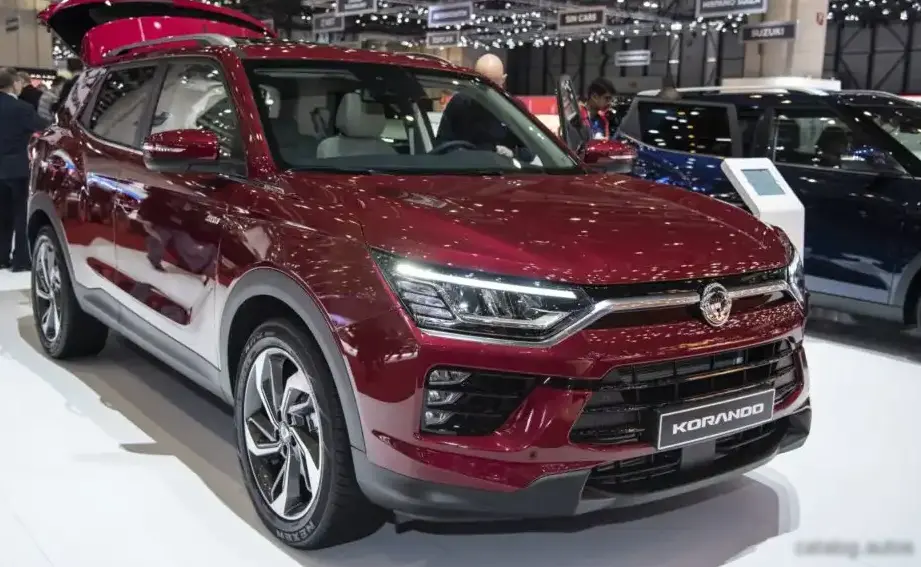
The SsangYong Korando IV 2.0 MPI (149 hp) with the AISIN automatic transmission represents a significant entry point into the fourth generation of SsangYong’s popular SUV, launched in 2019. Positioned as a mainstream offering within the Korando IV lineup, this variant aimed to provide a balance of affordability, practicality, and reasonable performance for family buyers. The Korando IV, built on a completely new platform compared to its predecessor, represented a substantial leap forward in design, technology, and overall refinement for the South Korean automaker. This specific configuration was primarily targeted at the European and Asian markets, where fuel efficiency and comfortable driving experiences are highly valued.
Technical Specifications
| Brand | SsangYong |
| Model | Korando |
| Generation | Korando IV |
| Type (Engine) | 2.0 MPI (149 Hp) AISIN |
| Start of production | 2019 |
| Powertrain Architecture | Internal Combustion engine |
| Body type | SUV |
| Seats | 5 |
| Doors | 5 |
| Fuel Type | Petrol (Gasoline) |
| Maximum speed | 187 km/h (116.2 mph) |
| Weight-to-power ratio | 9.8 kg/Hp, 101.7 Hp/tonne |
| Weight-to-torque ratio | 7.4 kg/Nm, 134.5 Nm/tonne |
| Power | 149 Hp @ 6000 rpm |
| Power per litre | 74.6 Hp/l |
| Torque | 197 Nm @ 4000 rpm (145.3 lb.-ft. @ 4000 rpm) |
| Engine Model/Code | G20DF |
| Engine displacement | 1998 cm3 (121.93 cu. in.) |
| Number of cylinders | 4 |
| Engine configuration | Inline |
| Cylinder Bore | 86 mm (3.39 in.) |
| Piston Stroke | 86 mm (3.39 in.) |
| Fuel injection system | Multi-port manifold injection |
| Engine aspiration | Naturally aspirated engine |
| Engine oil capacity | 4.5 l (4.76 US qt | 3.96 UK qt) |
| Coolant | 8 l (8.45 US qt | 7.04 UK qt) |
| Kerb Weight | 1465 kg (3229.77 lbs.) |
| Max. weight | 2070 kg (4563.57 lbs.) |
| Max load | 605 kg (1333.8 lbs.) |
| Trunk (boot) space – minimum | 551 l (19.46 cu. ft.) |
| Trunk (boot) space – maximum | 1248 l (44.07 cu. ft.) |
| Fuel tank capacity | 47 l (12.42 US gal | 10.34 UK gal) |
| Permitted trailer load with brakes (12%) | 1500 kg (3306.93 lbs.) |
| Permitted trailer load without brakes | 500 kg (1102.31 lbs.) |
| Length | 4450 mm (175.2 in.) |
| Width | 1870 mm (73.62 in.) |
| Height | 1629 mm (64.13 in.) |
| Wheelbase | 2675 mm (105.31 in.) |
| Front track | 1590 mm (62.6 in.) |
| Rear (Back) track | 1610 mm (63.39 in.) |
| Front overhang | 910 mm (35.83 in.) |
| Rear overhang | 865 mm (34.06 in.) |
| Ride height (ground clearance) | 180 mm (7.09 in.) |
| Minimum turning circle (turning diameter) | 10.7 m (35.1 ft.) |
| Approach angle | 18° |
| Departure angle | 24.5° |
| Ramp-over (brakeover) angle | 15.9° |
| Drivetrain Architecture | The Internal combustion engine (ICE) drives the front wheels of the vehicle. |
| Drive wheel | Front wheel drive |
| Number of gears and type of gearbox | 6 gears, automatic transmission |
| Front suspension | Independent type McPherson |
| Rear suspension | Independent multi-link suspension |
| Front brakes | Ventilated discs |
| Rear brakes | Disc |
| Assisting systems | ABS (Anti-lock braking system) |
| Steering type | Steering rack and pinion |
| Power steering | Electric Steering |
Powertrain & Engine Architecture
The Korando IV 2.0 MPI utilizes SsangYong’s G20DF engine, a naturally aspirated 1.998-liter inline-four cylinder gasoline engine. This engine employs multi-point fuel injection and a dual overhead camshaft (DOHC) valvetrain. While not a particularly high-tech engine in terms of forced induction or direct injection, it prioritizes reliability and cost-effectiveness. The engine produces 149 horsepower at 6,000 rpm and 197 Nm (145.3 lb-ft) of torque at 4,000 rpm. The engine is paired with a six-speed automatic transmission sourced from AISIN, a well-respected Japanese transmission manufacturer. This transmission was chosen for its smoothness and durability, contributing to a more refined driving experience compared to some of SsangYong’s earlier automatic offerings. The drivetrain is front-wheel drive, a configuration common in this segment, although all-wheel drive was available on higher trim levels.
Driving Characteristics
The 2.0 MPI automatic Korando IV delivers adequate, but not exhilarating, performance. Acceleration is best described as leisurely, with a 0-60 mph time estimated around 10-11 seconds. The AISIN transmission is well-programmed, offering smooth shifts and generally avoiding unnecessary gear hunting. However, the relatively low horsepower and torque figures mean that overtaking maneuvers require careful planning. Compared to the more powerful 1.6-liter turbocharged gasoline engine or the diesel options available in the Korando IV range, this variant feels noticeably less responsive. The automatic transmission’s gear ratios are tuned for fuel efficiency rather than outright performance, prioritizing comfortable cruising over spirited driving. The front-wheel-drive configuration contributes to a slight tendency towards understeer in cornering, but the chassis is generally well-balanced.
Equipment & Trim Levels
The 2.0 MPI automatic trim typically served as a mid-range offering in the Korando IV lineup. Standard equipment generally included air conditioning, a touchscreen infotainment system with Bluetooth connectivity, power windows and mirrors, and basic safety features like ABS and multiple airbags. Higher trim levels added features such as leather upholstery, heated seats, a sunroof, and advanced driver-assistance systems (ADAS) like lane departure warning and automatic emergency braking. Interior materials were generally of good quality for the price point, with a focus on durability and practicality. Optional extras included metallic paint, upgraded audio systems, and parking sensors.
Chassis & Braking
The Korando IV utilizes a McPherson strut front suspension and a multi-link rear suspension, providing a comfortable and controlled ride. The suspension is tuned to prioritize comfort over sporty handling. Braking duties are handled by ventilated discs at the front and solid discs at the rear. ABS (Anti-lock Braking System) is standard. The Korando IV’s chassis is relatively lightweight, contributing to its decent fuel economy and manageable handling characteristics. Stabilizer bars are fitted front and rear to reduce body roll during cornering.
Market Reception & Comparison
The Korando IV 2.0 MPI automatic was generally well-received by automotive critics as a practical and affordable family SUV. It was praised for its comfortable ride, spacious interior, and generous equipment levels for the price. However, the engine was often criticized for being underpowered, particularly when fully loaded with passengers and luggage. Compared to rivals like the Hyundai Tucson or Kia Sportage, the Korando IV offered a more competitive price point but lacked the brand recognition and refinement of its Korean competitors. Fuel economy was respectable, averaging around 28-32 mpg in mixed driving conditions, depending on driving style and load. Reliability reports have been generally positive, with few major issues reported with the powertrain.
Legacy
The SsangYong Korando IV 2.0 MPI (149 hp) AISIN represents a solid and dependable choice in the used car market. The AISIN automatic transmission is known for its longevity, and the naturally aspirated engine is relatively simple to maintain. While not the most exciting SUV to drive, it offers a comfortable and practical transportation solution for families. Its affordability and generous equipment levels make it an attractive option for budget-conscious buyers. As with any used vehicle, a thorough inspection by a qualified mechanic is recommended before purchase, paying particular attention to the condition of the suspension components and the overall maintenance history.