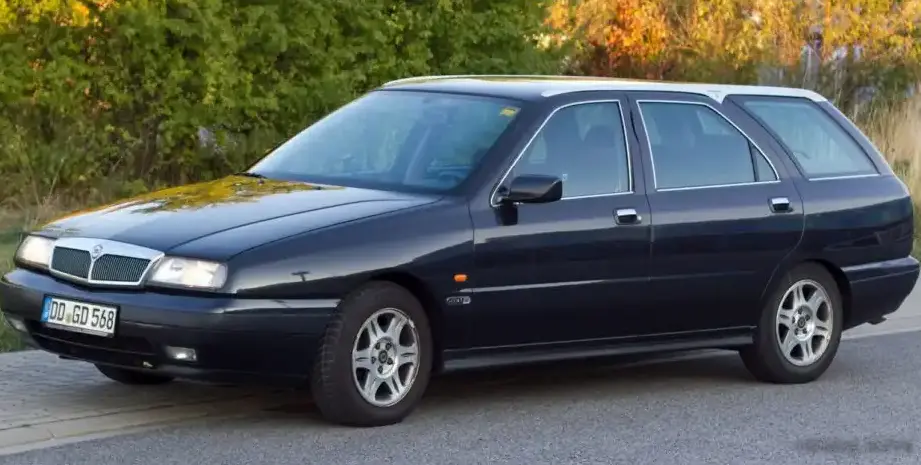
The Lancia Kappa Station Wagon (838) 2.0 20V, produced between 1996 and July 2000, represented a significant offering in the upper-midsize station wagon segment for the Italian automaker. Positioned as a more practical variant of the Kappa sedan, the station wagon aimed to combine Lancia’s traditional focus on comfort and style with the versatility demanded by family buyers. It was built on the 838 platform, shared with the Alfa Romeo 166, and represented a move upmarket for Lancia, attempting to recapture some of the prestige associated with earlier models like the Flavia and Stratos. This particular 2.0-liter 20-valve engine and five-speed manual transmission combination occupied a middle ground in the Kappa wagon lineup, offering a balance between performance and fuel economy.
Technical Specifications
| Brand | Lancia |
| Model | Kappa |
| Generation | Kappa Station Wagon (838) |
| Type (Engine) | 2.0 20V (155 Hp) |
| Start of production | 1996 |
| End of production | July, 2000 |
| Powertrain Architecture | Internal Combustion engine |
| Body type | Station wagon (estate) |
| Seats | 5 |
| Doors | 5 |
| Fuel consumption (urban) | 15 l/100 km (15.7 US mpg, 18.8 UK mpg, 6.7 km/l) |
| Fuel consumption (extra urban) | 8.4 l/100 km (28 US mpg, 33.6 UK mpg, 11.9 km/l) |
| Fuel Type | Petrol (Gasoline) |
| Acceleration 0 – 100 km/h | 10 sec |
| Acceleration 0 – 62 mph | 10 sec |
| Acceleration 0 – 60 mph | 9.5 sec |
| Maximum speed | 205 km/h (127.38 mph) |
| Weight-to-power ratio | 9.7 kg/Hp, 102.6 Hp/tonne |
| Weight-to-torque ratio | 8.1 kg/Nm, 123.2 Nm/tonne |
| Power | 155 Hp @ 6500 rpm |
| Power per litre | 77.6 Hp/l |
| Torque | 186 Nm @ 4000 rpm (137.19 lb.-ft. @ 4000 rpm) |
| Engine layout | Front, Transverse |
| Engine Model/Code | 838 A6.000 |
| Engine displacement | 1998 cm3 (121.93 cu. in.) |
| Number of cylinders | 5 |
| Engine configuration | Inline |
| Cylinder Bore | 82 mm (3.23 in.) |
| Piston Stroke | 75.65 mm (2.98 in.) |
| Compression ratio | 10.4:1 |
| Number of valves per cylinder | 4 |
| Fuel injection system | Multi-port manifold injection |
| Engine aspiration | Naturally aspirated engine |
| Valvetrain | DOHC |
| Engine oil capacity | 5.4 l (5.71 US qt | 4.75 UK qt) |
| Coolant | 8.3 l (8.77 US qt | 7.3 UK qt) |
| Kerb Weight | 1510 kg (3328.98 lbs.) |
| Max. weight | 2090 kg (4607.66 lbs.) |
| Max load | 580 kg (1278.68 lbs.) |
| Trunk (boot) space – minimum | 525 l (18.54 cu. ft.) |
| Fuel tank capacity | 70 l (18.49 US gal | 15.4 UK gal) |
| Length | 4687 mm (184.53 in.) |
| Width | 1826 mm (71.89 in.) |
| Height | 1464 mm (57.64 in.) |
| Wheelbase | 2700 mm (106.3 in.) |
| Front track | 1547 mm (60.91 in.) |
| Rear (Back) track | 1541 mm (60.67 in.) |
| Drivetrain Architecture | The Internal combustion engine (ICE) drives the front wheels of the vehicle. |
| Drive wheel | Front wheel drive |
| Number of gears and type of gearbox | 5 gears, manual transmission |
| Front suspension | Wishbone |
| Rear suspension | Spring Strut |
| Front brakes | Ventilated discs |
| Rear brakes | Disc |
| Assisting systems | ABS (Anti-lock braking system) |
| Steering type | Steering rack and pinion |
| Power steering | Hydraulic Steering |
| Tires size | 195/65R15 |
Powertrain & Engine Architecture
The heart of this Kappa variant is the 838 A6.000 2.0-liter inline five-cylinder engine. This engine, a key component of the Lancia and Alfa Romeo collaboration, featured a cast iron block and an aluminum cylinder head. The 20-valve configuration (four valves per cylinder) and multi-port fuel injection contributed to its relatively high specific output for the time. The engine’s design prioritized smooth operation and refinement over outright performance. The five-cylinder layout, while less common than four or six-cylinder engines, offered a unique engine note and a good balance of power and smoothness. The five-speed manual transmission was a robust unit, designed to handle the engine’s torque output. It featured a conventional shift linkage and provided precise gear changes.
Driving Characteristics
The 2.0 20V Kappa Station Wagon offered a comfortable and composed driving experience. With 155 horsepower, acceleration was adequate, reaching 60 mph in around 9.5 seconds. While not a sports car, the engine provided sufficient power for highway cruising and overtaking. The manual transmission allowed for greater driver control compared to the available automatic option. The gear ratios were well-chosen for everyday driving, providing good responsiveness in most situations. Compared to the more powerful V6 versions of the Kappa, this 2.0-liter model felt less stressed and more economical. It also offered a more engaging driving experience than the lower-powered 1.8-liter variants.
Equipment & Trim Levels
The 2.0 20V Kappa Station Wagon typically came equipped with a respectable level of standard features. These included power windows, central locking, air conditioning, and an AM/FM radio. Higher trim levels added features such as leather upholstery, alloy wheels, a sunroof, and upgraded audio systems. Interior appointments focused on comfort and quality, with well-shaped seats and a generally well-designed dashboard. Optional extras included a navigation system (a rarity for the time) and automatic climate control.
Chassis & Braking
The Kappa Station Wagon utilized a front-wheel-drive layout with independent wishbone suspension at the front and a spring strut rear suspension. This setup provided a good balance of ride comfort and handling. The steering was hydraulic power-assisted, offering light and precise control. Braking duties were handled by ventilated discs at the front and solid discs at the rear, equipped with an Anti-lock Braking System (ABS) as standard. The suspension was tuned for comfort, prioritizing a smooth ride over sporty handling. Stabilizer bars were fitted front and rear to reduce body roll during cornering.
Market Reception & Comparison
The Lancia Kappa Station Wagon, particularly the 2.0 20V variant, was generally well-received by automotive critics. It was praised for its comfortable ride, spacious interior, and stylish design. However, some critics noted that the engine, while adequate, lacked the outright performance of some of its rivals. Fuel economy was considered reasonable for a vehicle of its size and class. Compared to other station wagons in the European market, such as the Volvo V70 and Audi A6 Avant, the Kappa offered a more distinctive Italian flair but lacked the brand recognition and perceived reliability of its German competitors. The 1.8-liter Kappa wagons were more affordable but offered significantly less performance, while the V6 models were considerably more expensive.
Legacy
The Lancia Kappa, while not a commercial blockbuster, remains a fondly remembered vehicle among enthusiasts. The 2.0 20V engine proved to be relatively reliable, although regular maintenance is essential to prevent issues with the timing belt and other components. Today, well-maintained examples of the Kappa Station Wagon are becoming increasingly sought after by collectors and classic car enthusiasts. The car represents a unique blend of Italian style, comfort, and practicality, and serves as a reminder of Lancia’s once-prominent position in the European automotive market. Finding parts can be challenging, but a dedicated community of owners and specialists exists to support the preservation of these vehicles.