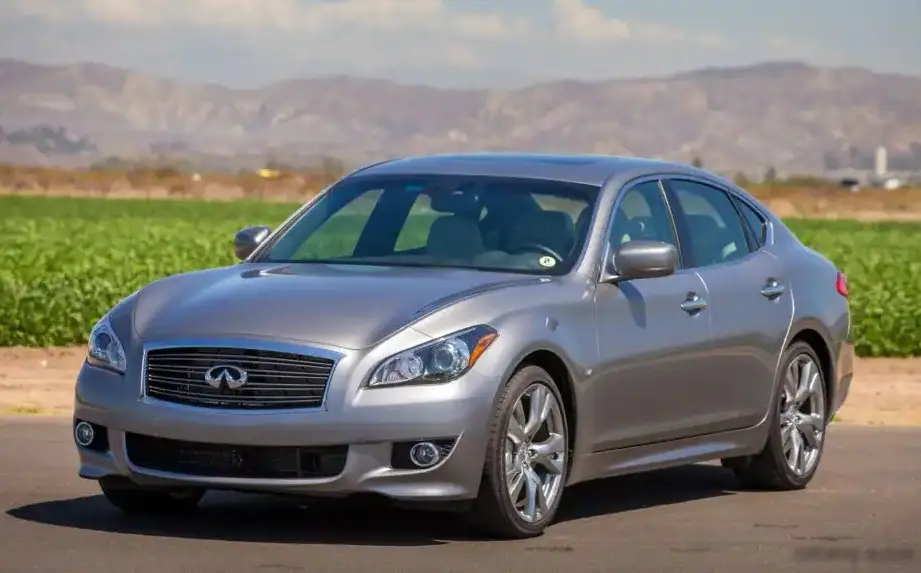
The Infiniti Q70 2.2D, produced from October 2014 to August 2018, represented a key offering in Infiniti’s mid-size luxury sedan lineup. This variant, powered by a 2.2-liter turbocharged diesel engine producing 170 horsepower, was primarily aimed at the European and Asian markets where diesel engines held significant popularity. Positioned as an entry-level option within the Q70 range, it provided a balance of fuel efficiency and reasonable performance, appealing to buyers seeking a comfortable and refined driving experience without the higher costs associated with the larger gasoline engines. The Q70 itself was a facelift of the M series, rebranded under the Infiniti naming scheme, and built upon the Nissan FM platform.
Technical Specifications
| Brand | Infiniti |
| Model | Q70 |
| Generation | Q70 (facelift 2014) |
| Type (Engine) | 2.2D (170 Hp) Automatic |
| Start of production | October, 2014 |
| End of production | August, 2018 |
| Powertrain Architecture | Internal Combustion engine |
| Body type | Sedan |
| Seats | 5 |
| Doors | 4 |
| Fuel consumption (urban) | 5.7-5.9 l/100 km (41.3 – 39.9 US mpg) |
| Fuel consumption (extra urban) | 4.2-4.3 l/100 km (56 – 54.7 US mpg) |
| Fuel consumption (combined) | 4.8-4.9 l/100 km (49 – 48 US mpg) |
| CO2 emissions | 124-128 g/km |
| Fuel Type | Diesel |
| Acceleration 0 – 100 km/h | 8.9 sec |
| Acceleration 0 – 62 mph | 8.9 sec |
| Acceleration 0 – 60 mph | 8.5 sec |
| Maximum speed | 220 km/h (136.7 mph) |
| Emission standard | Euro 6 |
| Weight-to-power ratio | 11.2 kg/Hp |
| Weight-to-torque ratio | 4.8 kg/Nm |
| Power | 170 Hp @ 3200-4000 rpm |
| Torque | 400 Nm @ 1600-2800 rpm (295.02 lb.-ft. @ 1600-2800 rpm) |
| Engine layout | Front, Longitudinal |
| Engine Model/Code | OM 651.930 |
| Engine displacement | 2143 cm3 (130.77 cu. in.) |
| Number of cylinders | 4 |
| Engine configuration | Inline |
| Cylinder Bore | 83 mm (3.27 in.) |
| Piston Stroke | 99 mm (3.9 in.) |
| Number of valves per cylinder | 4 |
| Fuel injection system | Diesel Commonrail |
| Engine aspiration | Turbocharger, Intercooler |
| Valvetrain | DOHC |
| Engine oil capacity | 6.5 l (6.87 US qt | 5.72 UK qt) |
| Kerb Weight | 1904-1945 kg (4197.6 – 4287.99 lbs.) |
| Max. weight | 2375-2405 kg (5235.98 – 5302.12 lbs.) |
| Max load | 460-471 kg (1014.13 – 1038.38 lbs.) |
| Trunk (boot) space | 450 l (15.89 cu. ft.) |
| Fuel tank capacity | 74 l (19.55 US gal | 16.28 UK gal) |
| Permitted trailer load (braked) | 1500 kg (3306.93 lbs.) |
| Permitted trailer load (unbraked) | 750 kg (1653.47 lbs.) |
| Length | 4980 mm (196.06 in.) |
| Width | 1845 mm (72.64 in.) |
| Width (with mirrors) | 2096 mm (82.52 in.) |
| Height | 1493 mm (58.78 in.) |
| Wheelbase | 2900 mm (114.17 in.) |
| Front track | 1575 mm (62.01 in.) |
| Rear track | 1570 mm (61.81 in.) |
| Ride height | 152 mm (5.98 in.) |
| Drag coefficient | 0.27-0.28 |
| Turning circle | 11.4 m (37.4 ft.) |
| Drivetrain | Rear wheel drive |
| Gearbox | 7 gears, automatic transmission |
| Front suspension | Double wishbone, Independent coil spring, Transverse stabilizer |
| Rear suspension | Independent multi-link spring suspension with stabilizer |
| Front brakes | Ventilated discs, 320×28 mm |
| Rear brakes | Ventilated discs, 308×15 mm |
| Steering | Steering rack and pinion, Electric Power Steering |
| Tires | 245/50 R18; 245/40 R20 |
| Wheel rims | 8J x 18; 9J x 20 |
Powertrain & Engine Architecture
The heart of the Q70 2.2D is the OM651.930, a 2.143-liter inline-four cylinder diesel engine developed by Mercedes-Benz and supplied to Infiniti under a collaborative agreement. This engine is a highly refined unit, featuring common-rail direct injection, a variable geometry turbocharger, and an intercooler. The common-rail system, operating at extremely high pressures, ensures precise fuel delivery for optimal combustion and reduced emissions. The DOHC (Double Overhead Camshaft) valvetrain, with four valves per cylinder, further enhances breathing and contributes to the engine’s power output. The engine’s architecture prioritizes low-end torque, making it well-suited for comfortable cruising and effortless acceleration. Paired with a 7-speed automatic transmission, the powertrain delivers smooth and responsive shifts. This transmission, sourced from ZF, is known for its efficiency and reliability.
Driving Characteristics
The Q70 2.2D Automatic offers a composed and refined driving experience. While not overtly sporty, the 170 horsepower and 400 Nm (295 lb-ft) of torque provide adequate performance for everyday driving situations. Acceleration from 0-60 mph takes approximately 8.5 seconds, and the car feels stable and planted at highway speeds. The automatic transmission is programmed for comfort, with smooth gear changes and a willingness to downshift when needed. Compared to the more powerful 3.7-liter V6 versions of the Q70, the 2.2D lacks the same level of outright acceleration, but it compensates with significantly improved fuel economy. The gear ratios are tuned to maximize efficiency, with taller gearing in higher gears for relaxed cruising. The rear-wheel-drive configuration contributes to a balanced feel, although it doesn’t offer the all-weather capability of all-wheel-drive systems found on some competitors.
Equipment & Trim Levels
The Q70 2.2D typically came equipped with a generous array of standard features, reflecting its luxury positioning. These included leather upholstery, power-adjustable front seats, a premium audio system, dual-zone automatic climate control, and a rearview camera. Infiniti’s touchscreen infotainment system, while functional, was sometimes criticized for its complexity and dated graphics. Optional extras included a navigation system, a surround-view monitor, adaptive cruise control, and a Bose premium sound system. Trim levels were relatively simple, with most variations revolving around the addition of optional packages. Interior color schemes typically included black, gray, and wheat leather options. Exterior styling remained consistent across the 2.2D variant, with the option of various wheel designs and paint colors.
Chassis & Braking
The Q70 2.2D utilizes a double-wishbone front suspension and an independent multi-link rear suspension, providing a comfortable and controlled ride. Stabilizer bars are fitted to both axles to minimize body roll during cornering. Braking duties are handled by ventilated disc brakes on all four wheels, providing ample stopping power. Anti-lock Braking System (ABS) and Electronic Brakeforce Distribution (EBD) are standard features. The suspension tuning is geared towards comfort, prioritizing a smooth ride over sharp handling. The steering is electrically assisted, offering a light and precise feel. The Q70’s chassis is robust and well-insulated, contributing to a quiet and refined cabin environment.
Market Reception & Comparison
The Infiniti Q70 2.2D was generally well-received by automotive critics, who praised its fuel efficiency, comfortable ride, and luxurious interior. However, some reviewers noted that the infotainment system felt dated and that the car lacked the dynamic flair of some of its European rivals. Compared to other trims in the Q70 lineup, the 2.2D offered a more affordable entry point, appealing to buyers who prioritized economy over outright performance. Its fuel economy figures of 4.8-4.9 l/100 km (49-48 US mpg) were significantly better than those of the V6 models. In terms of reliability, the OM651 diesel engine has proven to be a durable and long-lasting unit, although regular maintenance is essential.
Legacy
The Infiniti Q70 2.2D, while not a high-volume seller, established a foothold for diesel power within the Infiniti brand in select markets. The OM651 engine’s reputation for reliability has ensured that used examples of the Q70 2.2D remain relatively sought-after. Today, these cars represent a compelling value proposition for buyers seeking a comfortable, fuel-efficient, and well-equipped luxury sedan. However, potential buyers should be aware of the potential maintenance costs associated with diesel engines, including the diesel particulate filter (DPF) and the potential for injector issues. Overall, the Q70 2.2D remains a capable and refined vehicle that offers a unique blend of luxury and economy.