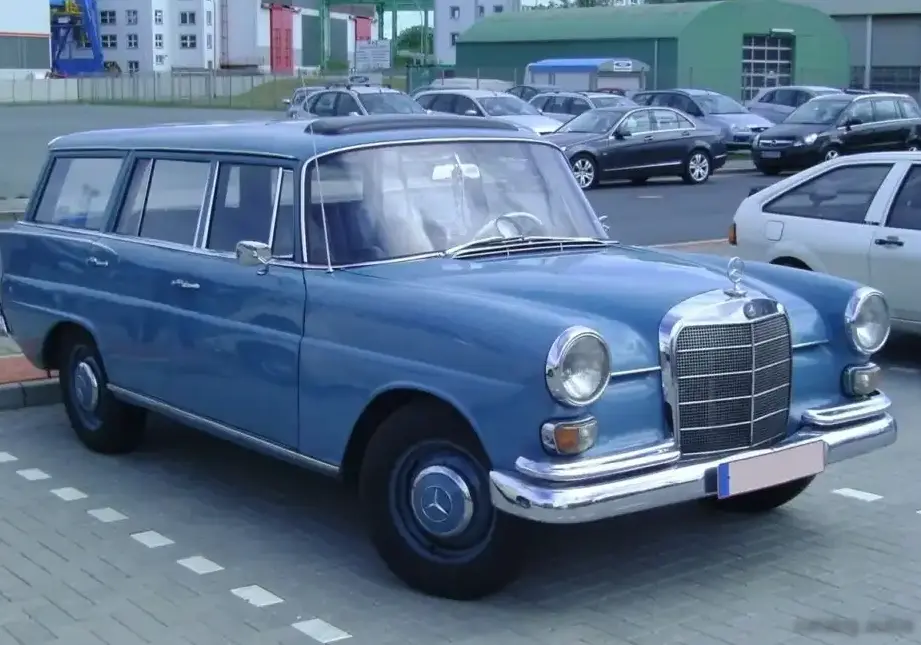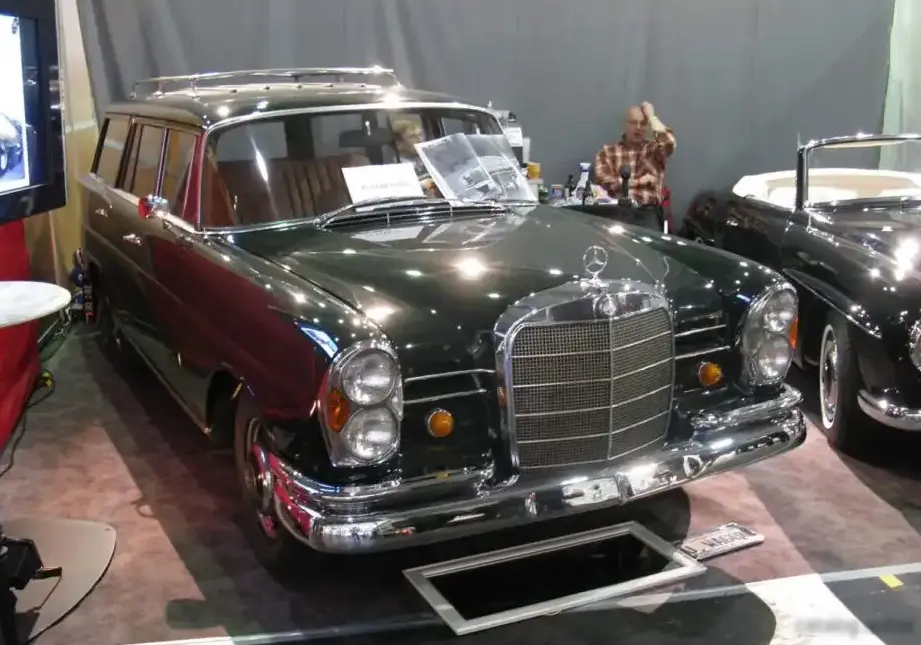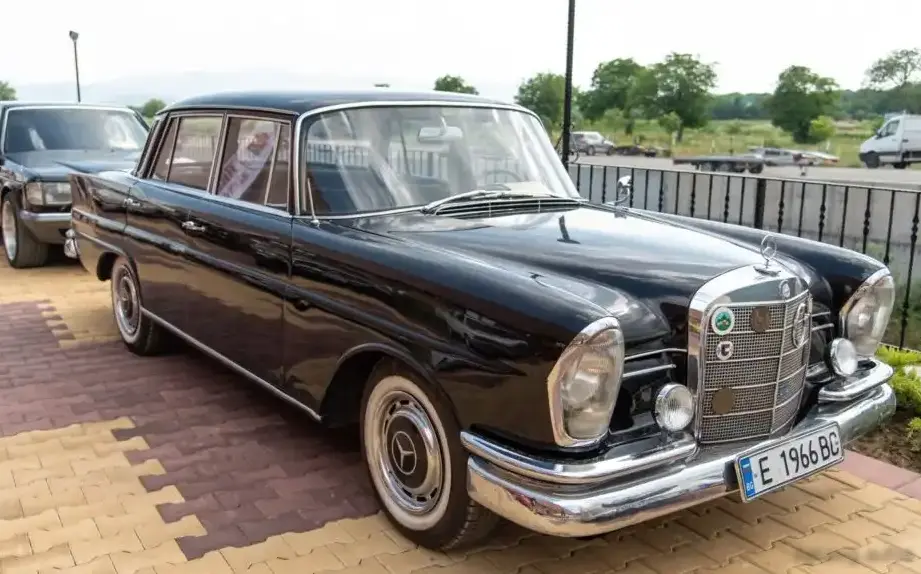
The Mercedes-Benz W111 “Fintail” 220 Sb, produced from May 1959 to July 1965, represents a pivotal moment in post-war Mercedes-Benz design and engineering. Positioned as a mid-range offering within the W111 series – which also included the 220S and 220SE – the 220 Sb aimed to provide a blend of comfort, performance, and durability for the burgeoning middle class. It was a key model in establishing Mercedes-Benz as a maker of sophisticated, yet accessible, luxury automobiles. The “Sb” designation indicated the standard specification for the 220 model, differentiating it from the more luxurious “S” and “SE” variants. The W111 platform, shared with the 220S, was a significant departure from the earlier “Ponton” series, introducing the distinctive fin-like rear wings that gave the model its nickname.
Technical Specifications
| Brand | Mercedes-Benz |
| Model | Fintail |
| Generation | Fintail (W111) |
| Type (Engine) | 220 Sb (110 Hp) |
| Start of production | May, 1959 |
| End of production | July, 1965 |
| Powertrain Architecture | Internal Combustion engine |
| Body type | Sedan |
| Seats | 5 |
| Doors | 4 |
| Fuel consumption (economy) – combined | 10.7 l/100 km |
| Fuel consumption (economy) – combined | 22 US mpg |
| Fuel consumption (economy) – combined | 26.4 UK mpg |
| Fuel consumption (economy) – combined | 9.3 km/l |
| Fuel Type | Petrol (Gasoline) |
| Acceleration 0 – 100 km/h | 15 sec |
| Acceleration 0 – 62 mph | 15 sec |
| Acceleration 0 – 60 mph | 14.3 sec |
| Maximum speed | 165 km/h |
| Maximum speed | 102.53 mph |
| Weight-to-power ratio | 12.1 kg/Hp |
| Weight-to-power ratio | 82.7 Hp/tonne |
| Weight-to-torque ratio | 7.7 kg/Nm |
| Weight-to-torque ratio | 129.3 Nm/tonne |
| Power | 110 Hp @ 5000 rpm |
| Power per litre | 50.1 Hp/l |
| Torque | 172 Nm @ 3500 rpm |
| Torque | 126.86 lb.-ft. @ 3500 rpm |
| Engine layout | Front, Longitudinal |
| Engine Model/Code | M 180 V / 180.941 |
| Engine displacement | 2195 cm3 |
| Engine displacement | 133.95 cu. in. |
| Number of cylinders | 6 |
| Engine configuration | Inline |
| Cylinder Bore | 80 mm |
| Cylinder Bore | 3.15 in. |
| Piston Stroke | 72.8 mm |
| Piston Stroke | 2.87 in. |
| Compression ratio | 8.7:1 |
| Number of valves per cylinder | 2 |
| Fuel injection system | Carburettor |
| Engine aspiration | Naturally aspirated engine |
| Valvetrain | SOHC |
| Kerb Weight | 1330 kg |
| Kerb Weight | 2932.15 lbs |
| Max. weight | 1845 kg |
| Max. weight | 4067.53 lbs |
| Max load | 515 kg |
| Max load | 1135.38 lbs |
| Fuel tank capacity | 65 l |
| Fuel tank capacity | 17.17 US gal | 14.3 UK gal |
| Length | 4875 mm |
| Length | 191.93 in. |
| Width | 1795 mm |
| Width | 70.67 in. |
| Height | 1500 mm |
| Height | 59.06 in. |
| Wheelbase | 2750 mm |
| Wheelbase | 108.27 in. |
| Front track | 1470 mm |
| Front track | 57.87 in. |
| Rear (Back) track | 1485 mm |
| Rear (Back) track | 58.46 in. |
| Drivetrain Architecture | The Internal combustion engine (ICE) drives the rear wheels of the vehicle. |
| Drive wheel | Rear wheel drive |
| Number of gears and type of gearbox | 4 gears, manual transmission |
| Front suspension | Double wishbone, Transverse stabilizer |
| Rear suspension | Trailing arm |
| Front brakes | Disc |
| Rear brakes | Drum |
| Steering type | Cone worm with recirculation balls |
Powertrain & Engine Architecture
The 220 Sb was powered by the M180 V inline-six cylinder engine, displacing 2.2 liters (2195 cc). This engine, a robust and relatively simple design, featured a single overhead camshaft (SOHC) operating two valves per cylinder. Fuel delivery was handled by a Solex 40 PHH II carburetor, a common setup for the period. The engine produced 110 horsepower at 5000 rpm and 172 Nm (126.86 lb-ft) of torque at 3500 rpm. The engine’s longitudinal mounting and rear-wheel drive configuration were typical for Mercedes-Benz at the time. The four-speed manual transmission was standard, providing a relatively direct connection between the engine and the rear wheels. The engine code, 180.941, identifies specific variations within the M180 family. The M180 was known for its smooth operation and durability, though it wasn’t a particularly high-revving or powerful engine by contemporary standards.
Driving Characteristics
The 220 Sb offered a comfortable and refined driving experience, prioritizing smoothness and quietness over outright performance. Acceleration from 0 to 60 mph took around 14.3 seconds, and the top speed was approximately 102.53 mph. Compared to the more powerful 220S and 220SE models, the 220 Sb felt noticeably less energetic, particularly when accelerating or climbing hills. The four-speed manual transmission, while precise, required frequent shifting to maintain optimal engine speed. The gear ratios were geared towards cruising comfort rather than spirited driving. The suspension, featuring double wishbones at the front and a trailing arm setup at the rear, provided a compliant ride, absorbing bumps and imperfections in the road surface effectively. However, the car’s relatively soft suspension also resulted in some body roll during cornering.
Equipment & Trim Levels
The 220 Sb was generally equipped with a fairly standard level of features for a mid-range luxury car of the late 1950s and early 1960s. Standard equipment included comfortable cloth upholstery, a wood-trimmed dashboard, and basic instrumentation. Optional extras included a sunroof, whitewall tires, a radio, and upgraded upholstery materials. The interior was relatively spacious for its time, offering comfortable seating for five passengers. The dashboard layout was functional and straightforward, with clearly labeled controls. The 220 Sb’s trim level was positioned as the entry point into the W111 range, offering a more affordable alternative to the more lavishly equipped 220S and 220SE models.
Chassis & Braking
The W111 chassis was a robust and well-engineered structure, providing a solid foundation for the car’s mechanical components. The front suspension utilized double wishbones with a transverse stabilizer bar, while the rear suspension employed a trailing arm design. Brakes were disc brakes at the front and drum brakes at the rear, a common configuration for the period. The steering system was a cone worm with recirculation balls, providing reasonably precise steering feel. The 220 Sb’s curb weight of 1330 kg (2932.15 lbs) contributed to its stable handling characteristics, but also limited its acceleration performance.
Market Reception & Comparison
The 220 Sb was generally well-received by automotive critics, who praised its comfortable ride, refined interior, and solid build quality. However, some critics noted that its performance was somewhat underwhelming compared to its rivals. Compared to the 220S and 220SE, the 220 Sb offered a more affordable entry point into the W111 range, but at the expense of some performance and luxury features. Fuel economy was typical for a car of its size and era, averaging around 22 US mpg. Reliability was generally good, although maintenance costs could be relatively high due to the car’s complex engineering.
Legacy
The Mercedes-Benz W111 220 Sb remains a popular classic car today, appreciated for its elegant styling, comfortable ride, and solid engineering. The M180 engine, while not particularly powerful, is known for its durability and relatively simple maintenance requirements. Well-maintained examples of the 220 Sb can command respectable prices in the used car market. The car’s enduring appeal is a testament to the quality of its design and construction, and its place in Mercedes-Benz history as a pivotal model in the company’s post-war success. Parts availability is generally good, although some specific components can be difficult to find. The 220 Sb represents a significant chapter in the evolution of the Mercedes-Benz brand, bridging the gap between the post-war “Ponton” models and the more modern designs of the 1960s.