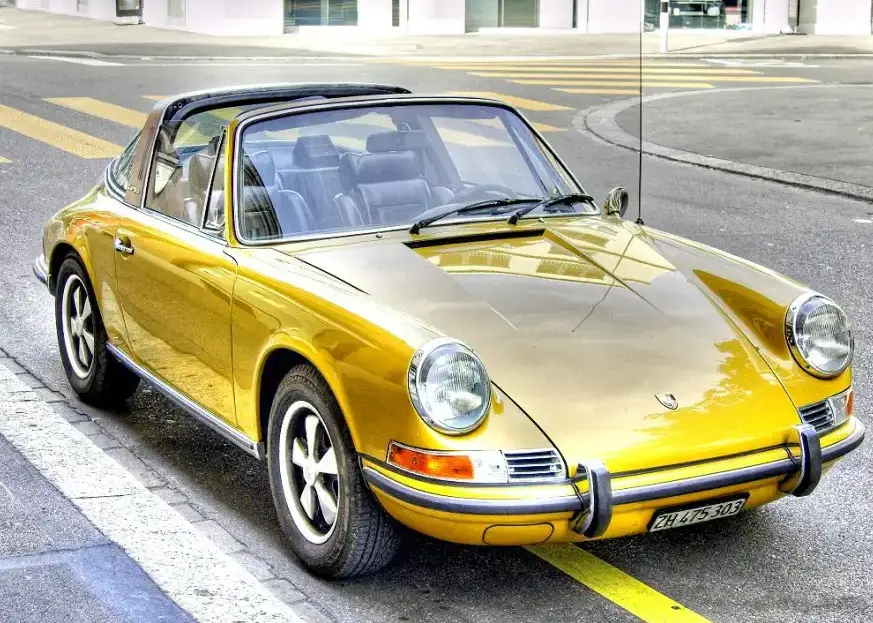
The Porsche 911 Targa (F) 2.7 Carrera, produced between 1972 and 1973, represents a pivotal moment in the evolution of the iconic 911. Falling within the ‘F’ series of the early 911, this variant was characterized by its 2.7-liter flat-six engine producing 210 horsepower. It occupied a performance-oriented niche within the Targa lineup, positioned above the base 911 Targa but below the more potent 911 Carrera RS. The Targa body style, with its distinctive removable roof panel and fixed roll bar, offered an open-air driving experience while maintaining a degree of structural rigidity. This model is significant for being one of the last of the early, air-cooled 911s before significant changes were introduced in the mid-1970s.
Technical Specifications
| Brand | Porsche |
| Model | 911 |
| Generation | 911 Targa (F) |
| Type (Engine) | 2.7 Carrera (210 Hp) |
| Start of production | 1972 |
| End of production | 1973 |
| Powertrain Architecture | Internal Combustion engine |
| Body type | Targa |
| Seats | 4 |
| Doors | 2 |
| Fuel Type | Petrol (Gasoline) |
| Maximum speed | 245 km/h (152.24 mph) |
| Weight-to-power ratio | 5.2 kg/Hp, 190.9 Hp/tonne |
| Power | 210 Hp @ 6300 rpm |
| Power per litre | 78.2 Hp/l |
| Engine layout | Rear, Longitudinal |
| Engine Model/Code | 911.83 |
| Engine displacement | 2687 cm3 (163.97 cu. in.) |
| Number of cylinders | 6 |
| Engine configuration | Boxer |
| Cylinder Bore | 90 mm (3.54 in.) |
| Piston Stroke | 70.4 mm (2.77 in.) |
| Engine aspiration | Naturally aspirated engine |
| Engine oil capacity | 13 l (13.74 US qt | 11.44 UK qt) |
| Kerb Weight | 1100 kg (2425.08 lbs.) |
| Max. weight | 1380 kg (3042.38 lbs.) |
| Max load | 280 kg (617.29 lbs.) |
| Permitted trailer load with brakes (12%) | 800 kg (1763.7 lbs.) |
| Permitted trailer load without brakes | 480 kg (1058.22 lbs.) |
| Length | 4291 mm (168.94 in.) |
| Width | 1610 mm (63.39 in.) |
| Height | 1320 mm (51.97 in.) |
| Wheelbase | 2271 mm (89.41 in.) |
| Front track | 1372 mm (54.02 in.) |
| Rear (Back) track | 1345 mm (52.95 in.) |
| Front overhang | 932 mm (36.69 in.) |
| Rear overhang | 1088 mm (42.83 in.) |
| Drivetrain Architecture | The Internal combustion engine (ICE) drives the rear wheels of the vehicle. |
| Drive wheel | Rear wheel drive |
| Number of gears and type of gearbox | 5 gears, manual transmission |
| Front suspension | Spring Strut, Wishbone |
| Rear suspension | Trailing arm |
| Front brakes | Disc |
| Rear brakes | Disc |
| Tires size | 185/70 R15 |
| Wheel rims size | 6J x 15 |
Powertrain & Engine Architecture
The heart of the 911 Targa 2.7 Carrera is the 911.83 engine, a 2.7-liter air-cooled flat-six. This engine represented a significant increase in displacement over the earlier 2.4-liter units, contributing to the power increase. It featured Bosch mechanical fuel injection, a system known for its responsiveness and reliability. The engine utilized a single overhead camshaft design, operating two valves per cylinder. The boxer configuration, with horizontally opposed cylinders, provided a low center of gravity, enhancing handling. The 210 horsepower was achieved through a combination of increased displacement, improved cylinder heads, and optimized fuel injection. The engine was mated to a robust 5-speed manual transmission, delivering power to the rear wheels. This transmission was known for its precise shifts and durability.
Driving Characteristics
The 911 Targa 2.7 Carrera offered a distinct driving experience. While not as raw or track-focused as the Carrera RS, it provided a compelling blend of performance and usability. The 210 hp engine delivered strong acceleration, with a noticeable powerband that encouraged spirited driving. The rear-engine layout contributed to a unique handling characteristic, requiring driver awareness and skill. The Targa top, while adding some weight compared to the coupe, didn’t significantly detract from the car’s agility. The 5-speed manual transmission allowed for precise control over the engine’s power, making it enjoyable on both winding roads and open highways. Compared to the base 911 Targa, the 2.7 Carrera offered a substantial performance upgrade, while remaining more approachable than the hardcore RS model.
Equipment & Trim Levels
The 911 Targa 2.7 Carrera came reasonably well-equipped for its time. Standard features included leatherette upholstery, a wood-rimmed steering wheel, and a basic sound system. The Targa top, of course, was a defining feature, offering an open-air experience. Optional extras included upgraded sound systems, power windows, and various trim options. Interior color choices were limited but allowed for some personalization. The dashboard layout was typical of early 911s, with a central speedometer and tachometer, along with auxiliary gauges for oil temperature, oil pressure, and fuel level. The overall interior ambiance was functional and driver-focused.
Chassis & Braking
The 911 Targa 2.7 Carrera utilized a robust chassis with independent suspension all around. The front suspension featured spring struts and wishbones, while the rear employed trailing arms. This setup provided a good balance of ride comfort and handling precision. Braking duties were handled by disc brakes on all four wheels, offering adequate stopping power for the car’s performance capabilities. The steering was unassisted, providing direct feedback to the driver. The car’s relatively light weight, at around 2425 lbs, contributed to its agility and responsiveness.
Market Reception & Comparison
The 911 Targa 2.7 Carrera was well-received by automotive journalists and enthusiasts alike. It was praised for its performance, handling, and distinctive Targa styling. Critics noted the improvement in power and torque compared to earlier 911 models. Compared to the base 911 Targa, the 2.7 Carrera offered a significant performance advantage, justifying its higher price tag. Against the Carrera RS, it offered a more comfortable and usable driving experience, albeit with slightly less outright performance. Fuel economy was typical for a sports car of the era, and reliability was generally good, although maintenance required a skilled mechanic familiar with air-cooled Porsche engines.
Legacy
The Porsche 911 Targa 2.7 Carrera holds a significant place in Porsche history. It represents a high point in the development of the early 911, combining performance, style, and usability. Today, these cars are highly sought after by collectors and enthusiasts. The 2.7-liter engine is considered a robust and reliable unit, although regular maintenance is essential to keep it running smoothly. Values have steadily increased in recent years, reflecting the car’s desirability and rarity. The 911 Targa 2.7 Carrera remains a testament to Porsche’s engineering prowess and its commitment to creating iconic sports cars.