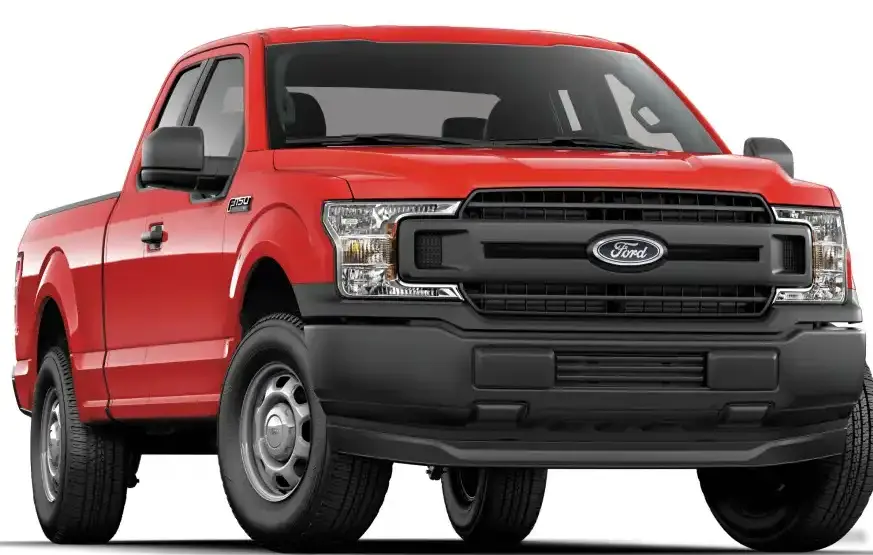
Technical Specifications
| Brand | Ford |
| Model | F-Series F-150 |
| Generation | F-Series F-150 XIII SuperCab (facelift 2018) |
| Type (Engine) | 5.0 V8 (395 Hp) Automatic |
| Start of production | 2018 |
| End of production | October, 2020 |
| Powertrain Architecture | Internal Combustion engine |
| Body type | Pick-up |
| Seats | 5-6 |
| Doors | 2 |
| Fuel consumption (urban) | 13.8 l/100 km (17 US mpg, 20.5 UK mpg, 7.2 km/l) |
| Fuel consumption (extra urban) | 10.2 l/100 km (23.1 US mpg, 27.7 UK mpg, 9.8 km/l) |
| Fuel consumption (combined) | 12.4 l/100 km (19 US mpg, 22.8 UK mpg, 8.1 km/l) |
| Fuel Type | Petrol (Gasoline) |
| Power | 395 Hp @ 5750 rpm |
| Power per litre | 79.8 Hp/l |
| Torque | 542 Nm @ 4500 rpm (399.76 lb.-ft. @ 4500 rpm) |
| Engine layout | Front, Longitudinal |
| Engine displacement | 4949 cm3 (302.01 cu. in.) |
| Number of cylinders | 8 |
| Engine configuration | V-engine |
| Number of valves per cylinder | 4 |
| Fuel injection system | Direct injection |
| Engine oil capacity | 8.3 l (8.77 US qt | 7.3 UK qt) |
| Coolant capacity | 13.2 l (13.95 US qt | 11.61 UK qt) |
| Trunk (boot) space (minimum) | 1764 l (62.3 cu. ft.) |
| Fuel tank capacity | 87 l (22.98 US gal | 19.14 UK gal) |
| Length | 5890-6363 mm (231.89 – 250.51 in.) |
| Width | 2029 mm (79.88 in.) |
| Width with mirrors folded | 2121 mm (83.5 in.) |
| Width including mirrors | 2459 mm (96.81 in.) |
| Height | 1918 mm (75.51 in.) |
| Wheelbase | 3683-4158 mm (145 – 163.7 in.) |
| Ride height (ground clearance) | 221 mm (8.7 in.) |
| Drivetrain Architecture | Rear wheel drive, Internal Combustion engine |
| Number of gears and type of gearbox | 10 gears, automatic transmission |
| Front suspension | Independent coil spring |
| Rear suspension | Leaf spring |
| Front brakes | Ventilated discs |
| Rear brakes | Ventilated discs |
| Assisting systems | ABS (Anti-lock braking system) |
| Steering type | Steering rack and pinion |
| Power steering | Electric Steering |
| Tires size | 245/70 R17; 265/60 R18; 275/55 R20 |
| Wheel rims size | 17; 18; 20 |
The 2018-2020 Ford F-150 SuperCab with the 5.0-liter V8 and 10-speed automatic represented a sweet spot in the F-150 lineup. The SuperCab configuration offered extended rear seating compared to the regular cab, while the 5.0L V8 provided substantial power for towing, hauling, and everyday driving. This variant positioned itself as a versatile option for both work and personal use, appealing to buyers who needed more than a base model but didn’t require the premium features or higher cost of the top-tier trims. It built upon the foundation of the thirteenth-generation F-150, which prioritized aluminum body panels for weight reduction and improved fuel efficiency.
Powertrain & Engine Architecture
The heart of this F-150 variant is the 5.0-liter Coyote V8 engine. This naturally aspirated engine utilizes a 92.5mm bore and 93mm stroke, resulting in a displacement of 4949cc (302.01 cubic inches). It features a deep-skirted cast iron block with aluminum cylinder heads, four valves per cylinder, and a variable valve timing system. The engine employs direct fuel injection, enhancing combustion efficiency and power output. The 5.0L V8 is known for its robust construction and relatively simple design, contributing to its reliability. Paired with this engine is Ford’s 10R80 10-speed automatic transmission. This transmission, co-developed with General Motors, offers a wide gear ratio spread, allowing for both strong acceleration and efficient highway cruising. The 10-speed design also contributes to improved fuel economy compared to the previous 6-speed automatic.
Driving Characteristics
The 5.0-liter V8 delivers a noticeable step up in performance compared to the base 3.3-liter V6 or the 2.7-liter EcoBoost turbocharged engine. With 395 horsepower and 400 lb-ft of torque, the F-150 provides ample power for towing trailers, hauling heavy loads, and accelerating confidently. The 10-speed automatic transmission is generally smooth and responsive, making quick downshifts for passing maneuvers. While not as fuel-efficient as the EcoBoost engines, the 5.0L V8 offers a more traditional V8 driving experience with a satisfying exhaust note. The wide gear ratios of the 10-speed transmission help to keep the engine in its optimal power band, maximizing efficiency and responsiveness. Compared to manual transmission equipped F-150s, the automatic provides ease of use, especially in stop-and-go traffic and when towing.
Equipment & Trim Levels
The 5.0-liter V8 engine was available on a range of F-150 trim levels, including XLT, Lariat, King Ranch, and Platinum. The base XLT trim typically included features like air conditioning, a basic infotainment system, and cloth upholstery. Higher trims, such as the Lariat, added leather upholstery, heated and ventilated front seats, a larger touchscreen display, and advanced safety features. The King Ranch and Platinum trims offered even more luxurious appointments, including premium leather, wood trim, and advanced technology packages. Standard equipment for all trims with the 5.0L V8 included a trailer hitch receiver and trailer sway control. Optional extras included a panoramic sunroof, a Bang & Olufsen sound system, and various driver-assistance technologies.
Chassis & Braking
The 2018-2020 F-150 SuperCab utilized a fully boxed frame constructed from high-strength steel. The front suspension featured independent coil springs, while the rear suspension employed leaf springs. This configuration provided a good balance of ride comfort and load-carrying capacity. Braking duties were handled by ventilated disc brakes on all four wheels, providing ample stopping power. The ABS (Anti-lock Braking System) was standard. The rear axle ratio varied depending on the specific trim level and optional equipment, influencing both towing capacity and fuel economy. Stabilizer bars were included to reduce body roll during cornering.
Market Reception & Comparison
Critics generally praised the 5.0-liter V8 engine for its power and refinement. It was often seen as a more appealing alternative to the turbocharged EcoBoost engines for buyers who preferred a traditional V8 experience. Fuel economy was considered adequate, but not class-leading. Compared to the 3.5-liter EcoBoost, the 5.0L V8 offered a simpler powertrain with potentially lower long-term maintenance costs. However, the EcoBoost engines generally provided better fuel economy and slightly higher towing capacity. The 5.0L V8 was often favored by those who prioritized reliability and a more linear power delivery.
Legacy
The 5.0-liter V8 engine paired with the 10-speed automatic transmission has proven to be a reliable and durable powertrain combination in the F-150. These models continue to hold their value in the used car market, particularly those that have been well-maintained. The engine’s relatively simple design and robust construction contribute to its longevity. While newer F-150 models offer more advanced technology and improved fuel efficiency, the 2018-2020 5.0L V8 SuperCab remains a popular choice for buyers seeking a capable, reliable, and enjoyable full-size pickup truck.