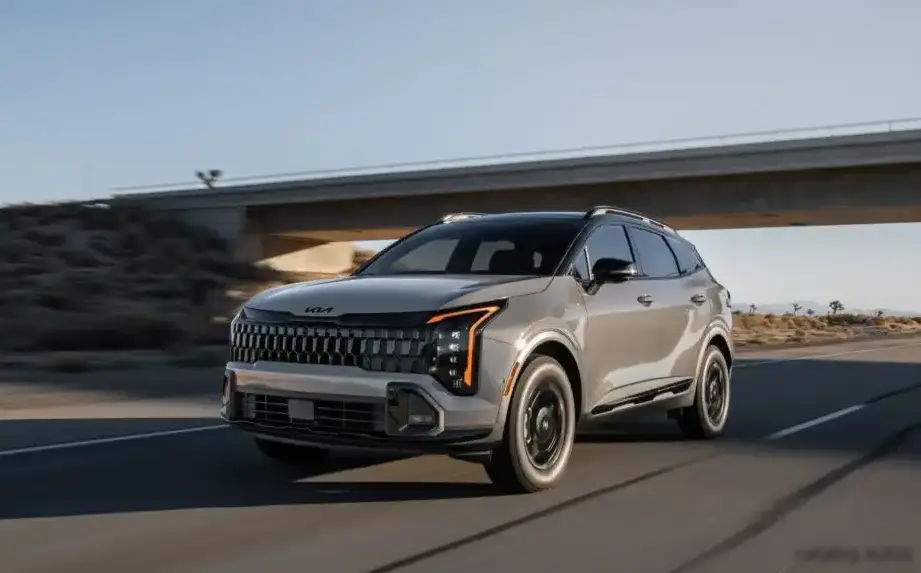
The Kia Sportage V (facelift, introduced in 2024) 1.6 T-GDI 239 Hp Hybrid Automatic represents a significant offering in the increasingly competitive compact SUV segment. Production began in July 2025, positioning this variant as a mid-to-upper trim level within the fifth-generation Sportage lineup (NQ5). This model combines a turbocharged gasoline engine with a full hybrid electric vehicle (FHEV) system, aiming to deliver a balance of performance, fuel efficiency, and modern technology. The Sportage, a mainstay of the Kia brand, has consistently been a popular choice for families and individuals seeking a versatile and reliable vehicle, and this hybrid variant builds upon that reputation.
Technical Specifications
| Brand | Kia |
| Model | Sportage |
| Generation | Sportage V (facelift 2024) |
| Type (Engine) | 1.6 T-GDI (239 Hp) Hybrid Automatic |
| Start of production | July, 2025 |
| Powertrain Architecture | FHEV (Full Hybrid Electric Vehicle) |
| Body type | SUV |
| Seats | 5 |
| Doors | 5 |
| Fuel consumption at Low speed (WLTP) | 6.3 l/100 km (37.3 US mpg, 44.8 UK mpg, 15.9 km/l) |
| Fuel consumption at Medium speed (WLTP) | 4.9 l/100 km (48 US mpg, 57.6 UK mpg, 20.4 km/l) |
| Fuel consumption at high speed (WLTP) | 5.3 l/100 km (44.4 US mpg, 53.3 UK mpg, 18.9 km/l) |
| Fuel consumption at very high speed (WLTP) | 7.0 l/100 km (33.6 US mpg, 40.4 UK mpg, 14.3 km/l) |
| Combined fuel consumption (WLTP) | 6.0 l/100 km (39.2 US mpg, 47.1 UK mpg, 16.7 km/l) |
| CO2 emissions (WLTP) | 135 g/km |
| Fuel Type | Petrol (Gasoline) |
| Acceleration 0 – 100 km/h | 7.9 sec |
| Acceleration 0 – 62 mph | 7.9 sec |
| Acceleration 0 – 60 mph | 7.5 sec |
| Maximum speed | 196 km/h (121.79 mph) |
| Emission standard | Euro 6e bis |
| Weight-to-power ratio | 6.7 kg/Hp, 150.3 Hp/tonne |
| Weight-to-torque ratio | 5.7 kg/Nm, 176.1 Nm/tonne |
| Gross battery capacity | 1.49 kWh |
| Battery voltage | 270 V |
| Battery technology | Lithium-polymer (LiPo) |
| Battery weight | 64 kg (141.1 lbs) |
| Battery location | Below the floor, under the rear seats |
| Electric motor power | 65 Hp @ 1900-2100 rpm |
| Electric motor Torque | 250 Nm @ 0-1800 rpm (184.39 lb.-ft. @ 0-1800 rpm) |
| Electric motor location | Between the combustion engine and the transmission |
| Electric motor type | Synchronous |
| System power | 239 Hp @ 6000 rpm |
| System torque | 280 Nm @ 1500-4500 rpm (206.52 lb.-ft. @ 1500-4500 rpm) |
| Power | 180 Hp @ 6000 rpm |
| Power per litre | 112.6 Hp/l |
| Torque | 265 Nm @ 1500-4500 rpm (195.45 lb.-ft. @ 1500-4500 rpm) |
| Engine layout | Front, Transverse |
| Engine Model/Code | G4FT |
| Engine displacement | 1598 cm3 (97.52 cu. in) |
| Number of cylinders | 4 |
| Engine configuration | Inline |
| Cylinder Bore | 75.6 mm (2.98 in) |
| Piston Stroke | 89 mm (3.5 in) |
| Compression ratio | 10.5:1 |
| Number of valves per cylinder | 4 |
| Fuel injection system | Direct injection |
| Engine aspiration | Turbocharger, Intercooler |
| Valvetrain | CVVD |
| Engine oil capacity | 4.8 l (5.07 US qt | 4.22 UK qt) |
| Coolant | 8.1 l (8.56 US qt | 7.13 UK qt) |
| Kerb Weight | 1590-1720 kg (3505.35 – 3791.95 lbs) |
| Max. weight | 2215 kg (4883.24 lbs) |
| Max load | 495-625 kg (1091.29 – 1377.89 lbs) |
| Trunk (boot) space – minimum | 587 l (20.73 cu. ft) |
| Trunk (boot) space – maximum | 1776 l (62.72 cu. ft) |
| Fuel tank capacity | 52 l (13.74 US gal | 11.44 UK gal) |
| Max. roof load | 100 kg (220.46 lbs) |
| Permitted trailer load with brakes (12%) | 1510 kg (3328.98 lbs) |
| Permitted trailer load without brakes | 750 kg (1653.47 lbs) |
| Permitted towbar download | 100 kg (220.46 lbs) |
| Length | 4540 mm (178.74 in) |
| Width | 1865 mm (73.43 in) |
| Height | 1645 mm (64.76 in) |
| Wheelbase | 2680 mm (105.51 in) |
| Front track | 1615-1630 mm (63.58 – 64.17 in) |
| Rear (Back) track | 1622-1637 mm (63.86 – 64.45 in) |
| Front overhang | 930 mm (36.61 in) |
| Rear overhang | 930 mm (36.61 in) |
| Ride height (ground clearance) | 170 mm (6.69 in) |
| Minimum turning circle (turning diameter) | 10.92 m (35.83 ft) |
| Front brakes | Ventilated discs, 320 mm |
| Rear brakes | Disc, 300 mm |
| Number of gears and type of gearbox | 6 gears, automatic transmission |
Powertrain & Engine Architecture
At the heart of the Sportage 1.6 T-GDI Hybrid is the G4FT engine, a 1.6-liter turbocharged inline-four cylinder gasoline engine. This engine utilizes direct fuel injection and Kia’s Continuously Variable Valve Duration (CVVD) technology, which optimizes valve timing based on driving conditions to improve efficiency and performance. The turbocharger and intercooler enhance power output. The engine is paired with a 44.1kW (65 hp) electric motor integrated between the engine and the six-speed automatic transmission. The electric motor draws power from a 1.49 kWh lithium-polymer battery pack located under the rear seats. This configuration allows for all-electric driving at lower speeds and assists the gasoline engine during acceleration, resulting in a combined system output of 239 hp and 280 Nm (206.52 lb-ft) of torque. The automatic transmission is specifically tuned to work seamlessly with the hybrid system, optimizing gear selection for both fuel economy and responsiveness.
Driving Characteristics
The 1.6 T-GDI Hybrid Automatic Sportage offers a refined driving experience. The electric motor provides instant torque, resulting in brisk acceleration, with a 0-60 mph time of around 7.5 seconds. The six-speed automatic transmission shifts smoothly, and the hybrid system intelligently manages power delivery. Compared to lower-powered Sportage variants, this model offers significantly more punch, making overtaking and highway merging easier. While not as sporty as some competitors, the Sportage prioritizes comfort and ease of driving. The hybrid system contributes to quiet operation, especially during low-speed electric driving. The gear ratios are optimized for a balance between fuel efficiency and responsiveness, with the electric motor filling in gaps in the engine’s torque curve.
Equipment & Trim Levels
The 1.6 T-GDI Hybrid Automatic typically comes well-equipped, often positioned as a mid-to-high trim level. Standard features generally include automatic climate control, an 8-inch touchscreen infotainment system with Apple CarPlay and Android Auto compatibility, a suite of advanced driver-assistance systems (ADAS) such as lane keeping assist, forward collision avoidance assist, and adaptive cruise control, and comfortable cloth upholstery. Higher trim levels offer upgrades like leather seats, a larger touchscreen display, a premium sound system, a panoramic sunroof, and heated/ventilated front seats. Optional extras often include a 360-degree camera system and parking assist features.
Chassis & Braking
The Sportage utilizes a front-wheel-drive (FWD) platform, although all-wheel drive (AWD) is often available as an option. The front suspension consists of an independent McPherson strut setup with a transverse stabilizer bar, while the rear features an independent multi-link suspension, also with a stabilizer bar. This configuration provides a comfortable ride and predictable handling. Braking duties are handled by ventilated discs at the front and solid discs at the rear. The Sportage is equipped with ABS (Anti-lock Braking System), Electronic Stability Control (ESC), and other safety features to ensure confident stopping power.
Market Reception & Comparison
The Kia Sportage 1.6 T-GDI Hybrid Automatic has been generally well-received by critics and consumers. It’s praised for its fuel efficiency, comfortable ride, and generous standard features. Compared to the base engine options, the hybrid offers a noticeable performance boost and improved fuel economy. Against competitors like the Toyota RAV4 Hybrid and Honda CR-V Hybrid, the Sportage offers a compelling value proposition with its stylish design and comprehensive warranty. Some reviewers have noted that the Sportage’s handling isn’t as engaging as some rivals, but the overall package is considered competitive.
Legacy
The G4FT engine and the hybrid powertrain are relatively new to the market, but early indications suggest good long-term reliability. Kia’s reputation for building durable vehicles, combined with the robust design of the hybrid system, suggests that this powertrain should prove reliable over time. The Sportage 1.6 T-GDI Hybrid Automatic is expected to hold its value well in the used car market, thanks to its fuel efficiency and modern features. As hybrid technology becomes increasingly mainstream, this variant is likely to become a sought-after option for buyers looking for a practical and efficient compact SUV.