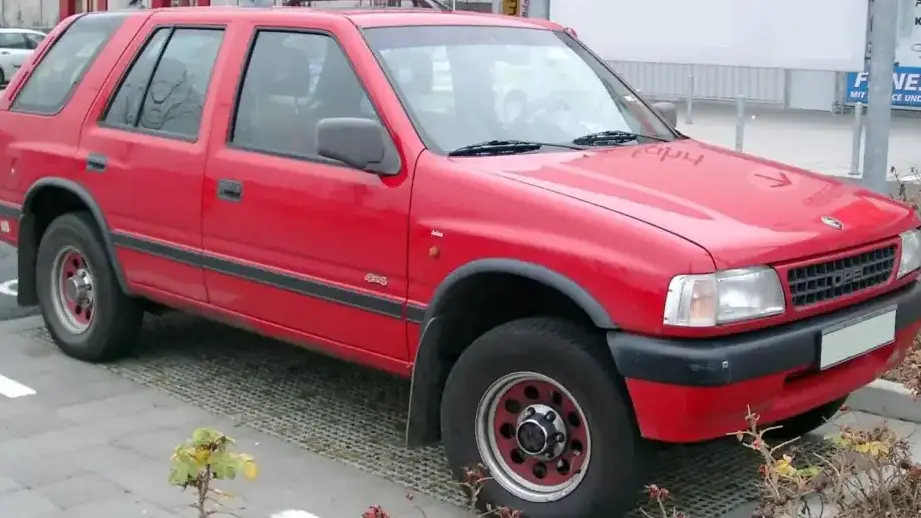
The Opel Frontera B Sport 2.2 DTI 4×4, produced from November 1998 to December 2003, represented a significant iteration of Opel’s mid-size SUV offering. Positioned as a more rugged and capable variant within the Frontera B range, the 2.2 DTI Sport aimed to appeal to drivers seeking a blend of off-road performance and on-road practicality. It was primarily marketed in Europe, where the demand for capable, affordable SUVs was growing. The Frontera B, built on the 60/80 platform shared with Isuzu, offered a more modern design and improved features compared to its predecessor, the Frontera A. This particular 2.2 DTI Sport trim occupied a middle ground in the lineup, offering a balance between the base models and the more powerful gasoline-powered options.
Technical Specifications
| Brand | Opel |
| Model | Frontera |
| Generation | Frontera B Sport |
| Type (Engine) | 2.2 DTI (115 Hp) 4×4 |
| Start of production | November, 1998 |
| End of production | December, 2003 |
| Powertrain Architecture | Internal Combustion engine |
| Body type | SUV |
| Seats | 5 |
| Doors | 3 |
| Fuel consumption (urban) | 11.5 l/100 km (20.5 US mpg, 24.6 UK mpg, 8.7 km/l) |
| Fuel consumption (extra urban) | 7.7 l/100 km (30.5 US mpg, 36.7 UK mpg, 13 km/l) |
| Fuel consumption (combined) | 9.2 l/100 km (25.6 US mpg, 30.7 UK mpg, 10.9 km/l) |
| CO2 emissions | 247 g/km |
| Fuel Type | Diesel |
| Acceleration 0 – 100 km/h | 13.9 sec |
| Acceleration 0 – 62 mph | 13.9 sec |
| Acceleration 0 – 60 mph | 13.2 sec |
| Maximum speed | 154 km/h (95.69 mph) |
| Emission standard | Euro 2 |
| Weight-to-power ratio | 15 kg/Hp, 66.9 Hp/tonne |
| Weight-to-torque ratio | 6.6 kg/Nm, 151.2 Nm/tonne |
| Power | 115 Hp @ 3800 rpm |
| Power per litre | 53 Hp/l |
| Torque | 260 Nm @ 1900 rpm (191.77 lb.-ft. @ 1900 rpm) |
| Engine layout | Front, Longitudinal |
| Engine Model/Code | Y22DTH, X22DTH |
| Engine displacement | 2171 cm3 (132.48 cu. in.) |
| Number of cylinders | 4 |
| Engine configuration | Inline |
| Cylinder Bore | 84 mm (3.31 in.) |
| Piston Stroke | 98 mm (3.86 in.) |
| Compression ratio | 18.5:1 |
| Number of valves per cylinder | 4 |
| Fuel injection system | Direct injection |
| Engine aspiration | Turbocharger |
| Valvetrain | OHC |
| Engine oil capacity | 6.1 l (6.45 US qt | 5.37 UK qt) |
| Coolant | 7.9 l (8.35 US qt | 6.95 UK qt) |
| Kerb Weight | 1720 kg (3791.95 lbs.) |
| Max. weight | 2300 kg (5070.63 lbs.) |
| Max load | 580 kg (1278.68 lbs.) |
| Trunk (boot) space – minimum | 320 l (11.3 cu. ft.) |
| Trunk (boot) space – maximum | 1137 l (40.15 cu. ft.) |
| Fuel tank capacity | 65 l (17.17 US gal | 14.3 UK gal) |
| Length | 4268 mm (168.03 in.) |
| Width | 1787 mm (70.35 in.) |
| Height | 1692 mm (66.61 in.) |
| Wheelbase | 2462 mm (96.93 in.) |
| Front track | 1515 mm (59.65 in.) |
| Rear (Back) track | 1520 mm (59.84 in.) |
| Drive wheel | All wheel drive (4×4) |
| Number of gears and type of gearbox | 5 gears, manual transmission |
| Front suspension | Torsion |
| Rear suspension | Coil spring |
| Front brakes | Disc |
| Rear brakes | Disc |
| Assisting systems | ABS (Anti-lock braking system) |
| Steering type | Steering rack and pinion |
| Power steering | Hydraulic Steering |
| Tires size | 235/75 R15 |
| Wheel rims size | 15 |
Powertrain & Engine Architecture
The heart of the Frontera B Sport 2.2 DTI was the Y22DTH (and sometimes X22DTH) 2.2-liter inline-four cylinder diesel engine. This engine utilized direct injection technology, a relatively advanced feature for diesel engines of the late 1990s and early 2000s. Direct injection, combined with a turbocharger and intercooler, allowed for increased power output and improved fuel efficiency compared to older indirect injection diesel designs. The engine featured an overhead camshaft (OHC) valvetrain with four valves per cylinder, contributing to its relatively smooth operation for a diesel. The 2.2 DTI produced 115 horsepower at 3800 rpm and 260 Nm (192 lb-ft) of torque at a low 1900 rpm. The engine was longitudinally mounted in the chassis, and power was delivered to all four wheels through a five-speed manual transmission. While an automatic transmission was offered on some Frontera B models, it was less common with the 2.2 DTI engine.
Driving Characteristics
The 2.2 DTI Sport, with its 115 hp and 260 Nm of torque, offered adequate, but not exhilarating, performance. Acceleration from 0 to 60 mph took around 13.2 seconds, and top speed was limited to approximately 96 mph. The engine’s strong low-end torque made it well-suited for off-road driving and towing, providing ample pulling power at lower engine speeds. However, on the highway, the engine could feel strained when overtaking or climbing hills. Compared to the more powerful gasoline-powered Frontera models, the 2.2 DTI lacked outright speed, but it compensated with significantly better fuel economy and lower running costs. The five-speed manual transmission provided a reasonable spread of gears, but the shift quality could be somewhat notchy. The 4×4 system, typically a part-time system with selectable 2H, 4H, and 4L modes, provided good traction in challenging conditions.
Equipment & Trim Levels
The Frontera B Sport trim level included several standard features aimed at enhancing comfort and convenience. These typically included air conditioning, power windows, central locking, and an upgraded interior trim compared to the base models. The interior featured cloth upholstery, and the dashboard layout was functional but not particularly luxurious. Optional extras available for the 2.2 DTI Sport included alloy wheels, a sunroof, and a more advanced audio system. Safety features were relatively basic for the time, typically including ABS brakes and a driver’s airbag.
Chassis & Braking
The Frontera B Sport utilized a body-on-frame construction, providing a robust and durable chassis. The front suspension consisted of torsion bars, while the rear suspension employed coil springs. This setup provided a comfortable ride on paved roads, while still offering sufficient articulation for off-road use. The braking system featured disc brakes on all four wheels, providing adequate stopping power for the vehicle’s weight. The ABS system helped to prevent wheel lockup during hard braking, improving stability and control.
Market Reception & Comparison
The Opel Frontera B Sport 2.2 DTI 4×4 was generally well-received by automotive critics as a practical and capable SUV. It was praised for its fuel efficiency, strong torque, and off-road capability. However, it was also criticized for its relatively slow acceleration and somewhat basic interior. Compared to other SUVs in its class, such as the Toyota RAV4 and Honda CR-V, the Frontera B offered a more rugged and utilitarian experience. Against its direct competitors like the Suzuki Grand Vitara, it often presented a more affordable option, though potentially at the expense of refinement. The 2.2 DTI engine offered a good balance between performance and economy, making it a popular choice for drivers who needed a versatile vehicle for both work and leisure.
Legacy
The Opel Frontera B, and specifically the 2.2 DTI variant, has developed a reputation for being a relatively reliable and durable vehicle. The Y22DTH engine, while not without its quirks, is generally considered to be a robust unit when properly maintained. Common issues include turbocharger failure and injector problems, but these are often manageable with regular servicing. Today, the Frontera B Sport 2.2 DTI 4×4 can be found on the used car market at relatively affordable prices. It remains a popular choice for those seeking a capable and affordable off-road vehicle, or a practical workhorse for rural areas. Its simple mechanical design and readily available parts make it a relatively easy vehicle to maintain and repair, contributing to its enduring appeal.