
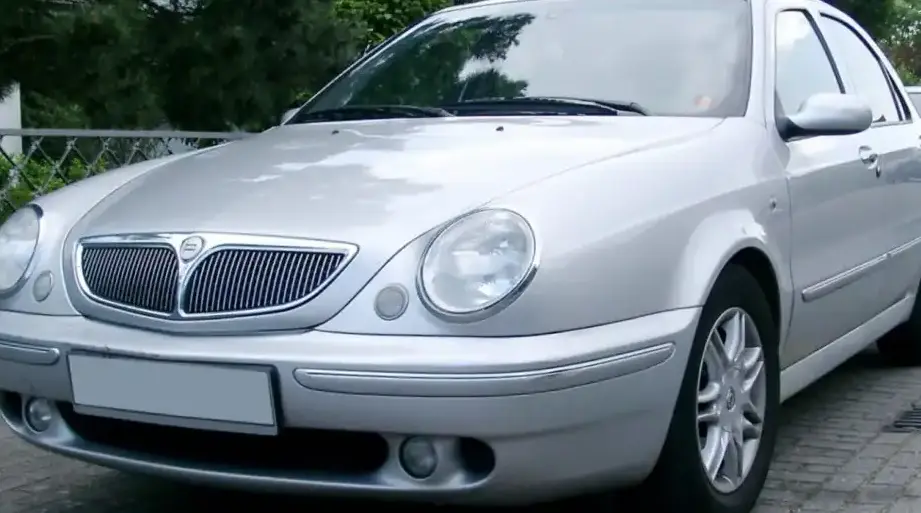
Technical Specifications
| Brand | Lancia |
| Model | Lybra |
| Generation | Lybra (839) |
| Type (Engine) | 1.9 JTD (110 Hp) |
| Start of production | 2000 |
| End of production | 2001 |
| Powertrain Architecture | Internal Combustion engine |
| Body type | Sedan |
| Seats | 5 |
| Doors | 4 |
| Fuel consumption (urban) | 8.1 l/100 km (29 US mpg, 34.9 UK mpg, 12.3 km/l) |
| Fuel consumption (extra urban) | 4.7 l/100 km (50 US mpg, 60.1 UK mpg, 21.3 km/l) |
| Fuel consumption (combined) | 5.9 l/100 km (39.9 US mpg, 47.9 UK mpg, 16.9 km/l) |
| CO2 emissions | 157 g/km |
| Fuel Type | Diesel |
| Acceleration 0 – 100 km/h | 11.3 sec |
| Acceleration 0 – 62 mph | 11.3 sec |
| Acceleration 0 – 60 mph | 10.7 sec |
| Maximum speed | 187 km/h (116.2 mph) |
| Emission standard | Euro 3 |
| Weight-to-power ratio | 11.2 kg/Hp |
| Weight-to-torque ratio | 4.5 kg/Nm |
| Power | 110 Hp @ 4000 rpm |
| Torque | 275 Nm @ 2000 rpm (202.83 lb.-ft. @ 2000 rpm) |
| Engine layout | Front, Transverse |
| Engine Model/Code | AR 37101 |
| Engine displacement | 1910 cm3 (116.56 cu. in.) |
| Number of cylinders | 4 |
| Engine configuration | Inline |
| Cylinder Bore | 82 mm (3.23 in.) |
| Piston Stroke | 90.4 mm (3.56 in.) |
| Number of valves per cylinder | 2 |
| Fuel injection system | Diesel Commonrail |
| Engine aspiration | Turbocharger, Intercooler |
| Valvetrain | SOHC |
| Engine oil capacity | 4.8 l (5.07 US qt, 4.22 UK qt) |
| Coolant capacity | 6.85 l (7.24 US qt, 6.03 UK qt) |
| Kerb Weight | 1235 kg (2722.71 lbs.) |
| Max. weight | 1830 kg (4034.46 lbs.) |
| Max load | 595 kg (1311.75 lbs.) |
| Trunk (boot) space (minimum) | 420 l (14.83 cu. ft.) |
| Fuel tank capacity | 60 l (15.85 US gal, 13.2 UK gal) |
| Permitted trailer load (with brakes – 8%) | 1500 kg (3306.93 lbs.) |
| Permitted trailer load (with brakes – 12%) | 1400 kg (3086.47 lbs.) |
| Permitted trailer load (without brakes) | 400 kg (881.85 lbs.) |
| Permitted towbar download | 75 kg (165.35 lbs.) |
| Length | 4466 mm (175.83 in.) |
| Width | 1743 mm (68.62 in.) |
| Height | 1462 mm (57.56 in.) |
| Wheelbase | 2593 mm (102.09 in.) |
| Front track | 1517 mm (59.72 in.) |
| Rear track | 1476 mm (58.11 in.) |
| Front overhang | 926 mm (36.46 in.) |
| Rear overhang | 947 mm (37.28 in.) |
| Minimum turning circle | 10.5 m (34.45 ft.) |
| Drivetrain | Front wheel drive |
| Number of gears | 5 |
| Gearbox type | Manual transmission |
| Front suspension | Independent type McPherson, Transverse stabilizer |
| Rear suspension | Wishbone, Transverse stabilizer, Trailing arm |
| Front brakes | Ventilated discs, 284 mm |
| Rear brakes | Disc, 251 mm |
| Assisting systems | ABS (Anti-lock braking system) |
| Steering type | Steering rack and pinion |
| Power steering | Hydraulic Steering |
| Tires size | 195/65 R15 |
| Wheel rims size | 6J x 15 |
The Lancia Lybra 1.9 JTD, produced from 2000 to 2001, represented a significant offering in the mid-size executive car segment for the Italian manufacturer. Part of the 839 series, this variant was positioned as a fuel-efficient and practical option within the Lybra range, appealing to buyers prioritizing economy and comfortable long-distance cruising. It sat alongside petrol-powered versions and a higher-output JTD engine, offering a balance between performance and running costs. The Lybra itself was a successor to the Lancia Delta and Prisma, aiming to recapture some of the brand’s former glory in a more modern package, built on a platform shared with Alfa Romeo and Fiat models.
Powertrain & Engine Architecture
The Lybra 1.9 JTD utilized the AR 37101 engine code, a 1910cc inline-four cylinder diesel engine. This engine was a product of Fiat Group’s advancements in direct injection diesel technology. It featured a common rail direct injection system, delivering fuel at extremely high pressure for improved combustion efficiency and reduced noise. The engine employed a single overhead camshaft (SOHC) valvetrain operating two valves per cylinder. A turbocharger with an intercooler was standard, boosting power output and improving throttle response. The 1.9 JTD engine was known for its relatively smooth operation for a diesel of its era, and its ability to deliver good fuel economy. The five-speed manual transmission was the standard offering, providing a balance between fuel efficiency and drivability.
Driving Characteristics
The 110 horsepower and 275 Nm (203 lb-ft) of torque produced by the 1.9 JTD engine provided adequate, though not exhilarating, performance. Acceleration from 0-60 mph took around 10.7 seconds, and top speed was approximately 116 mph. The engine’s torque curve was relatively flat, offering good pulling power from low engine speeds, making it well-suited for everyday driving and overtaking maneuvers. Compared to the higher-output 1.9 JTD versions (typically around 130-140 hp), the 110 hp version felt noticeably less responsive, particularly at higher speeds. However, it offered improved fuel economy and a slightly more relaxed driving experience. The five-speed manual transmission was well-matched to the engine’s characteristics, with gear ratios optimized for both fuel efficiency and usability.
Equipment & Trim Levels
The Lybra 1.9 JTD typically came equipped with a reasonable level of standard features, reflecting its positioning as a mid-range offering. These included central locking, electric front windows, power steering, and an ABS anti-lock braking system. Interior upholstery was typically cloth, with a functional and straightforward dashboard layout. Optional extras included air conditioning, alloy wheels, a sunroof, and upgraded audio systems. Higher trim levels offered leather upholstery, wood trim, and more advanced features. The Lybra aimed for a comfortable and refined interior, though it didn’t quite reach the levels of luxury offered by some of its German competitors.
Chassis & Braking
The Lybra 1.9 JTD featured independent suspension at the front, utilizing a McPherson strut setup with a transverse stabilizer bar. The rear suspension employed a wishbone and trailing arm configuration, also with a transverse stabilizer bar. This setup provided a comfortable ride quality, absorbing bumps and imperfections in the road surface effectively. Front brakes were ventilated discs, providing good stopping power, while rear brakes were solid discs. The chassis was designed to provide a balance between handling and comfort, leaning towards the latter. The steering was hydraulic power-assisted, offering light and easy steering feel.
Market Reception & Comparison
The Lancia Lybra 1.9 JTD was generally well-received by automotive critics as a practical and economical choice in the executive car segment. It was praised for its fuel efficiency, comfortable ride, and relatively refined diesel engine. However, it was often criticized for its somewhat bland styling and lack of the dynamic flair offered by some of its rivals. Compared to the higher-output JTD versions, the 110 hp model offered better fuel economy but lacked the same level of performance. It competed with cars like the Ford Mondeo, Volkswagen Passat, and Opel/Vauxhall Vectra, offering a distinctly Italian alternative.
Legacy
The Lancia Lybra 1.9 JTD, while not a sales blockbuster, has developed a reputation for reliability, particularly the engine itself. The 1.9 JTD engine is known to be robust and durable when properly maintained. Today, examples of the Lybra 1.9 JTD are becoming increasingly rare, and well-maintained examples are sought after by enthusiasts. The car represents a unique blend of Italian style and practicality, and its fuel-efficient diesel engine makes it an appealing option for those seeking a classic car with modern sensibilities. Parts availability can be a challenge, but a dedicated community of owners and specialists exists to support the continued preservation of this often-overlooked Italian sedan.
