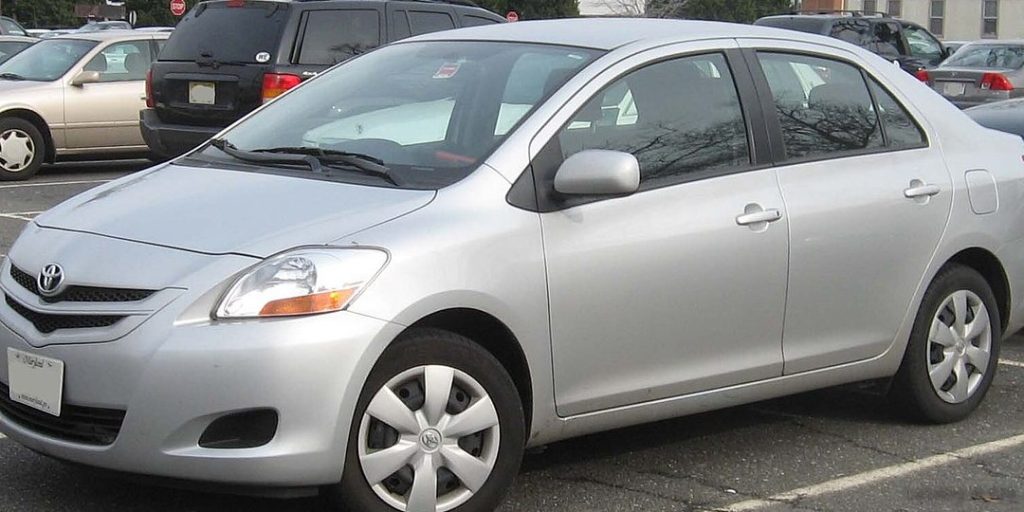
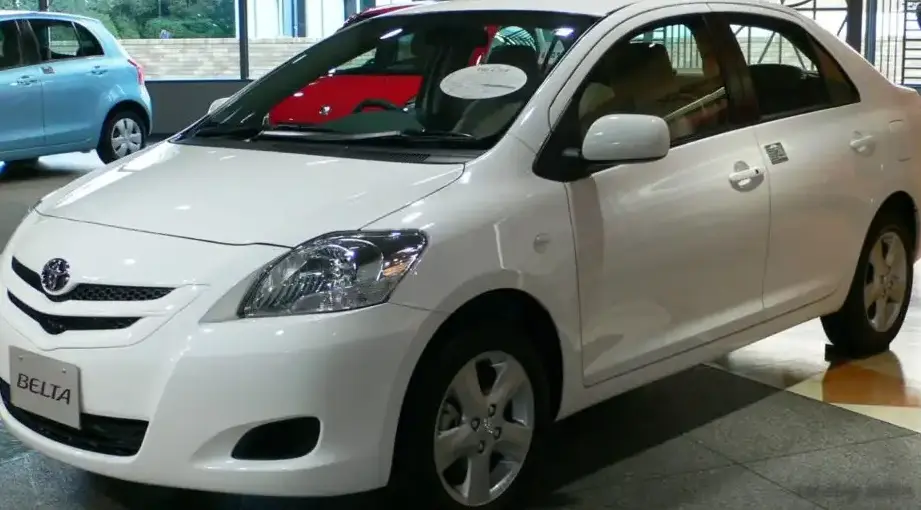
The Toyota Belta, launched in October 2021, represents Toyota’s entry into the subcompact sedan segment, primarily targeted towards markets in Asia and South America. Built as a rebadged version of the Suzuki Ciaz (produced under a partnership agreement between the two manufacturers), the Belta aims to provide a practical and affordable transportation solution. The 1.5i variant, equipped with a 105 horsepower engine and a four-speed automatic transmission, occupies the base to mid-range position within the Belta lineup, offering a balance between fuel efficiency and ease of driving. It serves as an accessible option for buyers prioritizing convenience over outright performance, and is positioned below any potential higher-trim level offerings with more features or a manual transmission.
Technical Specifications
| Brand | Toyota |
| Model | Belta |
| Generation | Belta (2021) |
| Type (Engine) | 1.5i (105 Hp) Automatic |
| Start of production | October, 2021 |
| Powertrain Architecture | Internal Combustion engine |
| Body type | Sedan |
| Seats | 5 |
| Doors | 4 |
| Fuel Type | Petrol (Gasoline) |
| Power | 105 Hp @ 6000 rpm |
| Power per litre | 71.8 Hp/l |
| Torque | 138 Nm @ 4000 rpm |
| Torque (lb-ft) | 101.78 lb.-ft. @ 4000 rpm |
| Engine layout | Front, Transverse |
| Engine Model/Code | K15B |
| Engine displacement | 1462 cm3 |
| Engine displacement (cu. in.) | 89.22 cu. in. |
| Number of cylinders | 4 |
| Engine configuration | Inline |
| Cylinder Bore | 74 mm |
| Cylinder Bore (in.) | 2.91 in. |
| Piston Stroke | 85 mm |
| Piston Stroke (in.) | 3.35 in. |
| Number of valves per cylinder | 4 |
| Fuel injection system | Multi-port manifold injection |
| Valvetrain | DOHC, VVT |
| Engine oil capacity | 3.1 l |
| Engine oil capacity (US qt) | 3.28 US qt |
| Engine oil capacity (UK qt) | 2.73 UK qt |
| Coolant capacity | 4.8 l |
| Coolant capacity (US qt) | 5.07 US qt |
| Coolant capacity (UK qt) | 4.22 UK qt |
| Engine systems | Start & Stop System, Particulate filter |
| Trunk (boot) space – minimum | 478 l |
| Trunk (boot) space – minimum (cu. ft.) | 16.88 cu. ft. |
| Fuel tank capacity | 43 l |
| Fuel tank capacity (US gal) | 11.36 US gal |
| Fuel tank capacity (UK gal) | 9.46 UK gal |
| Length | 4490 mm |
| Length (in.) | 176.77 in. |
| Width | 1730 mm |
| Width (in.) | 68.11 in. |
| Height | 1475 mm |
| Height (in.) | 58.07 in. |
| Minimum turning circle | 10.8 m |
| Minimum turning circle (ft) | 35.43 ft. |
| Drivetrain Architecture | ICE, Front wheel drive |
| Drive wheel | Front wheel drive |
| Number of gears | 4 |
| Gearbox type | automatic transmission |
| Front suspension | Independent type McPherson |
| Rear suspension | Torsion |
| Front brakes | Ventilated discs |
| Assisting systems | ABS (Anti-lock braking system) |
| Steering type | Steering rack and pinion |
| Power steering | Electric Steering |
| Tires size | 185/65 R15; 195/55 R16 |
| Wheel rims size | 15; 16 |
Powertrain & Engine Architecture
The Toyota Belta 1.5i utilizes the K15B engine, a 1.5-liter inline-four cylinder gasoline engine. This engine is a product of Suzuki’s engineering and is known for its reliability and fuel efficiency. The K15B features a multi-point fuel injection system and a Double Overhead Camshaft (DOHC) valvetrain with Variable Valve Timing (VVT) on the intake side. This VVT system helps optimize engine performance and fuel economy across a wider range of engine speeds. The engine produces 105 horsepower at 6000 rpm and 138 Nm (101.78 lb-ft) of torque at 4000 rpm. Paired with this engine is a four-speed automatic transmission. While not the most modern transmission in terms of gear count, it provides smooth and predictable shifts, prioritizing ease of use over sporty performance. The transmission is geared towards maximizing fuel efficiency and providing adequate acceleration for everyday driving conditions.
Driving Characteristics
The 1.5i automatic Belta delivers a comfortable and predictable driving experience. The four-speed automatic transmission, while lacking the responsiveness of a continuously variable transmission (CVT) or a six-speed automatic, offers smooth gear changes. Acceleration is adequate for city driving and highway merging, but it’s not particularly brisk. The engine’s torque curve is relatively flat, providing usable power throughout the rev range, but it doesn’t offer a strong surge of acceleration. Compared to a manual transmission version (if offered in some markets), the automatic will feel slightly less responsive. Compared to a potential higher-output engine variant, the 1.5i will naturally exhibit slower acceleration and reduced passing power. The focus is on providing a relaxed and fuel-efficient driving experience.
Equipment & Trim Levels
The 1.5i trim of the Toyota Belta typically includes standard features such as air conditioning, power windows, power door locks, and a basic audio system with Bluetooth connectivity. Safety features generally include ABS (Anti-lock Braking System) and dual airbags. Interior upholstery is typically cloth, and the dashboard features a functional, if somewhat basic, design. Optional extras available for this trim may include alloy wheels, a touchscreen infotainment system, and rear parking sensors. The overall interior ambiance is geared towards practicality and affordability rather than luxury.
Chassis & Braking
The Belta utilizes a front-wheel-drive configuration with an independent McPherson strut suspension in the front and a torsion beam suspension in the rear. This suspension setup provides a comfortable ride quality, absorbing bumps and irregularities in the road surface effectively. The front brakes are ventilated discs, providing adequate stopping power, while the rear brakes are typically drums. The steering is an electric power steering system, offering light and easy steering feel, making it convenient for maneuvering in urban environments. The chassis is tuned for comfort and stability, prioritizing a smooth ride over sporty handling.
Market Reception & Comparison
The Toyota Belta 1.5i Automatic has been generally well-received in its target markets as a practical and affordable sedan. Critics have praised its fuel efficiency and comfortable ride quality. However, some have noted the relatively basic interior and the lack of advanced features compared to some competitors. In terms of fuel economy, the 1.5i automatic typically achieves competitive figures within its class. Reliability is expected to be good, given Toyota’s reputation and the proven track record of the K15B engine. Compared to a potential higher-trim level with a more powerful engine, the 1.5i offers a lower purchase price and better fuel economy, but at the expense of performance.
Legacy
The Toyota Belta 1.5i Automatic, while a relatively new model, is expected to have good long-term reliability due to the robust nature of the K15B engine and Toyota’s overall build quality. In the used car market, it is likely to be viewed as a dependable and affordable option for buyers seeking a practical and fuel-efficient sedan. The simplicity of the powertrain – a naturally aspirated engine and a conventional four-speed automatic – suggests that maintenance costs should be relatively low. As the model ages, its value will likely be determined by its condition, mileage, and the overall demand for affordable compact sedans in its respective markets.