
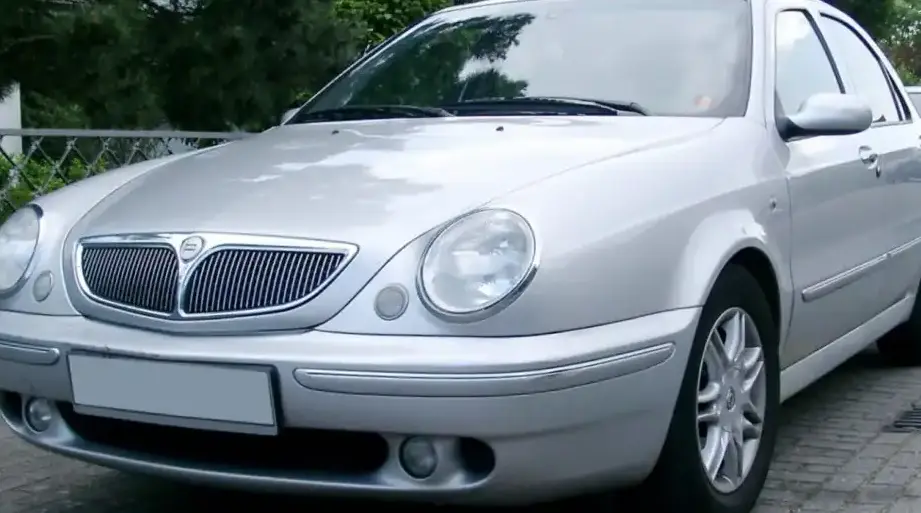
Technical Specifications
| Brand | Lancia |
| Model | Lybra |
| Generation | Lybra (839) |
| Type (Engine) | 1.9 JTD (115 Hp) |
| Start of production | May, 2001 |
| End of production | October, 2005 |
| Powertrain Architecture | Internal Combustion engine |
| Body type | Sedan |
| Seats | 5 |
| Doors | 4 |
| Fuel consumption (urban) | 8.4 l/100 km (28 US mpg, 33.6 UK mpg, 11.9 km/l) |
| Fuel consumption (extra urban) | 4.7 l/100 km (50 US mpg, 60.1 UK mpg, 21.3 km/l) |
| Fuel consumption (combined) | 6.1 l/100 km (38.6 US mpg, 46.3 UK mpg, 16.4 km/l) |
| Fuel Type | Diesel |
| Acceleration 0 – 100 km/h | 10.8 sec |
| Acceleration 0 – 62 mph | 10.8 sec |
| Acceleration 0 – 60 mph | 10.3 sec |
| Maximum speed | 190 km/h (118.06 mph) |
| Weight-to-power ratio | 11.2 kg/Hp, 89.1 Hp/tonne |
| Weight-to-torque ratio | 4.7 kg/Nm, 213.2 Nm/tonne |
| Power | 115 Hp @ 4000 rpm |
| Power per litre | 60.2 Hp/l |
| Torque | 275 Nm @ 2000 rpm (202.83 lb.-ft. @ 2000 rpm) |
| Engine layout | Front, Transverse |
| Engine Model/Code | 937 A2.000 |
| Engine displacement | 1910 cm3 (116.56 cu. in.) |
| Number of cylinders | 4 |
| Engine configuration | Inline |
| Cylinder Bore | 82 mm (3.23 in.) |
| Piston Stroke | 90.4 mm (3.56 in.) |
| Compression ratio | 18.5:1 |
| Number of valves per cylinder | 2 |
| Fuel injection system | Diesel Commonrail |
| Engine aspiration | Turbocharger, Intercooler |
| Engine oil capacity | 4.8 l (5.07 US qt | 4.22 UK qt) |
| Coolant capacity | 7.3 l (7.71 US qt | 6.42 UK qt) |
| Kerb Weight | 1290 kg (2843.96 lbs.) |
| Max. weight | 1830 kg (4034.46 lbs.) |
| Max load | 540 kg (1190.5 lbs.) |
| Trunk (boot) space – minimum | 420 l (14.83 cu. ft.) |
| Fuel tank capacity | 60 l (15.85 US gal | 13.2 UK gal) |
| Length | 4466 mm (175.83 in.) |
| Width | 1743 mm (68.62 in.) |
| Height | 1462 mm (57.56 in.) |
| Wheelbase | 2593 mm (102.09 in.) |
| Front track | 1497 mm (58.94 in.) |
| Rear track | 1459 mm (57.44 in.) |
| Drivetrain Architecture | Front wheel drive |
| Number of gears | 5 |
| Gearbox type | Manual transmission |
| Front suspension | Spring Strut |
| Rear suspension | Coil spring |
| Front brakes | Ventilated discs |
| Rear brakes | Disc |
| Assisting systems | ABS (Anti-lock braking system) |
| Steering type | Steering rack and pinion |
| Power steering | Hydraulic Steering |
| Tires size | 195/65 R15 |
The Lancia Lybra, launched in 1999 as a replacement for the Kappa, represented Lancia’s attempt to create a comfortable and stylish mid-size executive car. The 839 series, produced until 2005, offered a range of engine options, including several diesel variants. The 1.9 JTD, introduced in 2001, quickly became a popular choice, particularly in Europe where diesel engines held a significant market share. It was built on the 1HX0/A3 platform, shared with other Fiat Group vehicles like the Alfa Romeo 156 and the Fiat Marea. The Lybra aimed to offer a more premium experience than its platform siblings, focusing on comfort, refinement, and distinctive Italian design.
Powertrain & Engine Architecture
The heart of the Lybra 1.9 JTD is the 937 A2.000 engine, a 1910cc inline-four cylinder diesel. This engine utilizes a second-generation common rail direct injection system, providing improved fuel atomization and more precise control over the combustion process. This resulted in better fuel economy, reduced emissions, and a smoother power delivery compared to earlier diesel designs. The engine features a single overhead camshaft (SOHC) operating two valves per cylinder. A turbocharger with an intercooler is employed to boost power and torque. The five-speed manual transmission was the standard offering for this variant, chosen for its balance of efficiency and driver engagement. The transmission’s gear ratios were tuned to maximize the engine’s torque output, providing strong acceleration in everyday driving situations.
Driving Characteristics
The Lybra 1.9 JTD delivers a comfortable and relaxed driving experience. While not a performance-oriented vehicle, the 115 horsepower and 275 Nm (203 lb-ft) of torque provide adequate power for most driving situations. Acceleration from 0-60 mph takes around 10.3 seconds, and the car has a top speed of approximately 118 mph. The engine is particularly strong in the mid-range, making overtaking maneuvers relatively effortless. Compared to the higher-output 2.4 JTD variant, the 1.9 JTD offers a more economical driving experience, but sacrifices some outright performance. The manual transmission provides a more direct connection to the engine, allowing for greater control.
Equipment & Trim Levels
The Lybra 1.9 JTD typically came equipped with a respectable level of standard features. These included power windows, central locking, air conditioning, and an RDS stereo system. Higher trim levels, such as the “LS” and “LX”, added features like alloy wheels, leather upholstery, automatic climate control, and a sunroof. Optional extras included a navigation system, parking sensors, and upgraded audio systems. Interior upholstery was typically cloth on the base models, with leather available as an upgrade. The dashboard layout was functional and well-designed, with a focus on ergonomics and ease of use.
Chassis & Braking
The Lybra 1.9 JTD utilizes a MacPherson strut front suspension and a coil spring rear suspension. This setup provides a comfortable ride quality, absorbing bumps and imperfections in the road surface effectively. The car features ventilated disc brakes at the front and solid disc brakes at the rear, providing adequate stopping power for its weight class. Anti-lock Braking System (ABS) was standard equipment, enhancing safety and stability during emergency braking situations. The steering is a hydraulic power-assisted rack and pinion system, offering precise and responsive handling.
Market Reception & Comparison
The Lancia Lybra 1.9 JTD was generally well-received by automotive critics, who praised its comfortable ride, stylish design, and fuel-efficient engine. However, some criticisms were leveled at its somewhat bland handling and the perceived lack of brand prestige compared to German rivals. Compared to the petrol-powered Lybra variants, the 1.9 JTD offered significantly better fuel economy and a more relaxed driving experience. Against competitors like the Ford Mondeo, Volkswagen Passat, and Opel/Vauxhall Vectra, the Lybra offered a more distinctive and luxurious interior, but often at a slightly higher price point.
Legacy
The Lancia Lybra 1.9 JTD has proven to be a relatively reliable vehicle, with the 937 A2.000 engine being known for its durability. However, like all diesel engines, it is important to maintain regular servicing and use high-quality oil. Common issues include injector problems and turbocharger wear, but these are typically manageable with proper maintenance. Today, the Lybra 1.9 JTD is a relatively affordable used car, appealing to buyers looking for a comfortable, economical, and stylish sedan. Its blend of Italian flair and practical usability continues to make it a desirable option for those seeking an alternative to mainstream mid-size cars.
