Technical Specifications
| Brand | Porsche |
| Model | 924 |
| Generation | 924 |
| Type (Engine) | 2.0 (115 Hp) |
| Start of production | 1976 |
| End of production | 1982 |
| Powertrain Architecture | Internal Combustion engine |
| Body type | Coupe |
| Seats | 4 |
| Doors | 2 |
| Fuel Type | Petrol (Gasoline) |
| Acceleration 0 – 100 km/h | 11.2 sec |
| Acceleration 0 – 62 mph | 11.2 sec |
| Acceleration 0 – 60 mph | 10.6 sec |
| Maximum speed | 192 km/h (119.3 mph) |
| Weight-to-power ratio | 10.3 kg/Hp, 97 Hp/tonne |
| Weight-to-torque ratio | 7.6 kg/Nm, 131.6 Nm/tonne |
| Power | 115 Hp @ 5750 rpm |
| Power per litre | 58 Hp/l |
| Torque | 156 Nm @ 3500 rpm (115.06 lb.-ft. @ 3500 rpm) |
| Maximum engine speed | 6500 rpm |
| Engine layout | Front, Longitudinal |
| Engine Model/Code | 047.4, 047.E |
| Engine displacement | 1984 cm3 (121.07 cu. in.) |
| Number of cylinders | 4 |
| Engine configuration | Inline |
| Cylinder Bore | 86.5 mm (3.41 in.) |
| Piston Stroke | 84.4 mm (3.32 in.) |
| Compression ratio | 9:1 |
| Number of valves per cylinder | 2 |
| Fuel injection system | Multi-port manifold injection |
| Engine aspiration | Naturally aspirated engine |
| Valvetrain | SOHC |
| Engine oil capacity | 4.5 l (4.76 US qt | 3.96 UK qt) |
| Coolant | 6.4 l (6.76 US qt | 5.63 UK qt) |
| Kerb Weight | 1185 kg (2612.48 lbs.) |
| Max. weight | 1500 kg (3306.93 lbs.) |
| Max load | 315 kg (694.46 lbs.) |
| Fuel tank capacity | 62 l (16.38 US gal | 13.64 UK gal) |
| Max. roof load | 35 kg (77.16 lbs.) |
| Permitted trailer load with brakes (12%) | 800 kg (1763.7 lbs.) |
| Permitted trailer load without brakes | 500 kg (1102.31 lbs.) |
| Length | 4320 mm (170.08 in.) |
| Width | 1685 mm (66.34 in.) |
| Height | 1270 mm (50 in.) |
| Wheelbase | 2400 mm (94.49 in.) |
| Front track | 1418 mm (55.83 in.) |
| Rear (Back) track | 1372 mm (54.02 in.) |
| Ride height (ground clearance) | 125 mm (4.92 in.) |
| Minimum turning circle (turning diameter) | 10.1 m (33.14 ft.) |
| Drivetrain Architecture | The Internal combustion engine (ICE) drives the rear wheels of the vehicle. |
| Drive wheel | Rear wheel drive |
| Number of gears and type of gearbox | 5 gears, manual transmission |
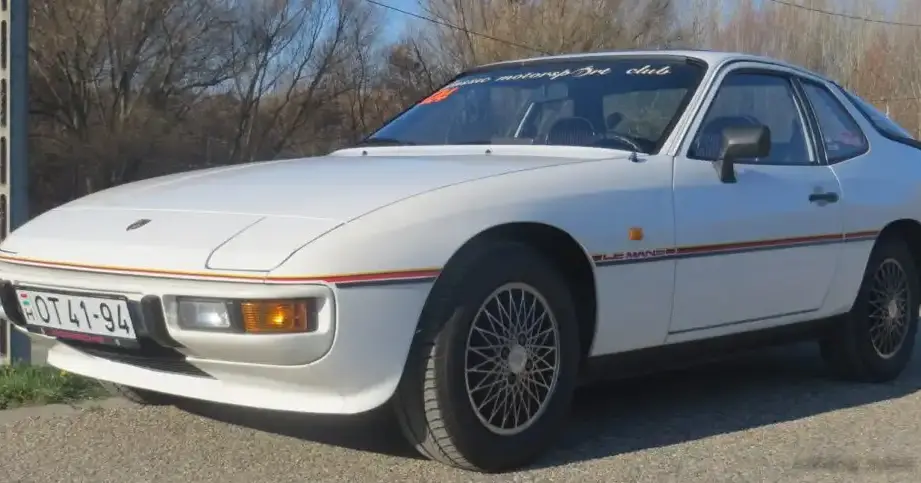
The Porsche 924 2.0, launched in 1976, marked a significant turning point for the German sports car manufacturer. It was Porsche’s first foray into the realm of front-engined, water-cooled production vehicles, a departure from the long-standing tradition of rear-engine, air-cooled 911s. Positioned as the entry-level Porsche, the 2.0-liter variant aimed to broaden the brand’s appeal and attract a new demographic of buyers. The 924 was part of the initial 924 series (internally designated as the 924.0), and served as the foundation for subsequent engine upgrades and model variations. It was designed to replace the aging 914, offering a more refined and modern driving experience.
Powertrain & Engine Architecture
The 924 2.0 is powered by a 1984cc inline-four cylinder engine, internally known as the M147/4. Engine codes 047.4 and 047.E were utilized throughout its production run. This engine features a single overhead camshaft (SOHC) operating two valves per cylinder. Fuel delivery is managed by a Bosch K-Jetronic mechanical fuel injection system, a technology lauded for its reliability and efficiency during that period. The engine is mounted longitudinally within the chassis. Crucially, the 924 2.0 was exclusively offered with a five-speed manual transmission, providing a direct mechanical link between the engine and the rear wheels. This transmission was a robust unit, engineered to handle the engine’s output and deliver a sporty driving feel. The engine’s relatively uncomplicated design contributed to its inherent durability and ease of maintenance.
Driving Characteristics
The 924 2.0 delivers a balanced driving experience, prioritizing handling and composure over outright acceleration. Generating 115 horsepower, the car could accelerate from 0 to 60 mph in approximately 10.6 seconds, achieving a top speed of around 119 mph. While these figures aren’t particularly impressive by contemporary standards, they were competitive within its class during the late 1970s. The front-engine layout and relatively lightweight construction (around 2600 lbs) contribute to neutral handling characteristics. The five-speed manual transmission allows drivers to maintain the engine within its optimal power band, providing responsive acceleration. Compared to later, more powerful 924 variants like the 924 Turbo, the 2.0-liter model lacks the raw power and aggressive character. However, it offers a more accessible and forgiving driving experience, making it well-suited for everyday use.
Equipment & Trim Levels
The 924 2.0 was relatively sparsely equipped compared to other sports cars of the era, reflecting its entry-level positioning within the Porsche lineup. Standard features included cloth upholstery, a basic instrument cluster, and manual windows and locks. Air conditioning and a sunroof were popular optional extras. The interior trim was functional and focused on providing a comfortable driving environment. The dashboard layout is clean and straightforward, with easily readable gauges. Porsche offered a range of optional accessories, allowing buyers to personalize their 924 to a degree. The overall interior ambiance leans more towards a well-equipped Volkswagen than a traditional Porsche, but it was still considered a step above other cars in its price bracket.
Chassis & Braking
The 924 2.0 features an independent suspension system on all four wheels. The front suspension utilizes McPherson struts with coil springs and an anti-roll bar, while the rear suspension employs a semi-trailing arm design with coil springs and a transverse stabilizer. This suspension setup provides a comfortable ride and good handling characteristics. Braking is handled by disc brakes at the front and drum brakes at the rear. While the drum brakes were adequate for normal driving conditions, they were a common point of criticism when compared to the all-disc brake setups found on higher-specification 924 models. The steering system is a rack-and-pinion setup with hydraulic power assistance, providing precise and responsive steering feel.
Market Reception & Comparison
The Porsche 924 2.0 received a mixed reception from automotive critics upon its introduction. Some praised its handling, styling, and relative affordability, while others criticized its engine performance and somewhat basic interior appointments. Compared to the iconic 911, the 924 2.0 offered a more accessible entry point into the Porsche brand, but it lacked the prestige and performance of its rear-engined sibling. When compared to competitors such as the BMW 2002 and Alfa Romeo GTV, the 924 2.0 offered a unique combination of German engineering and sporty styling. Fuel economy was reasonable for a sports car of the era, and the 924 2.0 proved to be a reliable and durable vehicle when properly maintained.
Legacy
The Porsche 924 2.0 played a vital role in expanding Porsche’s customer base and laying the groundwork for future front-engined models. While it may not be as celebrated as some of Porsche’s more iconic vehicles, it remains a popular choice among enthusiasts. The 924’s simple engine design and robust construction contribute to its long-term reliability. Today, well-maintained examples of the 924 2.0 are becoming increasingly collectible. Parts availability is generally good, and the car’s relatively straightforward mechanics make it a suitable project for amateur mechanics. The 924 2.0 represents a unique and important chapter in Porsche’s history, and its legacy continues to be appreciated by Porsche enthusiasts worldwide.