
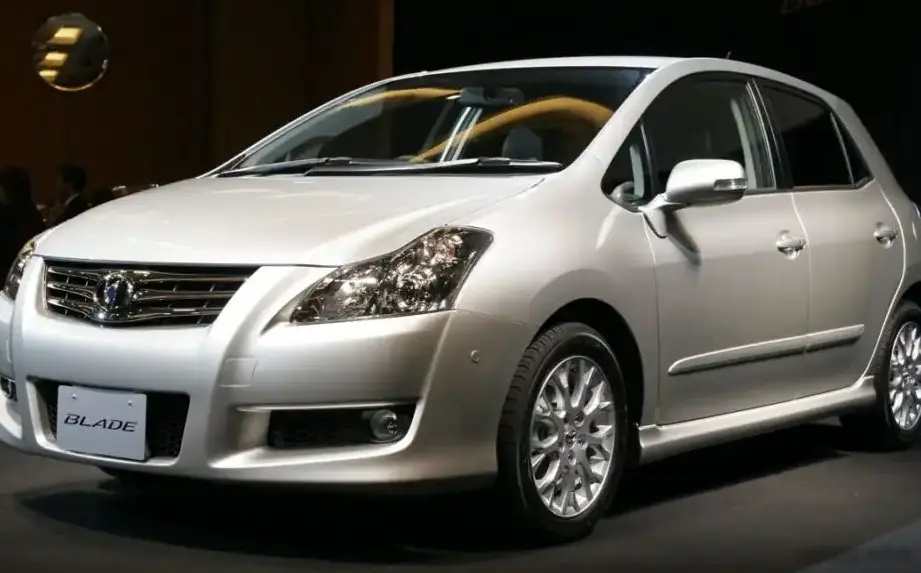
The Toyota Blade 3.4 24V6, specifically the Blade Maste trim, was a performance-oriented hatchback produced by Toyota from October 2006 to November 2011. Marketed primarily in Japan, the Blade occupied a niche position, offering a blend of sporty styling, a powerful V6 engine, and a relatively practical hatchback body style. It was built on Toyota’s MC platform, shared with other models like the Toyota Avensis and the Lexus ES. The Blade aimed to appeal to buyers seeking a more engaging driving experience than typically found in mainstream Japanese vehicles of the era.
Technical Specifications
| Brand | Toyota |
| Model | Blade |
| Generation | Blade |
| Type (Engine) | 3.4 24V6 (280 Hp) Blade Maste |
| Start of production | October, 2006 |
| End of production | November, 2011 |
| Powertrain Architecture | Internal Combustion engine |
| Body type | Hatchback |
| Seats | 5 |
| Doors | 5 |
| Fuel Type | Petrol (Gasoline) |
| Acceleration 0 – 100 km/h | 6.6 sec |
| Acceleration 0 – 62 mph | 6.6 sec |
| Acceleration 0 – 60 mph | 6.3 sec |
| Maximum speed | 180 km/h (111.85 mph) |
| Weight-to-power ratio | 4.5 kg/Hp, 224 Hp/tonne |
| Weight-to-torque ratio | 6.1 kg/Nm, 164.8 Nm/tonne |
| Power | 280 Hp @ 6200 rpm |
| Power per litre | 81 Hp/l |
| Torque | 206 Nm (151.94 lb.-ft.) |
| Engine layout | Front, Transverse |
| Engine Model/Code | 2GR-FE |
| Engine displacement | 3456 cm3 (210.9 cu. in.) |
| Number of cylinders | 6 |
| Engine configuration | V-engine |
| Cylinder Bore | 94 mm (3.7 in.) |
| Piston Stroke | 83 mm (3.27 in.) |
| Compression ratio | 10.8:1 |
| Number of valves per cylinder | 4 |
| Fuel injection system | Multi-port manifold injection |
| Engine aspiration | Naturally aspirated engine |
| Engine oil capacity | 6.1 l (6.45 US qt | 5.37 UK qt) |
| Coolant | 8.7 l (9.19 US qt | 7.65 UK qt) |
| Kerb Weight | 1250 kg (2755.78 lbs.) |
| Trunk (boot) space – minimum | 354 l (12.5 cu. ft.) |
| Trunk (boot) space – maximum | 761 l (26.87 cu. ft.) |
| Fuel tank capacity | 60 l (15.85 US gal | 13.2 UK gal) |
| Length | 4220 mm (166.14 in.) |
| Width | 1760 mm (69.29 in.) |
| Height | 1515 mm (59.65 in.) |
| Wheelbase | 2600 mm (102.36 in.) |
| Front track | 1515 mm (59.65 in.) |
| Rear (Back) track | 1510 mm (59.45 in.) |
| Minimum turning circle | 10.4 m (34.12 ft.) |
| Drivetrain Architecture | The Internal combustion engine (ICE) drives the front wheels of the vehicle. |
| Drive wheel | Front wheel drive |
| Number of gears and type of gearbox | 6 gears, automatic transmission |
| Front suspension | Independent, type McPherson with coil spring and anti-roll bar |
| Rear suspension | Independent multi-link spring suspension with stabilizer |
| Front brakes | Ventilated discs |
| Rear brakes | Disc |
| Assisting systems | ABS (Anti-lock braking system) |
| Steering type | Steering rack and pinion |
| Power steering | Electric Steering |
Powertrain & Engine Architecture
The heart of the Blade 3.4 Maste is the 2GR-FE 3.5-liter V6 engine. This engine is a member of Toyota’s GR family, known for its robust construction and smooth power delivery. The 2GR-FE features a 60-degree V-angle, dual overhead camshafts (DOHC), and four valves per cylinder. It utilizes multi-port fuel injection and a relatively high 10.8:1 compression ratio to extract maximum performance from its displacement. The engine produces 280 horsepower at 6200 rpm and 206 Nm (151.94 lb-ft) of torque. This power is channeled through a six-speed automatic transmission, which was specifically tuned for the Blade to provide responsive shifts and a balance between performance and fuel efficiency. The transmission doesn’t offer manual shift modes, focusing on smooth, automatic operation.
Driving Characteristics
The Blade 3.4 Maste delivers a noticeably more spirited driving experience compared to other, more conservatively-powered Japanese hatchbacks. The 280 hp V6 provides ample power for brisk acceleration, achieving 0-60 mph in approximately 6.3 seconds. While the six-speed automatic transmission is generally smooth, it isn’t as quick to downshift as some dual-clutch transmissions found in European performance cars. The gear ratios are optimized for acceleration in the mid-range, making it well-suited for everyday driving and overtaking maneuvers. The front-wheel-drive layout, while providing good traction in most conditions, can exhibit some torque steer under hard acceleration. The suspension is tuned for a balance between comfort and handling, offering a reasonably compliant ride without excessive body roll.
Equipment & Trim Levels
The Blade Maste trim represented the higher end of the Blade lineup. Standard features typically included alloy wheels, a sport-tuned suspension, automatic climate control, power windows and locks, and a premium audio system. Interior upholstery was generally a combination of cloth and leather, with a focus on providing a comfortable and sporty environment. Optional extras could include a navigation system, sunroof, and upgraded audio components. The dashboard layout was functional and driver-focused, with clear instrumentation and logically placed controls.
Chassis & Braking
The Blade utilizes a McPherson strut front suspension and an independent multi-link rear suspension. This setup provides a good balance of ride comfort and handling precision. Stabilizer bars are fitted to both the front and rear axles to reduce body roll during cornering. The braking system consists of ventilated discs at the front and solid discs at the rear. Anti-lock braking system (ABS) is standard, enhancing safety and control during emergency braking situations. The steering is rack and pinion with electric power assistance, providing a responsive and precise feel.
Market Reception & Comparison
The Toyota Blade 3.4 Maste was generally well-received by Japanese automotive critics, who praised its powerful engine, sporty handling, and relatively practical hatchback body style. However, some critics noted that the front-wheel-drive layout limited its ultimate handling potential compared to rear-wheel-drive competitors. Compared to other Blade trims, such as those equipped with smaller engines, the 3.4 Maste offered a significant performance upgrade, but at a higher price point. Fuel economy was also lower compared to the more economical variants. In terms of reliability, the 2GR-FE engine has proven to be a durable and long-lasting unit, with relatively few reported issues.
Legacy
The Toyota Blade, particularly the 3.4 Maste variant, has developed a modest following among enthusiasts. The 2GR-FE engine is known for its reliability and potential for modification. While not a mainstream performance car, the Blade offered a unique combination of power, practicality, and Japanese build quality. On the used car market, well-maintained examples of the Blade 3.4 Maste can command a premium price, particularly those with low mileage and a complete service history. The car represents a somewhat overlooked chapter in Toyota’s history, showcasing the company’s willingness to experiment with more performance-oriented models.
